The next search interface may not ask users to open ten tabs. An agent will find, compare, verify and perform part of the action itself. For SEO, this is a new class of site “user”.
Data and sources as of: September 14, 2026
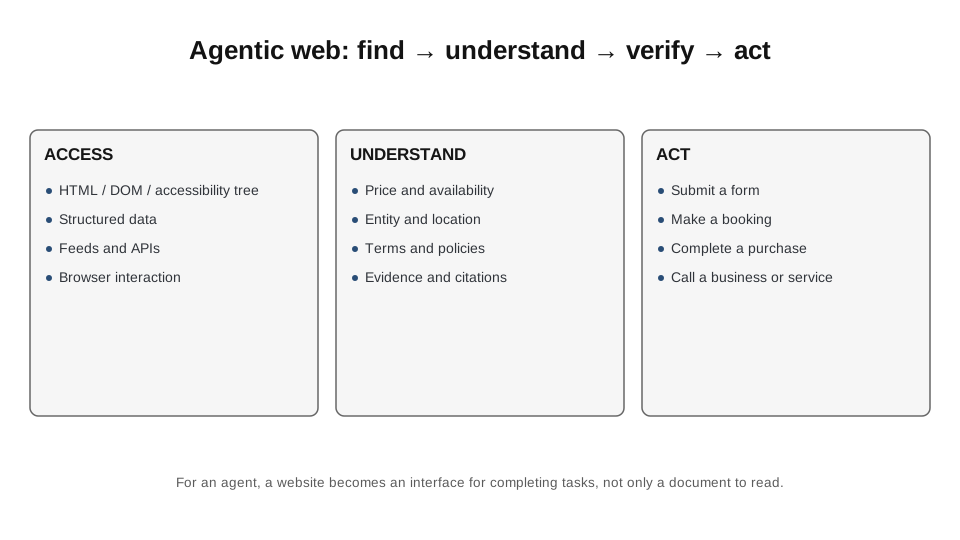
42.1. An agent is different from an answer
A generative answer synthesises information. An agent also has a plan/action loop: obtain the state, choose the next action, interact with a site/API and verify the result. At Search I/O 2026, Google described information agents and the expansion of agentic booking; OpenAI ChatGPT agent uses a visual browser, text browser, terminal, APIs and connectors.[1][2]
This matters: visibility may end not in a click, but in an action. For a business, that is good if the economics still work. For analytics, it is more complicated.
42.2. The site as a machine interface
An agent can work through a GUI, DOM, accessibility tree, structured data, API or feed. The more stable the structure, the less ambiguity.
This does not mean “create schema for AI”. Google explicitly says that no special AI schema is needed for AI Search. But standardised Product/Offer/Organization/LocalBusiness data helps machines and search engines understand facts in supported contexts.[3][4]
42.3. Data that must be accurate now
Price, availability, shipping, location, opening hours and refund/cancellation terms are critical for a transactional agent. An outdated informational paragraph is unpleasant; outdated availability can break an action.
Content ops is therefore gradually becoming data ops: a source of truth, freshness timestamps, validation and API/feed monitoring.
42.4. Merchant data as an example
Google documents Product structured data and Merchant Center feeds as ways to communicate price, availability, shipping and returns more accurately; Merchant Center is required for some shopping surfaces.[4] This is already a model of “publishing data, not just text”.
For other verticals, the equivalents may be booking feeds, inventory APIs, local business data and event feeds. Not all of these are ranking factors; they are infrastructure for accurate eligibility and actions.
42.5. A browser agent sees UX as functionality
Operator/ChatGPT agent demonstrated that a model can click, enter text and scroll through a GUI.[2] So “machine readability” does not end at the API. Form labels, accessibility, predictable states and error messages become machine usability.
Captchas, modal chaos, hidden controls, infinite spinners and an unstable DOM are no longer just CRO/accessibility debt, but agent compatibility debt.
42.6. Do not accidentally block the necessary path
SEO has long considered crawler access. The agent layer adds other user agents, browsers and authenticated flows. Access policy must be deliberate: what we allow to be crawled, where we allow actions and where login/consent/payment confirmation is required.
Security matters more than “being accessible to AI”. Do not expose private endpoints for the sake of agent friendliness.
42.7. Attribution without a classic referral
An agent may find a merchant, check the terms and bring the user to the final confirmation step. Or it may complete most of the flow itself. Referral analytics will not necessarily capture the entire contribution.
Server-side order sources, partner IDs, API attribution, assisted brand lift and experimental methods are needed. The old UTM-only worldview is becoming even less complete.
42.8. SEO for an agent = reliability + semantics + economics
I am not creating a separate 100-point “Agent SEO” checklist. I use the fundamentals: reachable data, correct semantics, stable actions, evidence, brand/entity consistency and fast, predictable UX.
If an agent consistently sees different prices in the HTML and at checkout, no llms.txt will solve the problem.
42.9. Monitoring agent readiness
I test critical flows with an automated browser: find a product/service, open its details, check availability, start a booking/cart and handle an error. This is synthetic monitoring, not a ranking test.
For public data, I check parity across HTML/structured data/feed/API. Divergence is an operational incident.
42.10. Machine-readable business
A strong digital business in the agentic web has more than just pages. It has clearly defined entities, structured inventory, policies, APIs/feeds where appropriate, a stable transaction flow and source-of-truth data.
SEO here becomes an interface discipline between business data and external discovery/action systems. This is closer to product/data engineering than to keyword density.
| Layer | Human | Crawler/Search | Agent |
|---|---|---|---|
| Content | reads text/visuals | receives HTML, rendering, index | extracts facts for a plan |
| Structure | navigation | links/canonical/schema | DOM/accessibility/API/feed |
| Transaction | clicks and enters data | usually does not execute | can execute steps |
| Metric | session/conversion | impression/click/citation | action success / assisted outcome |
Sources for Chapter 42
1. Google. Search I/O 2026: AI agents and more. https://blog.google/products-and-platforms/products/search/search-io-2026/
2. OpenAI. Introducing ChatGPT agent. https://openai.com/index/introducing-chatgpt-agent/
3. Google Search Central. AI features and your website. https://developers.google.com/search/docs/appearance/ai-features
4. Google Search Central. Merchant listing structured data. https://developers.google.com/search/docs/appearance/structured-data/merchant-listing
5. Google Search Central. Share product data with Google. https://developers.google.com/search/docs/specialty/ecommerce/share-your-product-data-with-google