The interface will change again. The method will remain: understand the system, observe the data, form a hypothesis, test and scale.
Data and sources as of: September 14, 2026
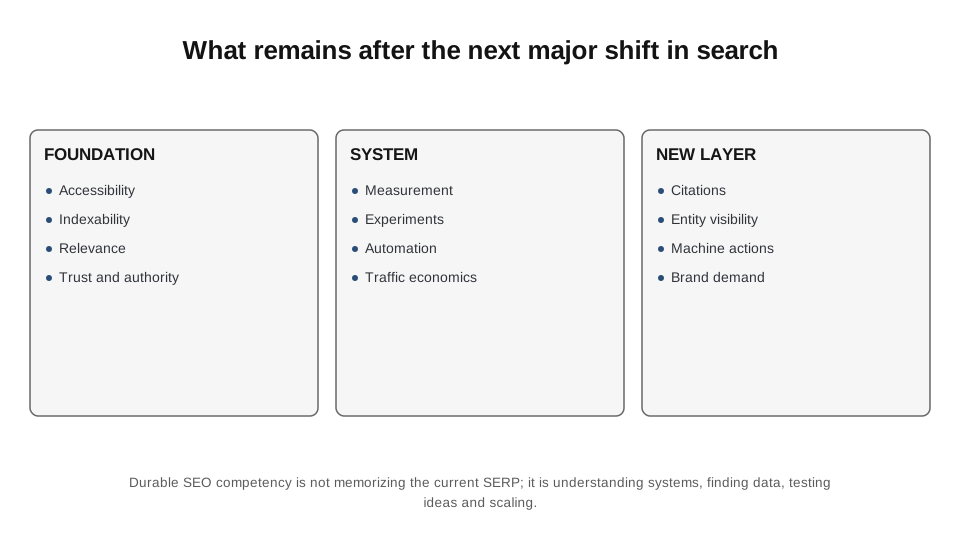
43.1. SEO does not equal the SERP
Ten blue links were never the discipline itself. SEO works with discovery, crawling, indexing, retrieval, ranking/selection, presentation and conversion. An AI Overview or an agent changes the presentation/action layer, but the foundation does not disappear.
In 2026, Google explicitly states that SEO best practices remain relevant to AI features and that there are no special requirements for appearing in AI Overviews/AI Mode.[1]
43.2. Position is losing its monopoly on visibility
A site may gain an organic ranking, a citation, a brand mention, product inclusion or an agent action. No metric is complete on its own.
A modern measurement stack must therefore work across multiple observable layers and honestly expose its blind spots.
43.3. Commodity knowledge is getting cheaper
An LLM can quickly synthesise a generic explanation. The moat therefore shifts to proprietary data, first-party experience, tools, fresh inventory, expert judgement, workflows and brand trust.
This does not mean explanatory text is unnecessary. It is needed as an interface to unique evidence, not as a copy of the top ten SERP results.
43.4. Technical SEO is becoming even more product-like
When Search and agents use rendering, structured data, feeds, browsers and APIs, the boundary between an “SEO issue” and a “product/data issue” blurs.
A Senior SEO must understand HTTP, templates, logs, data contracts and experimentation. Writing production backend code is not essential, but understanding the mechanics well enough to define the right acceptance test is.
43.5. Brand is not a magical ranking factor
A brand creates navigational demand, mentions, trusted first-party sources, reviews, earned links and repeat behaviour. These are many different observable phenomena, not a single “brand score”.
In AI environments, entity consistency and source quality may increase the likelihood of correct interpretation. But I do not call every brand metric a direct ranking factor without evidence.
43.6. SEO Lead = allocator of uncertainty
The main job of a Lead/Head is not to know the answer to everything. It is to reduce uncertainty quickly: what data is needed, which test is inexpensive, what is reversible and where risk is asymmetric.
AI increases the number of possible actions. That means selection quality becomes more important than generation speed.
43.7. Automation will remove operations, not responsibility
Regex, SQL, clustering, briefs, anomaly detection, schema drafts and code prototypes are increasingly well automated. But the system owner is still responsible for definitions, data quality, risk and the business decision.
If AI quickly created 50k pages, that does not mean 50k pages should be published.
43.8. An evidence-based approach will become a competitive advantage
In a world of endless generated advice, the ability to show the sample, method, source, limitation and causal boundary becomes more valuable. This applies to both content and internal SEO analytics.
A team that knows the difference between correlation, an experiment and a hypothesis is slower to fall for hype and faster to find a working mechanism.
43.9. What I would teach a new Senior SEO in 2026
Not “200 ranking factors”. I would teach web mechanics, information retrieval concepts, data analysis, experiment design, business economics, content differentiation, links/graph thinking and communication.
After that, a specific tool—Ahrefs, GSC, an LLM, a crawler—is simply an interface to the task.
43.10. A model that will outlast 2026
The book began with the chain from a URL to an AI answer. It ends even more simply: Understand the system → observe the data → form a hypothesis → test → measure → scale.
When Google changes its UI, the name of AI Mode or the way it displays citations, this model will not break. That is precisely why I believe it is more useful than any list of hacks.
| Old frame | More stable frame |
|---|---|
| keyword → rank | information need → candidate set → selection |
| position → CTR | visibility surface → click/mention/citation/action |
| content volume | information advantage |
| SEO checklist | system model + evidence |
| traffic forecast | scenario + uncertainty + economics |
| manual operations | automation + QA + ownership |
Sources for Chapter 43
1. Google Search Central. AI features and your website. https://developers.google.com/search/docs/appearance/ai-features
2. Google Search Central Blog. A new resource for optimising for generative AI in Google Search. https://developers.google.com/search/blog/2026/05/a-new-resource-for-optimizing
3. Google. Search I/O 2026. https://blog.google/products-and-platforms/products/search/search-io-2026/
4. OpenAI. Introducing ChatGPT agent. https://openai.com/index/introducing-chatgpt-agent/
5. Google Search Essentials. https://developers.google.com/search/docs/essentials
AFTERWORD
SEO as a system of thinking
If I were to leave you with one thought after this book, it would not be a list of tools or a set of “factors”. It would be the habit of breaking a problem down into a mechanism, data and a testable hypothesis.
Search has already changed so much that the simple “keyword → position → click” model no longer describes the entire channel. But the fundamentals have not become any less important. A URL still needs to be discovered. A document — fetched and rendered. Duplicates — canonicalised. Information — retrieved to meet a need. A site — made clear, useful and reliable enough to be a candidate for display, citation or action.
AI has made production cheaper. That is precisely why differentiation, evidence and judgement are becoming more valuable. Generating another hundred articles is easy. It is much harder to compile your own dataset, verify the terms of ten operators, run a controlled test, build a tool or find a systemic error across a million URLs.
In my work, I do not try to predict every change Google makes. I want the team to know which signals it can actually see, where the data is incomplete, what is a fact, what is a correlation and what is our working hypothesis. This brings calm when an update hits and speed when an opportunity arises.
SEO in 2026 is still about search. It is just that search can now end with a SERP, an AI answer, a citation, a recommendation, an agent action or a direct transaction. Our job is not to defend the old interface. Our job is to make information and businesses accessible, understandable, competitive and measurable within the interface that exists today.
Tools will change. So will the names of disciplines. The model will remain: understand the system → look at the data → formulate a hypothesis → test → measure → scale.
ACKNOWLEDGEMENTS
To the people who make this journey meaningful
First and foremost, I thank my parents - for everything. For life, love, support, patience and the inner strength that stayed with me even when I did not recognise it myself.
I thank my brother - for his closeness, honesty and the simple but deeply important feeling of having someone by my side who truly knows me.
I thank my friends - everyone who listened, debated, supported me, offered advice and helped me keep going. Part of this book grew out of our conversations, stories from work, mistakes and shared experience.
My special thanks to N. - for all the good we shared over many years, and for countless warm, joyful and truly wonderful moments. Not everything that matters needs a full name: some memories need only to be cherished.
There is one name on the cover, but no great work is born in complete solitude. This book holds the warmth, time and faith of people to whom I am sincerely grateful.
ABOUT AI AND THIS BOOK
The tool helped. The author is accountable.
It would be strange to write a book about SEO in 2026 and pretend that artificial intelligence played no part in the process. Of course I used it - to structure the material, identify weak points, check wording, work with large volumes of text and handle technical preparation.
To me, it is a working tool just like a crawler, a code editor or a spreadsheet: it can speed up the work, offer another perspective and help check the details. But it does not live the author’s professional journey, make decisions on real projects or take responsibility for the conclusions.
The experience, perspective, doubts, selection of facts, final wording and every decision about what to leave on these pages - are mine. I do not hide the tool, because this book is precisely about working in a new reality.
AI helped make this book broader and more precise. Its character, accountability and soul came from the author.
Mykhailo Oplakanets aka Werter