A strong SEO team does not measure people by the number of articles, links or completed tasks. It measures system health, learning speed and business outcomes.
Data and sources as of: September 14, 2026
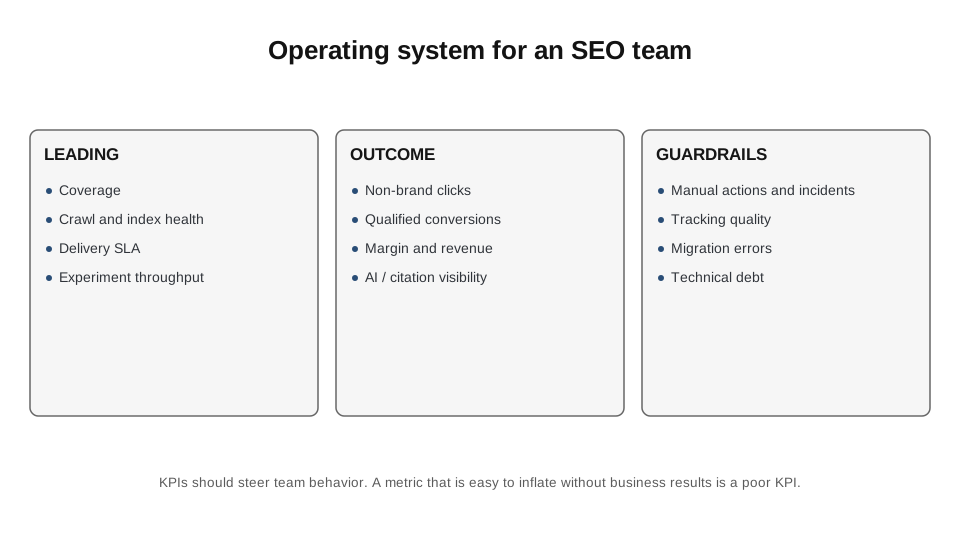
41.1. Roles built around systems, not job titles
On a small site, a Senior SEO may handle research, technical SEO, content and links. On a large site, these are separate functions. I design ownership around systems: crawling/indexing, architecture, content/product, authority, measurement, experimentation, international.
The title “SEO Manager” does not explain who is responsible for a canonicalisation incident. A RACI/owner map does.
41.2. A KPI should not be easy to game
The number of published pages encourages thin content. The number of acquired links encourages cheap links. Average position encourages choosing “convenient” keywords. I use outcomes + guardrails.
For example, a content team may track eligible indexed pages with qualified impressions and conversion contribution, but the guardrails are factual QA, decay rate and policy incidents.
41.3. Leading and lagging metrics
Revenue is a lagging metric. Index coverage, crawl health, delivery SLA and experiment velocity are leading metrics. If the team looks only at revenue, it learns about problems too late.
But a leading metric must not become an end in itself. A 99% index rate is useless if you are indexing 200k worthless URLs.
41.4. Reporting for the Head of SEO
I want to see one page: business outcomes, major changes, risks, bets, confidence, next decision. Not 40 GSC charts with no question to answer.
Breakdowns go in the appendix: query/page type/GEO, technical health, AI visibility, experiments, links, delivery.
41.5. Weekly operating review
Every week: incidents, shipped changes, leading metrics, experiments, blockers, next releases. 30–45 minutes is enough if the data is prepared asynchronously.
The meeting should not turn into a live reading of the dashboard. People arrive with a conclusion and a decision.
41.6. Monthly strategy review
Once a month, I look at cohort performance, roadmap assumptions, budget burn, market/competitor changes and learnings. This is where we can reprioritise.
The monthly review is not about “explaining to the CEO why traffic is down -7%”. It is a decision about where the next dollar/sprint will deliver the highest expected value.
41.7. KPIs for a Lead vs a specialist
A Lead is responsible for system output: roadmap quality, incident handling, delivery, measurement and team learning. A specialist is responsible for their domain and the quality of their decisions, not for total traffic as a vanity metric they cannot control.
When one person is “responsible for organic revenue” but does not control engineering, product, stock or CRO, the KPI is unfair and encourages politics.
41.8. Experiment throughput
In 2026, AI makes analysis and implementation prototypes cheaper. The competitive advantage is therefore not the number of generated ideas, but the number of learning loops completed to a high standard.
I count: hypotheses created → tests launched → interpretable results → scaled wins / killed ideas. A neutral result is also an output if it resolves uncertainty.
41.9. Documentation as leverage
A decision log, migration playbook, incident runbook, content schema and measurement dictionary are assets. They reduce dependence on one Senior SEO’s memory.
A team without documentation “rediscovers” every year why it is wrong to wait until just before launch to block staging through robots.txt.
41.10. What the Head of SEO should control
The Head of SEO should not manually check every title. Their control system covers business performance, technical risk, roadmap, capacity, budget, evidence quality, people and external dependencies.
If the Head of SEO spends all day doing keyword research, the organisation loses the role that should connect SEO with product and the P&L.
| Level | Key question | Metrics |
|---|---|---|
| Executive | Does the channel create value, and what is the risk? | revenue/margin, qualified conversions, forecast range, incidents |
| Head/Lead | Are the system and portfolio working? | non-brand clicks, coverage, delivery, experiment throughput, AI visibility |
| Specialist | Is the mechanism they own working? | template/query cohort, indexing, CTR, links/content QA |
| Engineering/Product | What needs to be delivered, and how will we verify it? | acceptance criteria, logs, statuses, test result |
Sources for Chapter 41
This chapter primarily describes the author’s operating model and contains no external statistical claims requiring a separate bibliography.