An SEO Lead does not manage a “list of recommendations”. They manage a portfolio of bets with different upside, evidence strength, dependencies and time to impact.
Data and sources as of: September 14, 2026
40.1. An audit is not a roadmap
An audit describes the state of the system. A roadmap describes what the team will do, in what order and why. Identifying 180 issues does not automatically create a strategy.
I turn findings into opportunities: recovered coverage, new query space, CTR gain, conversion gain, risk reduction, operational leverage. Only then do tasks enter the roadmap.
40.2. My priority formula
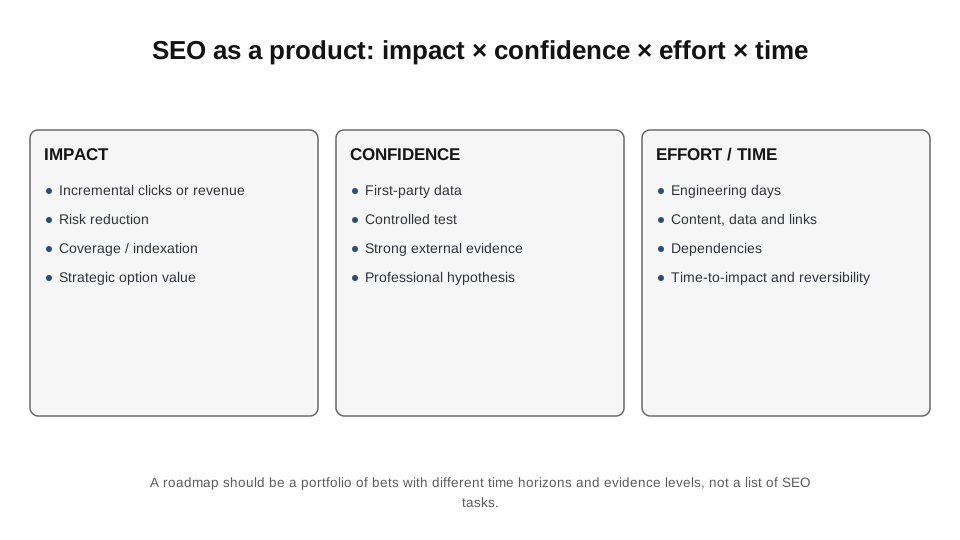
I do not treat a single magical ICE/RICE score as the truth. My starting point is Impact × Confidence, which I then divide by Effort and adjust for Time-to-impact, dependencies and reversibility.
A critical incident may have limited upside but the highest priority because of risk. A research spike may have zero direct traffic impact but cheaply resolve uncertainty for a large project.
40.3. Impact must be expressed in business units
“Improve internal linking” is not impact. “Increase the share of money pages within ≤3 clicks from the hub to 90% and improve discovery/index coverage” is an operating target. For revenue-facing tasks, use qualified conversions, margin, FTD, revenue.
For risk-related tasks, impact can be avoided loss: for example, eliminating the risk of accidental noindex before a migration.
40.4. Confidence is an evidence stack
I assign higher confidence to first-party observational data and controlled tests, lower confidence to correlation studies, and lower still to professional hypotheses. This does not mean hypotheses are off-limits; they simply need to be cheaper to test.
A roadmap without confidence becomes a political list dictated by whoever speaks loudest in the meeting.
40.5. Calculate effort based on the bottleneck
An SEO may estimate a task at “2 hours”, but if it requires a backend engineer, QA, a security review and a release three sprints away, the real effort is different. I account for the constrained resource, not just my own hours.
Likewise, 100 articles are not “100 × writer cost”: they require research, briefs, editorial QA, design/data, internal links, publishing, monitoring and maintenance.
40.6. A portfolio across time horizons
A sound roadmap includes quick fixes, medium-term bets and long-term assets. If everything is quick wins, there is no moat a quarter later. If everything is platform work, the business sees no feedback.
I usually maintain separate lanes: reliability/risk, growth, experiments, scale/automation, research. Their shares depend on the product’s stage.
40.7. Budget does not equal link budget
The SEO budget is people + engineering + content/data + distribution/PR + tooling + infrastructure + experiments. In affiliate SEO, link acquisition can be a major expense, but without site production and measurement it does not create a system.
I do not tell the CFO “we need $20k for SEO”; I show an allocation: what we are buying, the expected range, the leading metrics and when the review gate is.
40.8. Stage gates
I break large initiatives into discovery → pilot → validation → scale. For example, programmatic SEO: a 50-page pilot, then 500, then 10k—only if indexing, impressions and economics are validated.
This protects against the classic mistake: building 100k URLs and then discovering that the dataset creates no unique value.
40.9. Dependency map
Every bet has dependencies: tracking, data source, CMS capability, legal approval, template, canonical logic. I make them explicit in the roadmap.
SEO is often “late” not because of SEO itself, but because of a hidden dependency. Making dependencies visible reduces conflicts with product/engineering.
40.10. Roadmap review
Each month, I do not just ask “task done?”. I check assumptions: is demand still the same, has the search surface changed, did the pilot produce the expected signal, has capacity changed?
A roadmap is a living decision model. But changes must be versioned; otherwise, the team rewrites history retrospectively every month.
| Initiative | Impact | Confidence | Effort | Time | Solution |
|---|---|---|---|---|---|
| Fix accidental noindex | very high risk reduction | high | low | days | immediately |
| Programmatic cluster | high upside | medium | high | months | pilot |
| Title test top categories | medium | high | low | weeks | test |
| New GEO without demand data | potentially high | low | medium | months | research first |
Sources for Chapter 40
This chapter primarily describes the author’s operating model and contains no external statistical claims requiring a separate bibliography.