Recovery is a diagnostic discipline. If the cause is unknown, any “fix” is an uncontrolled experiment.
Data and sources as of: September 14, 2026
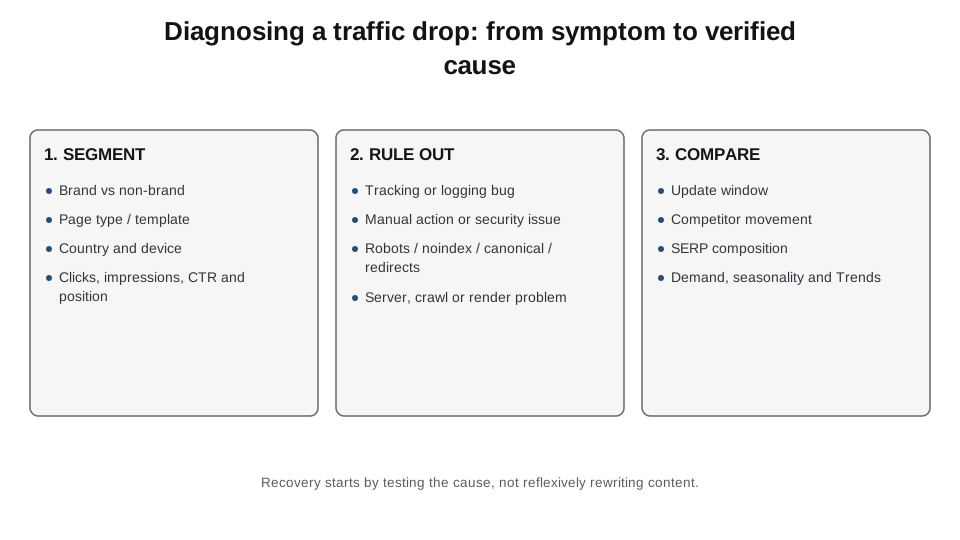
39.1. First, identify the shape of the drop
In its guidance, Google recommends starting with the Performance report, checking whether clicks, impressions and average position have changed, and comparing search types.[1] I also add page type, query class, country, device and brand/non-brand.
A sudden cliff, gradual decay, a seasonal decline and a step-change after a migration are different patterns. The chart does not provide a diagnosis, but it rules out some causes.
39.2. The first hour of incident response
I check Search Console messages, Manual Actions, Security Issues, indexing anomalies, robots.txt, noindex, canonical, redirect rules, DNS/CDN status, server errors, the deployment log and the analytics release. These are low-cost checks with high expected value.
If the site returned 200 yesterday but returns 503 today because of a WAF rule, there is no point analysing E-E-A-T. First, we get the system working again.
39.3. The second hour: localise the blast radius
A loss of 40% of total clicks may come from a single template that accounted for half the traffic. Or it may be a 5% drop across every page type. I build a page type × country × device × query class matrix and examine the contribution to the loss.
Contribution matters more than percentage change. A URL down -90% that generated 20 clicks should not distract from a category down -12% that lost 80,000 clicks.
39.4. Algorithmic change or demand
Google explicitly recommends checking Trends and demand changes, as well as the timeline of ranking updates.[1] If impressions are falling across all domains in a niche, that is a different problem from losing share while demand remains stable.
I compare our own impressions with market proxies, branded demand and competitor visibility. Seasonality cannot be “fixed with SEO”. It can be factored into forecasts and capacity.
39.5. Small vs large ranking drops
The current core update guide distinguishes between small and large position changes. A small movement in the top results is not a reason for drastic action; a large sitewide drop requires a deeper assessment.[2]
This matters psychologically. A team that reacts to every -1.2 change in position creates more noise than improvement.
39.6. Migrations: recovery through mapping
For URL migrations, Google recommends server-side permanent redirects, updating internal links, canonicals and sitemaps, and sufficient server capacity. Small/medium migrations may take several weeks to process; large sites need more time.[3]
Recovery here is measured not by “whether the old domain still ranks”, but by mapping coverage: old URL → final URL, redirect correctness, canonical alignment, discovered/indexed new URLs, traffic transfer by directory.
39.7. Do not make ten “improvements” at once
After a drop, the business applies pressure: let’s rewrite the copy, change the title, buy links, delete 20k pages and update the design. If you do everything, you lose the ability to learn.
I classify fixes as: hard defect, policy remediation, evidence-backed improvement, speculative test. A hard defect can be fixed immediately. Speculative changes should be tested in separate cohorts.
39.8. Recovery log
I keep a log: hypothesis, evidence, change, owner, deploy date, affected scope, expected leading metric, expected lag, result. This is not bureaucracy; it is the system’s memory.
After three months without a log, the team remembers only that “we did something with internal links”. With a log, you can backtest decisions and avoid repeating unsuccessful fixes.
39.9. When to wait
Google explicitly warns that after meaningful improvements, some effects may appear within a few days, while others may take months; recovery is not guaranteed.[2] This is not an excuse for inaction, but a reminder about lag.
Waiting makes sense only once leading signals confirm that the fix is live: the bot receives 200, the canonical is correct, URLs are discovered and content has changed. “Waiting for an update” without verifying implementation is not a strategy.
39.10. Exiting recovery mode
Recovery ends when the root cause is under control or at least operational risk has returned to normal. The site then returns to the growth portfolio: experiments, content, authority, product work.
If a team spends six months in “restore the old traffic” mode, it may miss a new query space. Sometimes the right goal is not to bring back 2025, but to build a better system for 2026.
| Pattern | What to check first | Don't do it right away |
|---|---|---|
| Cliff in 1 day | deploy, robots/noindex, server, manual/security | mass content rewrite |
| Gradual decay | demand, competition, content decay, SERP | panic pruning |
| Drop after migration | mapping, redirects, canonicals, sitemap, logs | changing URLs again |
| Only one template | render/data/template/indexing | drawing a sitewide conclusion |
| Impressions stable, clicks down | CTR/SERP/AI/features | blaming indexing |
Sources for Chapter 39
1. Google Search Central. Debugging Search traffic drops. https://developers.google.com/search/docs/monitor-debug/debugging-search-traffic-drops
2. Google Search Central. Core updates. https://developers.google.com/search/docs/appearance/core-updates
3. Google Search Central. Site moves. https://developers.google.com/search/docs/crawling-indexing/site-move-with-url-changes
4. Google Search Central. Changing hosting. https://developers.google.com/search/docs/crawling-indexing/site-move-no-url-changes