The SEO market does not consist solely of “safe recommendations”. But a professional discussion of risky tactics should have four columns: mechanics, expected upside, policy and the cost of failure.
Data and sources as of: September 14, 2026
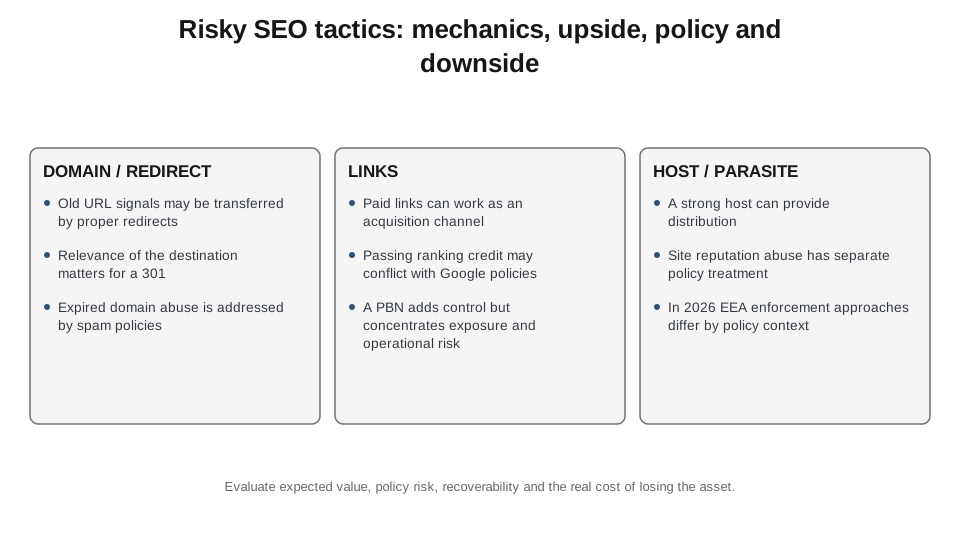
38.1. Risk is not a moral category
For a business, grey/black tactics represent portfolio risk. I look at expected upside, probability of loss, blast radius, recoverability and replacement cost. One PBN link on a disposable affiliate site and a site reputation deal on the main brand have different risk profiles, even if both violate policy.
So “works/does not work” is not enough. A tactic can work for six months and still be a bad investment if the expected cost of losing the domain exceeds the profit.
38.2. Expired domains: what exactly constitutes a violation
Google defines expired domain abuse as purchasing and repurposing an expired domain primarily to manipulate rankings with content that offers little or no value. The documentation explicitly gives the example of casino content on a former school’s domain.[1]
This does not mean that every expired domain purchase is prohibited. The critical policy criteria are primary purpose and value. But from an operational perspective, the old link graph is no insurance policy: topical history, spam anchors, redirects, index state and ownership transitions need to be checked separately.
38.3. A 301 is not a “DR transfer”
Google recommends permanent server-side redirects for genuine site moves and consolidation. When a migration is implemented correctly, redirects help transfer signals to the new URLs.[2] This is not equivalent to claiming that any old domain can be pointed at a money site to mechanically “transfer authority”.
I assess mapping relevance. An old document about topic A → a new equivalent about topic A has a clear rationale for users and for the migration. Hundreds of disparate expired URLs → a casino homepage is a different class of behaviour, with significantly weaker semantic mapping.
38.4. Redirect chains and their technical cost
Google advises redirecting directly to the final destination and avoiding chains; its site move guidance states that Googlebot can follow up to 10 hops, but the practical recommendation is to keep chains short, ideally no more than 3 and fewer than 5.[2]
For an SEO portfolio, this means: if domains have migrated several times, do not leave a legacy chain in place as “history”. Flatten redirects, update internal links and check the final status. Every hop adds latency and a point of failure.
38.5. PBNs: control in exchange for concentrated risk
A PBN is attractive because it offers control over placement, anchor, timing and destination. But that same control creates a correlated footprint: ownership, hosting, templates, analytics IDs, link patterns, content quality and registration history. I do not describe ways to hide a network—this is a race against detection systems, not a sustainable SEO model.
From a business perspective, something else matters more: if 30% of ranking dependency rests on resources that may disappear simultaneously, that is concentration risk. It needs to be visible in the link inventory, just as a CFO sees dependence on a single supplier.
38.6. Paid links
Google’s link spam policy treats buying or selling links for ranking manipulation as a violation; for advertising/paid placements, Google recommends `rel=sponsored` or other attributes that do not pass ranking credit.[1] The fact that the market buys links does not change their policy status.
In practical budgeting, I separate distribution/PR value from the expected SEO effect. A link that delivers qualified referral traffic, a brand mention and discovery has value even without “passing link equity”. This is more useful than reducing every placement to DR/price.
38.7. Parasite SEO and site reputation abuse
Site reputation abuse is third-party content placed primarily to exploit the host site’s established ranking signals.[1] In 2026, Google clarified enforcement in the EEA.[3] So “renting a subdirectory on a strong media site” can no longer be assessed solely by how quickly it ranks.
I assess dependency: whether I have control over URLs, content, redirects, analytics, renewal terms and deletion risk. Parasite SEO can be a fast channel, but almost always offers little asset ownership.
38.8. Doorways and multi-domain portfolios
Spam policies explicitly classify multiple domains/pages with slight variations, created to cover similar queries and funnel users to a single destination, as doorway abuse.[1] For affiliate portfolios, this is an important boundary condition.
A multi-domain strategy is not inherently a doorway strategy. Sites can have distinct brands, audiences, data, offers and editorial value. But if 20 domains differ only in their logo and H1 and lead into the same funnel, the policy risk is significantly higher.
38.9. Thin affiliation
An affiliate page does not become useful through word count. Its moat is original comparison, data, screenshots, testing, terms normalisation, availability, UX, filters and editorial judgement. If a page merely repackages merchant copy, it is a commodity and is easily replaced by a SERP/AI answer.
For iGaming, I pay particular attention to jurisdiction, the T&C timestamp, wagering requirements, minimum deposit, payment/restriction data and consistency with the actual offer. An error in a commercial fact destroys trust faster than weak keyword coverage.
38.10. Portfolio risk control
I maintain a risk register by domain and tactic: policy exposure, dependency, owner, replacement plan and maximum acceptable loss. A disposable experiment should not have access to core analytics, brand accounts or shared infrastructure unless necessary.
The point is not to make risky tactics “safe”. They do not become safe. The point is to know which asset you are putting at risk and whether you can survive losing it.
| Tactics | Upside | Main risk | Recoverability |
|---|---|---|---|
| Expired domain / redirect | faster launch, historical links | policy + irrelevance + toxic history | medium, if the core site is not dependent |
| PBN | control over placement/anchor | correlated network loss | low for links, higher for the main site |
| Paid links | controlled acquisition | link spam enforcement / wasted spend | medium |
| Parasite / host rental | rapid host visibility | the asset is not yours + site reputation policy | low |
| Multi-domain | SERP coverage + diversification | doorway footprint + ops complexity | depends on the sites’ autonomy |
Sources for Chapter 38
1. Google Search Central. Spam policies. https://developers.google.com/search/docs/essentials/spam-policies
2. Google Search Central. Site moves with URL changes. https://developers.google.com/search/docs/crawling-indexing/site-move-with-url-changes
3. Google Search Central Blog. Update to the Site Reputation Policy. https://developers.google.com/search/blog/2026/08/update-site-reputation-policy
4. Google Search Central. Redirects and Google Search. https://developers.google.com/search/docs/crawling-indexing/301-redirects