A drop after an update, an automated spam demotion and a manual action can look identical on a chart. If the team conflates them, it starts treating the wrong system.
Data and sources as of: September 14, 2026
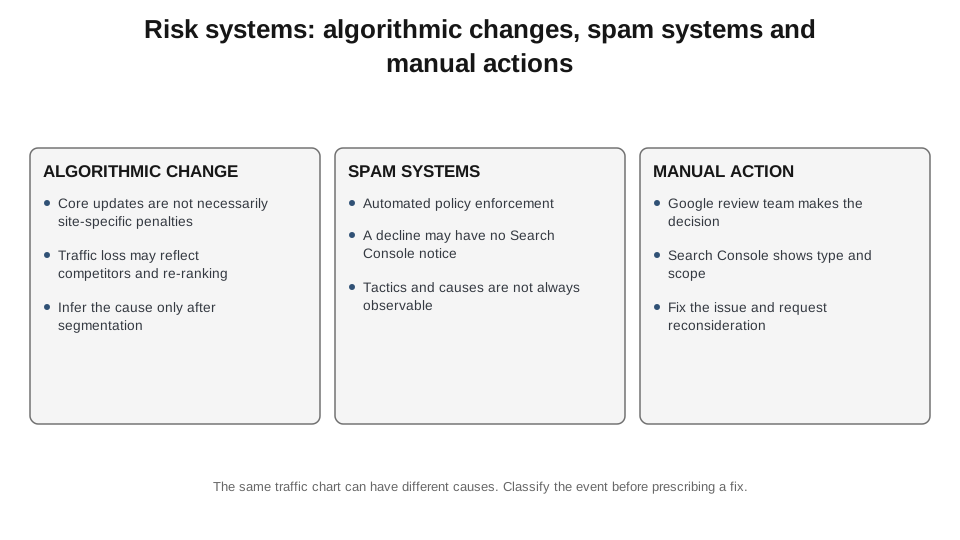
37.1. Three different classes of events
I distinguish three things: a broad reassessment of rankings, automated enforcement by spam-fighting systems and a manual action. A core update, according to Google's explanation, is not a penalty against a specific site: it is a broad change in how systems evaluate content and the competitive set.[1] A manual action, by contrast, follows a decision by a human reviewer and appears in Search Console.[2]
This is not semantics. The plan depends on the classification. A manual action comes with a specific report and a reconsideration procedure. A technical incident calls for a rollback or a fix. With broad re-ranking, there may be no single defect that can be “removed”.
37.2. Spam policies are not a list of “ranking factors”
Spam policies describe behaviour that may lead to lower rankings or exclusion from results. Google explicitly includes cloaking, doorway abuse, scaled content abuse, scraping, expired domain abuse, link spam and site reputation abuse.[3] In 2026, the rules also explicitly cover attempts to manipulate generative AI responses in Google Search.
I do not turn this document into a reverse-engineered guide to “exactly what Google catches”. It does not disclose thresholds, weights or detection logic. The policy sets out the boundary condition: what objectives and behaviour Google considers manipulative.
37.3. Core update: do not look for a magic button
Google's current documentation recommends first waiting for the rollout to finish, then comparing appropriate periods. For a core update, Google advises waiting at least one full week after completion before drawing conclusions in Search Console.[1] A small movement, such as 2→4, does not call for radical changes. A large and sustained movement such as 4→29 warrants a deeper assessment.
The worst response is to rewrite titles en masse, remove blocks, shorten copy or change internal links simply because someone on X/Telegram called one element an “update trigger”. This destroys the baseline and makes a causal interpretation of subsequent data impossible.
37.4. Manual action: you have observable evidence
The Search Console Manual Actions report shows whether a manual action has been applied, its type and its scope. Google also notifies you through the message centre. After fixing the issue, you can submit a Request review; if Google considers the violation resolved, the manual action is revoked.[2]
Here I take an incident-response approach: I preserve a snapshot of the site and the evidence before changes, describe the scope, remove the root cause, check the entire class of similar URLs and only then submit a reconsideration request. “We removed one page” will not help if the problem is systemic.
37.5. Site reputation abuse in 2026
Site reputation abuse concerns third-party content published primarily to exploit the host site's ranking signals.[3] In August 2026, Google separately updated enforcement in the European Economic Area: from August 30, manual actions under this policy have a different effect on search in the EEA than outside it.[4]
For international publishers, this means policy analysis cannot be done without accounting for geography. The same host/content relationship may have different consequences in different search experiences. This is another reason to retain the country dimension in diagnostics.
37.6. Spam update ≠ core update
Google distinguishes between ranking systems and updates to those systems. Historically, Search Central has documented core updates and spam systems separately. So “there was an update that day” is only a temporal correlation, not evidence of a specific mechanism.[5]
I align the timeline with Google Search Status / ranking update history, but then examine the pattern: which templates, queries, countries and page types lost ground. If only one commercial catalogue is declining while editorial content remains stable, a sitewide explanation is already less likely.
37.7. Scaled content abuse and AI
Google explicitly defines scaled content abuse in terms of purpose and value, not the tool used to create it. Generative AI is listed as one possible way to create many pages without added value, but automation itself does not constitute a violation.[3]
This matters for programmatic SEO: the question is not “AI or human”, but “why should this URL exist, what unique function/data/solution does it provide, and are we creating thousands of pages primarily to cover queries”.
37.8. When content removal is justified
In its core update guidance, Google calls content deletion a last resort: if content cannot be salvaged and was created primarily for search engines, then deletion may be logical.[1] This is not a recommendation to “delete 30% of your site after an update”.
I first classify the inventory: valuable, salvageable, redundant, obsolete, abusive. For valuable content — improvement; for redundant content — consolidation; for obsolete content — update or retirement; for abusive content — removal/noindex depending on purpose. Mass pruning without classification is another form of panic-driven SEO.
37.9. My incident classification table
Before any recovery sprint, I fill in a minimal matrix: start date, signal type, Search Console messages, security issues, change log, update timeline, affected countries, devices, page types, query classes, index coverage, crawl/log anomalies.
This takes hours, not weeks, but sharply reduces the chance of starting an expensive content rewrite when the cause is a noindex release, an incorrect canonical, a SERP change or a tracking bug.
37.10. What counts as recovery
Recovery does not mean “getting the old position back”. The competitive set and the SERP itself change. I define an observable target: restored eligible inventory, recovered non-brand clicks, stabilised conversion value, removal of manual action, reduction of an error class.
If a manual action is lifted after a policy fix but traffic does not return, that does not mean reconsideration “did not work”. Lifting the manual action restores the right to compete; it does not guarantee the previous rank.
| Signal | Most likely class | First check | Common mistake |
|---|---|---|---|
| Manual action in GSC | Manual action | Scope + policy + examples | Wait for “the next update” |
| Sharp drop after deployment | Technical incident | robots/noindex/canonical/redirect/logs | Rewrite content |
| Sitewide re-ranking in the rollout window | Core/ranking update | comparison of cohorts and competitors | Look for a single “penalty factor” |
| Decline limited to spam-like templates | Automated policy/spam system or quality re-ranking | template + intent + policy mapping | consider the entire domain “under a filter” |
Sources for Chapter 37
1. Google Search Central. Core updates. https://developers.google.com/search/docs/appearance/core-updates
2. Search Console Help. Manual actions report. https://support.google.com/webmasters/answer/9044175
3. Google Search Central. Spam policies. https://developers.google.com/search/docs/essentials/spam-policies
4. Google Search Central Blog. Update to the Site Reputation Policy, 2026-08-28. https://developers.google.com/search/blog/2026/08/update-site-reputation-policy
5. Google Search Central. Latest documentation updates. https://developers.google.com/search/updates