SEO without a business metric is easy to optimise for impressive-looking impression counts. GA4 helps connect sessions and events to channels, but attribution is a model, not a physical truth about “who created the sale”.
Data and sources as of: September 14, 2026
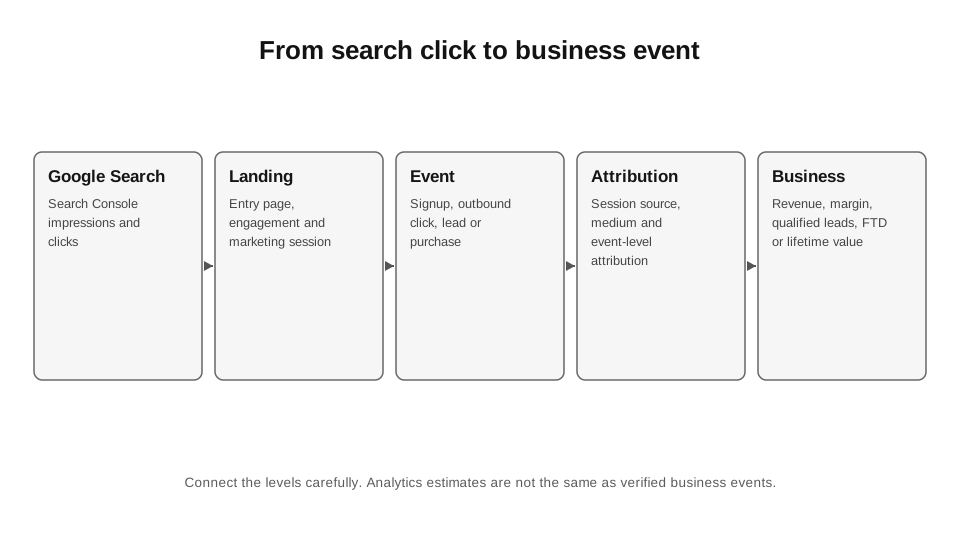
Search Console ends roughly where the user lands on the site. The business side is only beginning. For lead gen, I care about qualified leads; for ecommerce, revenue/margin; for affiliate, outbound clicks, registrations, FTDs or another available postback event.
GA4 is useful as a behavioural layer, but it depends on consent, client-side execution, ad blockers, cross-domain setup, event implementation and attribution settings. So “GA4 shows 812 organic sessions” is a measurement result under a specific configuration, not the absolute number of people arriving from search.
34.1. Session source/medium vs first user
GA4 has traffic-source dimensions with different scopes. `First user` describes the source that first acquired the user; `Session` describes the source of a particular session. Google explains that user- and session-scoped dimensions use paid and organic last click, while event-scoped attribution can use the selected attribution model.[1]
This means that “organic users” and “organic sessions” do not answer the same question. For SEO performance, I usually start with Session source/medium; for an acquisition cohort, First user.
34.2. Default channel group — a convenience, not a law of nature
Organic Search in GA4 is a rule-based channel grouping. It is useful for dashboards, but source/medium needs to be retained. A new AI referral may initially fall under Referral until the classification rules match your analytical needs.
OpenAI explicitly states that ChatGPT search referrals add `utm_source=chatgpt.com`, so they can be tracked separately in analytics.[2] I do not automatically mix this traffic with Organic Search; I create a custom reporting dimension, “AI referral”, on top of raw source/medium.
34.3. Attribution is the allocation of credit
GA4 offers data-driven attribution, paid and organic last click, and Google paid channels last click.[3] Data-driven attribution uses property data and estimates the contribution of touchpoints; last click assigns credit to the last eligible interaction.
If a user saw a brand in an AI answer, performed a branded Google search a day later and made a purchase, standard web analytics may have no observable “AI mention” touchpoint. So no attribution model can assign credit to an event you did not measure.
34.4. Do not compare GSC clicks and GA sessions 1:1
Google itself documents the differences between Search Console and Analytics: different measurement points, canonical URL attribution, tracking, time zones and other rules.[4] A click may occur without GA firing; a session may contain several pageviews; a user may return via direct traffic.
I use the GSC clicks → GA organic sessions ratio as a monitoring metric, not as a “correct coefficient”. If the ratio changes sharply after a consent banner release, that signals a tracking change, not necessarily an SEO change.
34.5. Events should be business-focused
`scroll_90` and `time_on_page` can help with diagnostics, but SEO KPIs should be closer to money. For ecommerce, purchase/revenue/margin. For SaaS, signup, activated account, paid conversion. For affiliate, outbound clicks plus, where available, a server-to-server postback with registration/deposit data.
I document the event contract: name, trigger, parameters, deduplication, source of truth. If “lead” fires both on submit and on the thank-you page, conversions will double regardless of SEO.
34.6. Affiliate: an outbound click is not yet revenue
In affiliate, browser analytics often sees the click to the operator but cannot see the downstream registration/FTD because it happens on another domain. This requires a postback or a partner report that can be joined by click ID, sub ID, date/geo/landing within the limits of permitted tracking.
Without this, the SEO team is optimising CTR to the operator, not traffic quality. Two landing pages may have the same number of outbound clicks and a threefold difference in FTD rate.
34.7. AI referrals
ChatGPT, Perplexity, Copilot and others can send referral traffic. This is a small but measurable part of AI visibility. I maintain a list of known AI referrers and review new referral domains weekly.
I do not call AI referrals “total AI traffic”. No-click visibility, branded follow-up searches and agent actions may not generate a direct referral. These are only observable clicks.
CODE 34.1. A custom AI referrals group in the GA4 export.
# CSV analysis from GA4 Traffic acquisition export.
# Columns: session_source, session_medium, sessions, key_events, revenue
import pandas as pd
df = pd.read_csv("ga4_acquisition.csv")
# Custom rule for AI-referral sources.
ai_sources = {"chatgpt.com", "perplexity.ai", "copilot.microsoft.com"}
df["channel_custom"] = "Other"
df.loc[df.session_medium.eq("organic"), "channel_custom"] = "Organic Search"
df.loc[df.session_source.isin(ai_sources), "channel_custom"] = "AI referral"
out = (df.groupby("channel_custom", as_index=False)
 .agg(sessions=("sessions","sum"),
 key_events=("key_events","sum"),
 revenue=("revenue","sum")))
out["key_event_rate"] = out.key_events / out.sessions.replace(0, pd.NA)
print(out.sort_values("revenue", ascending=False))
34.8. Landing page economics
For SEO, I look not only at channel aggregates, but at landing page × page type × query cluster. Revenue per organic session and key-event rate show the difference between informational traffic and money pages.
A low conversion rate for an informational article does not mean the article is unnecessary: it may generate assisted conversions or brand demand. But such claims need to be substantiated with path/cohort analysis, not storytelling.
34.9. Server-side measurement and consent
The stricter the privacy restrictions, the more gaps browser analytics has. Server-side measurement can improve the reliability of individual business events, but it is not a way to “bypass consent”. The legal/compliance layer must be part of the design.
I always keep the business source of truth separate: CRM, orders, partner postbacks. Analytics is a model of behaviour, while accounting/CRM is a separate system.
34.10. Attribution does not resolve causality
Even data-driven attribution does not prove that an SEO touchpoint caused a conversion in the causal sense. It is an allocation model. Estimating causal lift requires experiments or quasi-experimental designs.
That is why I separate “attributed revenue” and “incremental effect” in reporting. The former can be calculated regularly; the latter is much harder to estimate and is not feasible for every task.
| Level | Example | Source | Interpretation Risk |
|---|---|---|---|
| Session | sessions, engaged sessions | GA4 | consent/tracking gaps |
| Microconversion | signup, outbound click | GA4/events | implementation errors |
| Macroconversion | purchase, qualified lead | GA4/CRM | attribution |
| Affiliate outcome | registration, FTD | postback/network | cross-domain matching |
| Value | revenue, margin, LTV | backend/BI | delay and refunds |
Sources for Chapter 34
1. Google Analytics Help. Traffic-source scopes. https://support.google.com/analytics/answer/11080067?hl=en — User/session/event scopes.
2. OpenAI Help Center. Publishers and Developers FAQ. https://help.openai.com/uk-ua/articles/12627856-publishers-and-developers-faq — ChatGPT referrals and utm_source=chatgpt.com.
3. Google Analytics Help. Attribution. https://support.google.com/analytics/answer/10596866 — Three available attribution models.
4. Google Search Central. Search Console and Analytics. https://developers.google.com/search/docs/monitor-debug/google-analytics-search-console — Why the data does not match 1:1.
5. Google Analytics Help. Campaigns and traffic sources. https://support.google.com/analytics/answer/11242841?hl=uk — Traffic acquisition basics.