AI is strongest not where it “writes SEO copy”, but where it shortens the path from raw data to a verified hypothesis: classifying, extracting, transforming, explaining and helping write code.
Data and sources as of: September 14, 2026
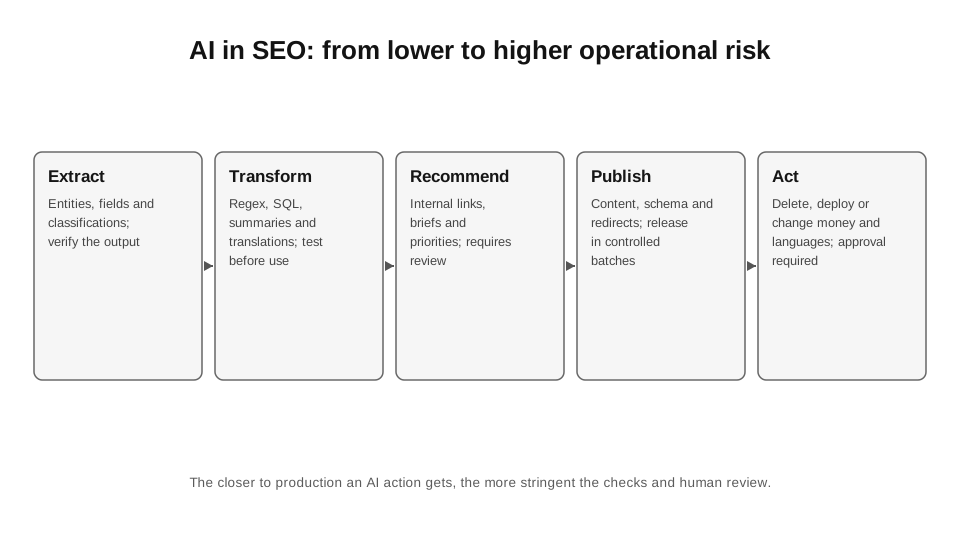
I do not divide SEO tasks into “AI allowed / AI not allowed”. I divide them by error tolerance. If a model misclassifies 2% of 100,000 keywords, that may be acceptable for exploration but unacceptable for automatically changing canonicals in production.
So the key parameter of an AI workflow is neither the model nor the prompt. It is verification cost. If the result is easy to verify with a rule, schema or validation set, AI scales well. If correctness is subjective or an error is costly, stronger human review is needed.
31.1. Clustering: do not ask it to “make clusters”
Keyword clustering with an LLM is useful for semantic grouping, but without a clear unit of clustering, results vary. The same keywords can be clustered by SERP overlap, intent, entity, page type or funnel stage. These are different tasks.
I define a hierarchy: first market/task, then entity, then intent, then desired page type. For a high-value cluster, I check the SERP manually or using data. An LLM has no access to the actual SERP unless you provide it.
31.2. SERP classification
A model is good at classifying SERP features already collected: commercial/listicle/product/local/forum/video. But the prompt must include the title, URL, snippet and features, not just the keyword. Otherwise, it is guessing intent from a phrase.
I manually label a sample of 100–300 queries, then calculate a confusion matrix. If “review” and “comparison” are consistently confused, I change the taxonomy, not just the model.
31.3. Content briefs
AI can quickly summarise competitors’ coverage, entities, questions and gaps. But a brief becomes useful only after you add your own perspective: first-party data, an experiment, product knowledge, constraints and source requirements. Otherwise, the brief steers the writer towards the arithmetic mean of the SERP.
I explicitly add a “what NOT to repeat” section so that commodity paragraphs do not take up half the article. For factual topics, I add a list of primary sources that must be verified before drafting.
31.4. Entity extraction and normalisation
This is one of the best AI use cases. You can extract brands, countries, payment methods, currencies, regulators and product attributes from thousands of pages. But it is better to force the output to conform to a JSON schema with enums, nullable fields and source snippets.
After extraction, I run deterministic validation: unknown enums, invalid dates, impossible currency/country pairs and missing sources. The model must not “correct” an unknown value without an uncertainty flag.
31.5. Regex, SQL and Python
An LLM dramatically lowers the barrier to entry for technical analysis. An SEO can describe a task, get SQL and work through it with an explanation. But the code must be tested on a sample. The most dangerous kind of error is syntactically correct SQL that calculates the wrong thing.
I ask the model to describe the assumptions and table grain first, then provide the SQL, then three sanity checks. If the query aggregates GSC data, you need to explicitly specify the dimensions, canonical URL behaviour, date timezone and denominator. “Runs without an error” does not mean “correct”.
31.6. Log analysis
An LLM can help write a parser or regex for bots, classify URL patterns and explain an anomaly. But it is better to aggregate raw logs deterministically and pass summaries to the model. This is cheaper, more private and easier to control.
For example, instead of a million rows, we pass the top page types by Googlebot hits, status distribution, response-time percentiles, top parameters and day-over-day change. The model helps formulate hypotheses, while the facts remain in the aggregate data.
31.7. Internal linking
AI is good at generating candidate anchors and semantic matches, but it does not know your graph strategy unless you describe it. I provide the source URL, target URL, title/H1, page type, existing anchors, priority score and exclusions.
Automatically inserting links without QA can easily create circular boilerplate, excessive anchors or links in irrelevant places. So AI proposes candidates, while a deterministic layer checks duplicates, maximum link counts, target status and canonicals.
31.8. Localisation
The model is useful as a first layer of translation and localisation, but regulated verticals require a local reviewer or primary-source checks. Currency, tax, legal age, bonus terms, licensing and payment methods cannot be “translated” from another market.
I separate language QA from market QA. A text can be written in perfect Spanish and still be factually wrong for Spain.
31.9. Evaluation set
Without an eval set, an AI workflow becomes a matter of taste. I create a small set of real examples with expected outputs and edge cases. For classification, I calculate accuracy/F1; for extraction, field-level precision/recall; for generation, factual error rate, citation coverage and style violations.
When the model or prompt changes, I run the same set. This is the only way to understand whether a “newer model” is actually better for our specific task.
| Task | What to measure | Automatic verification | Human review |
|---|---|---|---|
| Keyword classification | accuracy/F1 | enum, required fields | edge cases |
| Entity extraction | precision/recall | schema, source span | unknown values |
| SQL generation | correct result | unit tests, row counts | business logic |
| Content draft | factual error rate | source/number checks | stance, style, risk |
| Internal links | precision candidates | status/canonical/duplicates | semantic fit |
31.10. Hallucination budget
The phrase “AI sometimes hallucinates” is too abstract. I set an acceptable error budget. For brainstorming, 10% flawed ideas is not a problem. For a financial calculation, 0.1% may be unacceptable. This immediately determines the QA architecture.
In high-stakes factual content, the model must not generate a claim without a source field. If the source is missing, the output must be `SOURCE_REQUIRED`, not plausible text.
31.11. Prompt injection and data
When AI reads web pages, connected docs or user-generated text, the input may contain instructions that conflict with our task. External content must therefore be treated as data, not authority.
Do not pass secrets, private client data or production credentials to the model without appropriate enterprise controls. AI integration is part of data governance, not just a productivity feature.
31.12. Where AI offers no advantage
If all competitors can get the same “SEO article” in 30 seconds, using a model is not a moat in itself. The advantage comes from inputs, workflow, data, testing, distribution and speed of iteration.
That is why I evaluate AI not by the amount of content created, but by the reduction in cycle time: from question to verified answer, from anomaly to diagnosis, from dataset to production page, from brief to published evidence.
Sources for Chapter 31
1. Google Search Central. Creating helpful, reliable, people-first content. https://developers.google.com/search/docs/fundamentals/creating-helpful-content — Requirements for helpful and reliable output.
2. Google Search Central. AI optimisation guide. https://developers.google.com/search/docs/fundamentals/ai-optimization-guide — Generative AI does not create a separate, magical SEO discipline.
3. Google Search Central. Spam policies. https://developers.google.com/search/docs/essentials/spam-policies — Scaled content abuse is assessed by purpose and value, not merely by whether AI was used.