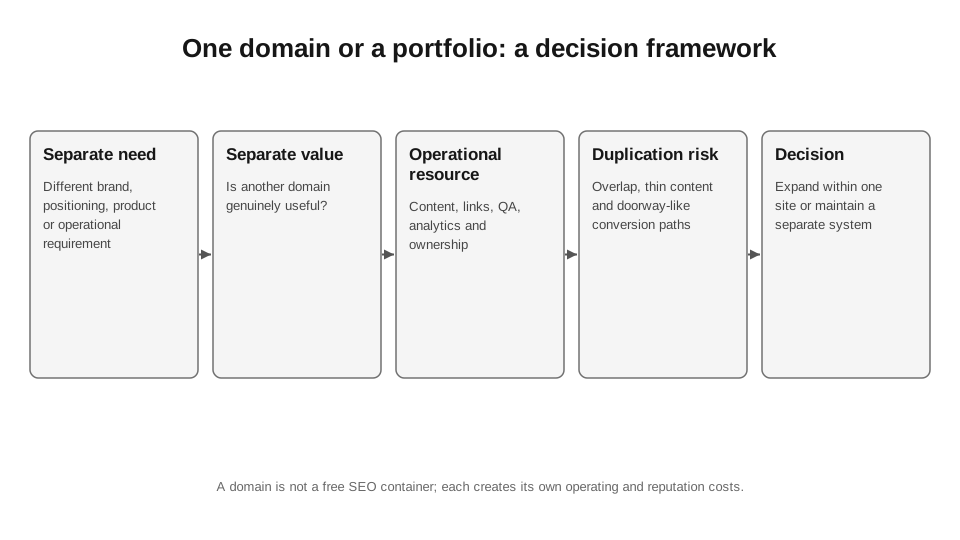
Multiple domains can be a justified business architecture, or they can be an expensive way to replicate the same site. The decision should be based on differences in product, brand, country and operational capacity, not on a belief that “more domains mean more SERP coverage”.
Data and sources as of: September 14, 2026
Multi-domain SEO is especially common in affiliate businesses, marketplaces, SaaS businesses with multiple brands, regulated verticals and international projects. In a presentation, it all looks simple: one domain per brand or country. Operationally, every additional domain multiplies DNS, hosting, Search Console, analytics, monitoring, legal pages, content updates, links, migrations, incidents and QA.
Google spam policies explicitly describe doorway abuse as creating multiple similar sites or pages to capture closely related queries and funnel users towards the actual destination.[1] A “portfolio” is therefore not automatically a neutral structure. The less genuine differentiation there is between domains, the weaker the business justification for their existence.
29.1. When a separate domain is justified
Strong reasons include a legally separate brand, a separate product, a substantially different market with its own team and content, different regulations, an acquisition or business sale, and technical isolation where independence has tangible value. A weak reason is “we want to occupy another search result”.
For international SEO, separate ccTLDs can be logical, but they are not the only option. Subdirectories often make it easier to consolidate authority, deployment and measurement. The architecture should follow the business, not the supposed magic of a domain extension.
29.2. The cost of a portfolio
If you have 20 domains, changing a privacy page, schema, tracking or a footer link is not one task but a distribution problem. I count not only domain and hosting costs, but also engineering hours, content maintenance, link acquisition, monitoring, compliance and the incident surface.
This is precisely why small affiliate portfolios often carry technical debt that is invisible in the P&L: half-broken analytics, expired certificates, stale bonuses, noindex after a redesign and inconsistent canonical rules. These are not “minor details” but a risk multiplier.
| Outline | What’s multiplied | How to measure |
|---|---|---|
| Technical | DNS, TLS, hosting, deployment, monitoring | incidents/month, maintenance time |
| SEO | GSC, sitemaps, crawling, indexing QA | audit time, coverage |
| Content | updates, localisation, legal claims | stale pages, editorial hours |
| Authority | links, mentions, brand demand | costs/domain, referring domains |
| Analytics | GA4, consent, events, attribution | missing/inconsistent events |
| Compliance | regulations, disclosures, age/geo rules | errors, manual checks |
29.3. Cross-domain cannibalisation
Two domains can compete for the same query space. This is not always bad: different brands can genuinely be competitors. But if they belong to the same team and have the same offering, you are splitting links, content and brand signals between copies.
I build a cross-domain query matrix: which domains receive impressions for the same query clusters, where ranking URLs change, where one domain displaces another, and whether conversion rates differ. Sometimes the second domain delivers incremental reach. Sometimes it is simply a more expensive way to get the same traffic.
29.4. Localisation must be real
Multi-geo targeting does not mean “translate the template”. Countries differ in currency, payment methods, regulations, delivery, availability, terms, support, competitors and brand recognition. A page for Spain and a page for Germany should differ not in language but in the actual product.
If one team cannot maintain local facts, hreflang will not make a page locally useful. Hreflang helps associate localised versions, but does not create relevance on its own.
29.5. Expired domains: asset recovery vs abuse
Buying an old domain is not prohibited in itself. Google defines expired domain abuse by its purpose: a domain is purchased and repurposed primarily to manipulate rankings by hosting low-value content. Official examples include casino content on a former primary school website.[1]
That is why DR is not what interests me when evaluating an expired domain. I examine its topical history, backlinks, redirects, owners, indexing, spam anchors, legal/trademark risk and whether the new product has a plausible connection to its past. Even a strong link graph does not turn irrelevant repurposing into a long-term asset.
29.6. Cross-domain migrations
When a portfolio is consolidated, the migration must include URL mapping, 1:1 redirects where equivalents exist, updated internal links, canonicals, hreflang, sitemaps, analytics and monitoring. Google warns that rankings may fluctuate during a site move while the system recrawls and reindexes URLs; larger sites may take longer to recover.[2]
You should not redirect thousands of irrelevant pages to the homepage just “to pass authority”. A redirect should lead to the closest genuine equivalent. If no equivalent exists, a 404/410 may be a cleaner solution.
29.7. A unified operational control plane
A portfolio becomes manageable when all sites share one telemetry model: consistent event names, dashboard schema, uptime checks, canonical tests, content freshness fields and ownership. A single hosting provider or CMS is not essential; what matters is a common language of control.
I consolidate domains into a registry: owner, purpose, geo, brand, CMS, DNS provider, analytics property, Search Console, release channel, renewal date, regulatory scope and critical contacts. This is basic, but it is precisely the absence of such a registry that turns 50 domains into chaos.
29.8. The portfolio as capital
In an affiliate business, a domain can be an asset with traffic, backlinks, brand demand and cash flow. Decisions to “keep / invest / merge / sell / close” are therefore best approached as portfolio management.
I assess a domain’s contribution margin after actual SEO costs, not just gross revenue. A site with $2k in revenue and $1.8k in links/content/maintenance costs is not the same kind of asset as a site with $1.5k in revenue and $200 in maintenance costs. This matters when the budget is limited.
29.9. The risk boundary
When dozens of nearly identical domains are created solely to capture similar SERPs and lead to the same offering, you are approaching a doorway pattern that Google explicitly describes in its spam policies.[1] I do not judge this morally; it is a question of risk/reward. But calling this model “safe white-hat multi-domain SEO” is wrong.
For every tactic in the portfolio, I record: policy status, likelihood of detection/enforcement, blast radius, recoverability and business dependence. Risk management begins with an honest description of the mechanics.
Sources for Chapter 29
1. Google Search Central. Spam policies. https://developers.google.com/search/docs/essentials/spam-policies — Doorway abuse, expired domain abuse, scaled content abuse.
2. Google Search Central. Site moves with URL changes. https://developers.google.com/search/docs/crawling-indexing/site-move-with-url-changes — Cross-domain migrations.
3. Google Search Central. International sites. https://developers.google.com/search/docs/specialty/international/managing-multi-regional-sites — International architecture options.
4. Google Search Central. Localised versions / hreflang. https://developers.google.com/search/docs/specialty/international/localized-versions — Linking language and regional versions.