Programmatic SEO starts not with a text generator, but with a rule for a URL’s existence: what distinct need, distinct dataset and business action justify creating another page.
Data and sources as of: September 14, 2026
Programmatic SEO is often mistakenly reduced to automatically creating thousands of pages from a template. That describes production, not strategy. For me, programmatic SEO is a system in which a dataset, rules for combining entities, a page template, internal linking, indexing and measurement work as a single product. If a URL has no distinct reason to exist, automation merely scales unnecessary pages faster.
The critical question before generation is not “how many pages can we make?” but “why do the search engine and the user need this particular combination of data?” Google explicitly classifies the mass creation of unoriginal pages whose primary purpose is to manipulate rankings as scaled content abuse, regardless of whether they are created by generative AI, a script or people.[1] Automation itself, then, is not the problem. The problem is the absence of distinct value for each URL.
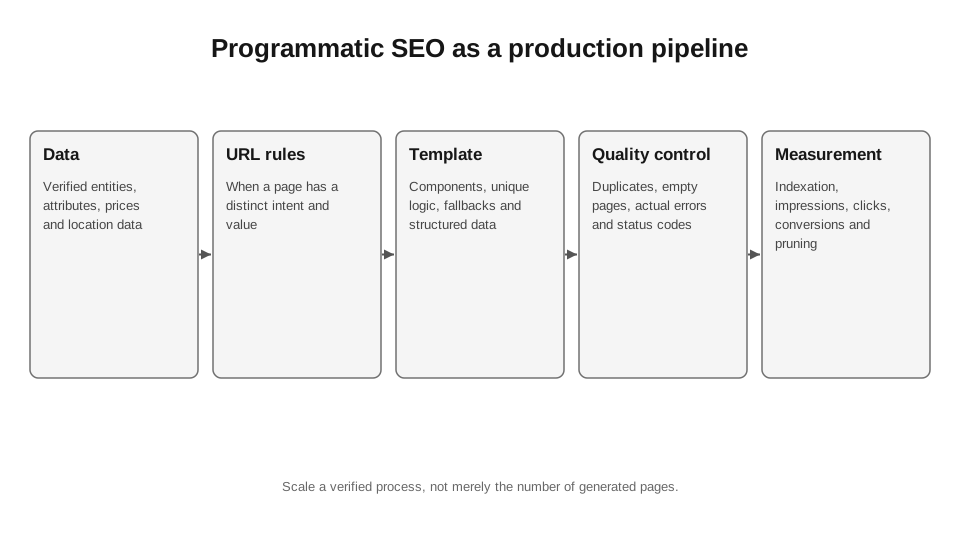
27.1. The rule for a URL’s existence
I use a simple gate: a URL is created only when it has a distinct combination of intent, data and a useful action. “Casino X bonus”, “Casino X withdrawal time” and “Casino X app” can be separate pages if the SERPs, user expectations and actual data differ. But creating a page for every permutation of “best casino + city + payment method + device” without distinct value is combinatorial noise.
In practice, the gate can be formalised through four questions: is there distinct demand; does the set of facts differ; can the page be made more useful than the general category page; does the page have a distinct conversion path? If two or more answers are “no”, I do not generate the URL automatically.
| Signal | Create | Don’t create |
|---|---|---|
| Demand | There are consistent queries or a clear user task. | The combination exists only because it can be generated. |
| Data | There are distinct first-party or structured facts. | The text differs only in the city/brand name. |
| SERP | The results show a distinct page type. | One general category page ranks for all variations. |
| Conversion | There is a distinct action, filter, calculator or comparison. | The page merely sends the user to another page. |
| Maintenance | The data can be updated automatically and monitored. | The data becomes outdated quickly; the source is unreliable. |
27.2. Combinatorial explosion
The most dangerous property of programmatic SEO is the geometric growth in possible URLs. 200 brands × 40 payment methods × 20 countries × 3 devices already amounts to 480,000 combinations. Most of them may have no distinct demand, data or purpose. This is precisely where an eligibility layer is needed before the page generator.
I first calculate the full theoretical space of combinations, then filter it step by step: combinations without data, without demand, without sufficient differentiation, with legal restrictions, duplicate intents and combinations with zero inventory. What remains is not “all possible URLs”, but an indexed product.
27.3. Data matters more than text
The template can be the same for 50,000 pages if the factual content differs and is useful. Conversely, 50,000 “unique” AI texts can be semantically interchangeable. In strong programmatic projects, the main asset is the dataset: prices, availability, rules, odds, specifications, geography, genuine reviews, measurements or other structured facts.
The text layer should explain the data, not mask its absence. If a data source has a date, version or update SLA, that should be stored in the data model. This makes it possible to automatically find pages with stale facts rather than wait until a user spots the error.
27.4. The template as a product
A template is not “H1 + 800 words”. It is a set of components with rules governing when they appear: summary, key facts, table, comparison, FAQ, calculator, map, availability, CTA, evidence and sources. Each component needs conditions: display it only when the data is sufficient; do not insert empty placeholders; have a fallback if an external API is unavailable.
On large sites, I test templates against edge cases: the shortest dataset, the longest names, zero inventory, one unit of inventory, a missing price, mixed currencies, an unknown brand and multiple languages. It is precisely these edge cases that create thousands of thin or broken pages after scaling.
27.5. Duplicates and canonicalisation
Programmatic SEO generates duplicates beyond the text level. Two URLs may display the same set of items through a different filter order, different parameters or alternative entity names. Before launch, you need a deterministic page key: a set of fields that uniquely defines the information need.
Canonical should not be a way to hide a poor URL model. If the system can avoid creating a duplicate, it is better not to create it. Canonical is a consolidation signal, but Google still chooses the canonical version itself, using multiple signals. [2]
27.6. Internal linking and discovery
Programmatic pages must be part of the site graph. If tens of thousands of URLs exist only in a sitemap, that is a sign of weak information architecture. Google explicitly explains for ecommerce that relationships between pages and the number of link hops help it understand the structure and relative importance of pages.[3]
I build hub pages around entities and attributes, rather than random “related pages”. Every URL should have a clear parent location: country → category → subcategory → item; brand → product → variant; league → team → match. This simultaneously makes navigation, discovery and orphan-page management easier.
27.7. Sitemap as a control plane
On a large programmatic site, a sitemap is not just a way to “submit URLs to Google”. I use sitemap files as managed inventory segments: by page type, country, language, launch date or status. This allows me to compare submitted URLs with indexed URLs and pinpoint problems faster.
A sitemap should contain canonical URLs that the site actually wants indexed. If the file mixes 200, 301, noindex, canonical-to-other and 404, the sitemap itself ceases to be useful as a diagnostic dataset.
27.8. Crawling and indexing as system constraints
When 100,000 URLs are generated per day, the question “can we generate them?” becomes less important than “can the search engine process the inventory properly?”. Google specifically warns that faceted navigation can create a practically unlimited number of URLs, cause unnecessary crawling and slow the discovery of important content.[4]
Before a large launch, I use a ramp-up: a small segment, a crawl/index/traffic check, then the next batch. A mass release without a control group makes diagnosis harder: when half the URLs are not indexed, it is unclear whether the problem lies in the template, demand, data quality, internal linking or simply the pace of the rollout.
27.9. AI in production
AI is useful for turning structured data into readable explanations, generating drafts, checking for missing fields, normalising names and classifying intent. But AI must not invent missing attributes. If the `withdrawal_time` field is empty, the model must not “know the typical value”. An empty field should trigger a fallback or prevent the component from being displayed.
In production, I separate the factual layer from the linguistic layer. Facts come from a controlled source and are passed to the model as immutable inputs. The model can explain them, but not change them. After generation, automated QA checks numbers, currencies, brands, URLs, dates and permitted values.
27.10. Pruning is part of the product
A programmatic site cannot simply keep growing. It needs a removal or consolidation policy. I track pages with no impressions, no unique data, zero inventory or persistent canonical conflicts, as well as intent duplicates and outdated entities. But “0 clicks in 90 days” is not automatic grounds for removing a URL: seasonality, the long tail and the page’s role in the architecture may matter more.
Pruning should be a segment-level experiment. Deleting 50,000 URLs and then explaining the overall traffic change is a weak experimental design. It is better to define a homogeneous group, a clear criterion, a control segment and an observation period.
27.11. What I measure
For programmatic SEO, I do not look only at total organic traffic. A minimum dashboard should show inventory, discoverability, crawling, indexing, impressions, clicks, conversions and freshness by page type. Then “50,000 pages delivered +20% traffic” can be broken down: how many were actually indexed, which templates deliver results, where overcrawling occurs and how many URLs created no value.
| Level | Metric | Question |
|---|---|---|
| Inventory | eligible URLs / generated URLs | How many pages passed the value gate? |
| Discovery | internal linked / sitemap only / orphan | Is the URL part of the graph? |
| Crawling | Googlebot hits, status mix | Are resources being spent on the right URLs? |
| Index | indexed / submitted by template | Which templates consistently fail to get indexed? |
| Demand | impressions / indexed URL | Is there real search visibility? |
| Business | conversions, revenue, leads | Does maintaining the URL set pay off? |
| Quality | stale facts, missing fields, errors | Are we scaling errors? |
Sources for Chapter 27
1. Google Search Central. Spam policies for Google Web Search. https://developers.google.com/search/docs/essentials/spam-policies — Scaled content abuse and doorway abuse.
2. Google Search Central. Consolidate duplicate URLs. https://developers.google.com/search/docs/crawling-indexing/consolidate-duplicate-urls — Canonicalisation and duplicate consolidation.
3. Google Search Central. Help Google understand your ecommerce site structure. https://developers.google.com/search/docs/specialty/ecommerce/help-google-understand-your-ecommerce-site-structure — Internal structure and product discovery.
4. Google Search Central Blog. Crawling December: Faceted navigation. https://developers.google.com/search/blog/2024/12/crawling-december-faceted-nav — Combinatorial URL space and overcrawl.