A practical measurement stack: Google generative impressions, Bing citations/grounding queries, ChatGPT referrals, third-party prompt trackers, fixed prompt sets and the main problem - different denominators.
Data and sources as of: September 14, 2026
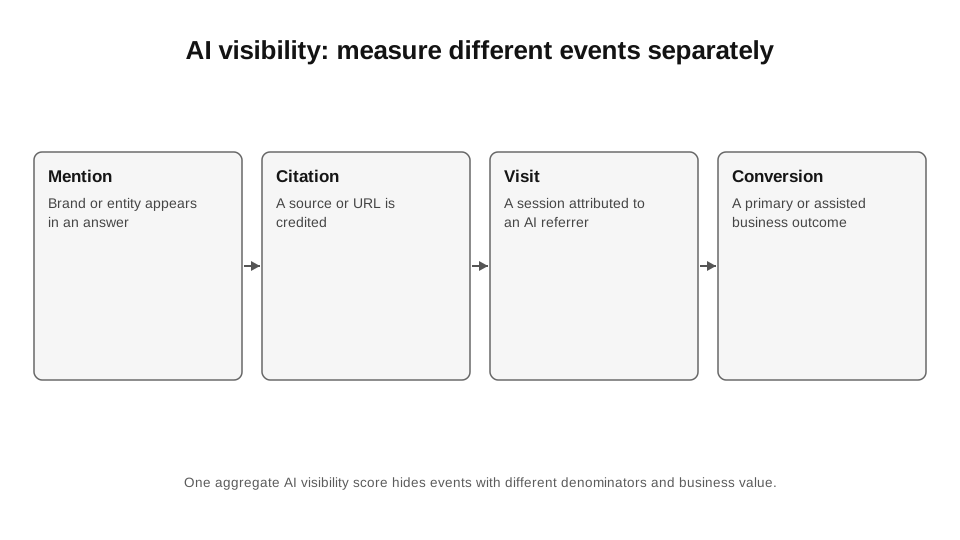
AI visibility can easily become the new DR: one attractive number, an opaque denominator and a competitor leaderboard. I am against this. In 2026, first-party telemetry is already available: Google Search Console has separate generative AI performance reports for AI Overviews/AI Mode, while Bing Webmaster Tools shows citations, cited pages and grounding queries.[1][2] This is not the full picture, but it is significantly better than pure scraping.
26.1. Google: generative impressions
The Google Search Console generative report shows impressions in generative features and dimensions for pages/countries/dates/devices. It does not provide a query dimension or dedicated clicks/CTR/position for the generative view.[1] So it lets you honestly say “the URL is getting exposure”, but not “this prompt generated 14 clicks”.
26.2. Bing: citations and grounding queries
Bing AI Performance shows Total Citations, Average Cited Pages, page-level citation activity and sample grounding queries.[2] This is a different kind of telemetry. Citation count does not indicate ranking or placement. Grounding queries are a sample, not a complete log. But for content gap analysis, this is a unique first-party signal.
26.3. ChatGPT: referrals are easier to measure than no-click mentions
OpenAI describes OAI-SearchBot and the ability of public websites to appear in ChatGPT Search.[3] On your side, you can measure referral sessions/conversions from known referrers. But the platform does not provide site owners with a complete analytics feed of no-click brand mentions within answers, so third-party prompt monitoring remains a sample.
26.4. Fixed prompt set - a laboratory, not a census
I build a set of prompts around tasks: discovery, comparison, brand, category, support. I record the exact wording, language, locale, model/platform, date, fresh/new session and repetition count. I call the metric “citation frequency in our test set”, not “AI market share”.
| Level | Metric | Source |
|---|---|---|
| Google exposure | generative impressions, cited pages if available | GSC |
| Bing/Copilot | citations, cited URLs, grounding queries | Bing Webmaster Tools |
| Prompt lab | mention/citation frequency by fixed prompts | in-house tracker |
| Traffic | sessions by AI referrer, landing pages | GA4/logs |
| Business | conversion/revenue assisted by AI traffic | analytics/CRM |
| Brand | branded demand and direct traffic trend | GSC/GA4/Trends |
26.5. Share of citations
You can calculate a brand’s share of citations among competitor citations in a fixed prompt set. The formula is useful for tracking trends, but depends on the composition of the set. If you add 100 prompts tomorrow where a competitor is strong, the metric will change without any actual change in the platform. That makes prompt set version a required field.
26.6. Volatility
For each prompt, I store not just the current source, but its history. Citation volatility = the share of runs/periods in which the source set changes. High volatility means a single screenshot is not representative at all; low volatility provides a stronger basis for an experiment.
26.7. Source overlap with the organic SERP
A useful research metric is the overlap between cited domains/URLs and top organic results. But correlation does not mean that organic rank caused the citation. Both may result from shared relevance/quality/authority systems. Google itself says that AI features are rooted in core ranking and quality systems.[4]
26.8. No-click attribution
If a user sees a brand in AI, then performs a branded search a day later and converts, standard last-click attribution will not give AI the credit. You can examine branded lift, geo/period experiments, post-view surveys and incrementality. But without user-level exposure data, the evidence for causality is weak. I do not attribute all direct traffic growth to “AI-assisted”.
26.9. What we can say with certainty in 2026
Google provides direct generative impressions; Bing provides direct citations and sample grounding queries; a website can measure referral traffic; third-party trackers provide controlled samples. No complete cross-platform census of prompts/answers/clicks exists for site owners. A good dashboard shows this limitation rather than hiding it behind a single score.
Sources for Chapter 26
1. Google Search Central. Search Generative AI performance reports. https://developers.google.com/search/blog/2026/06/gen-ai-performance-reports
2. Bing Webmaster Blog. AI Performance in Bing Webmaster Tools. https://blogs.bing.com/webmaster/February-2026/Introducing-AI-Performance-in-Bing-Webmaster-Tools-Public-Preview
3. OpenAI Help Center. Publishers and developers FAQ. https://help.openai.com/uk-ua/articles/12627856-publishers-and-developers-faq
4. Google Search Central. AI features and your website. https://developers.google.com/search/docs/appearance/ai-features