How to build an information advantage in an environment where basic text is cheap: proprietary data, experiments, tools, first-hand evidence, workflows, primary-source research and product utility.
Data and sources as of: September 14, 2026
If a model can create your material without access to your site, data or experience, your advantage is small. This does not mean that all informational content is dead. It means that “correct text” is becoming the baseline, while the differentiators are data, evidence, utility and trust.
25.1. Proprietary data
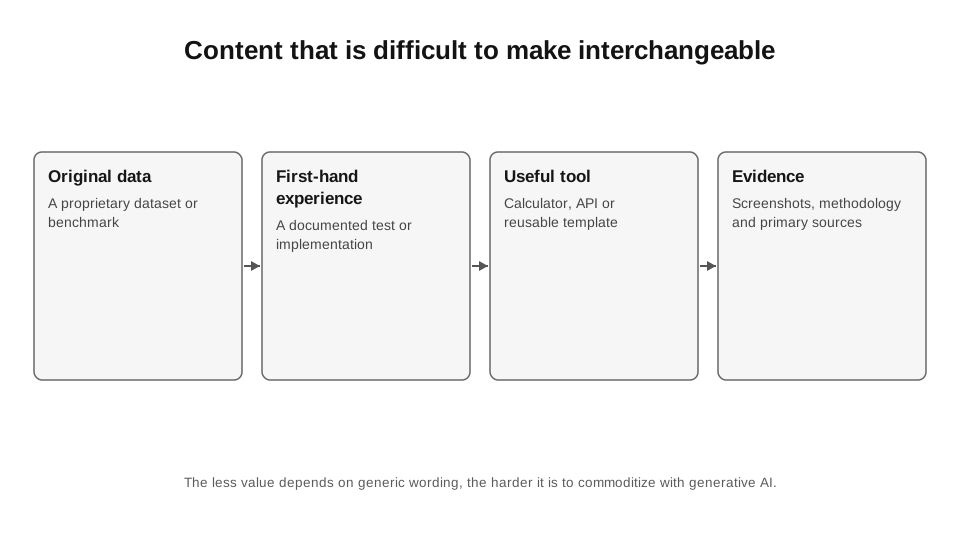
Even a small dataset can be powerful if the methodology is clear. 2 million GSC queries, 500 support tickets, 100 withdrawal tests, price history, crawl logs - this is material a competitor cannot honestly reproduce without collecting their own data. You do not always need a “large study”: sometimes 50 observations with clear limitations are enough.
25.2. Original experiments
An experiment is not “we changed the title and traffic grew”. It requires a hypothesis, sample, control/comparison, timeframe, confounders, result and limitation. Even if a test is imperfect, transparent methodology creates more value than categorical advice without evidence.
25.3. Tools and calculators
A tool often completes a task better than an article. A mortgage calculator, hreflang validator, odds converter, bonus wagering calculator, SERP diff, log parser. These pages can earn links, repeat visits and citations because they have functional value. An LLM can explain the formula, but the user still values a ready-to-use tool.
25.4. First-hand evidence
Photos, screenshots, screen recordings, measurements, support transcripts, code repos, before/after comparisons, invoice/terms snapshots - make claims verifiable. Google’s review guidance explicitly recommends evidence of your own experience and quantitative measurements.[1]
| Level | Example | My action |
|---|---|---|
| High | definitions, general advice, summaries of documentation | keep it brief, consolidate or do not create |
| Medium | comparisons with verified, up-to-date facts | invest in QA/freshness |
| Low | your own data, a tool, an experiment, first-hand evidence | make it a flagship asset |
| Unique | a product feature or dataset that only you have | build distribution and links around the asset |
25.5. Primary-source research
In regulated topics, the value often lies not in the “author’s experience” but in an accurate reading of laws, official docs, terms, APIs and regulator databases. This is also non-commodity work: finding a current source, correctly interpreting its scope, recording the cut-off date and not inventing what the document does not say.
25.6. Workflow content
A senior audience values not “what is a canonical” but “how to distinguish a canonical conflict from an index quality issue in 30 minutes”. An SOP, query, regex, spreadsheet model, decision tree - this is executable knowledge. I deliberately include these artefacts in this book because people open them while working.
25.7. AI as a production layer, not a source of truth
AI is good at accelerating clustering, extraction, drafting, SQL, code and QA suggestions. But proprietary value must come from real inputs. If the input is the same 10 top results, the output remains derivative regardless of style.
Sources for Chapter 25
1. Google Search Central. Write high quality reviews. https://developers.google.com/search/docs/specialty/ecommerce/write-high-quality-reviews
2. Google Search Central. Creating helpful, reliable, people-first content. https://developers.google.com/search/docs/fundamentals/creating-helpful-content
3. Google Search Central. Optimising for generative AI features. https://developers.google.com/search/docs/fundamentals/ai-optimization-guide