Breaking down fashionable terms into concrete tasks: search fundamentals, retrieval, citations, mentions, AI measurement and platform controls. No “secret GEO factors”.
Data and sources as of: September 14, 2026
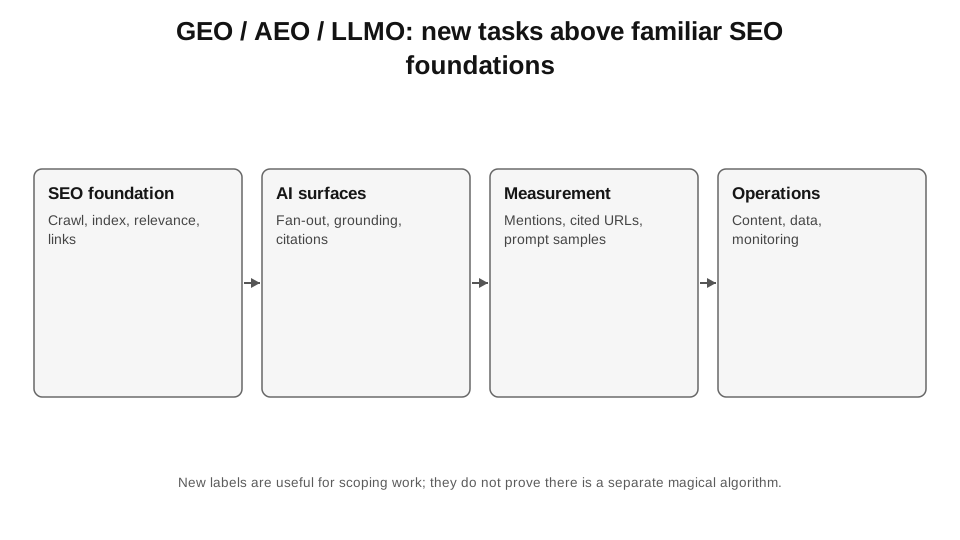
I use GEO/AEO/LLMO as labels when I need a shorthand for the scope of work. But I do not accept the claim that SEO has “ended” and a new discipline has replaced it. In 2026, Google states it directly: optimising for generative AI Search is optimising for the search experience and still SEO; foundational best practices remain relevant.[1]
24.1. What is genuinely new
| Task | How it differs from classic SEO |
|---|---|
| Prompt-set monitoring | there is no single canonical keyword; answers are stochastic |
| Citation tracking | source inclusion separate from organic position |
| Brand mention tracking | an entity can be mentioned without a URL |
| Grounding query analysis | a sample of retrieval phrases is available in Bing |
| Platform crawler controls | OAI-SearchBot, GPTBot, Googlebot/Google-Extended have different roles |
| AI referral attribution | new referrers and delayed/assisted journeys |
24.2. What has simply been renamed
Technical accessibility, indexability, useful content, clear entities, original evidence, the link graph, brand, freshness and internal architecture have not become different mechanisms because of the word GEO. If a consultant sells “GEO” without checking canonical/index/robots, they are optimising the surface without a foundation.
24.3. Google explicitly debunks myths in part of the GEO market
In its AI optimisation guide, Google addresses popular myths: llms.txt is not needed for ranking/visibility in Google Search; there is no special AI schema; there is no need to artificially chunk content; there is no need to create a page for every fan-out query.[1] This is a very useful boundary between measurable work and ritual.
24.4. Other platforms have different controls
ChatGPT Search uses OAI-SearchBot for search discovery; OpenAI separately describes GPTBot for training and other agents.[2] Bing has IndexNow and AI Performance. Google Search uses Googlebot controls for AI Overviews/Mode. So platform-specific operations are real, but they are infrastructure, not a “new content algorithm”.
24.5. Terminology without measurement is worthless
If an agency promises “GEO visibility +300%”, the first question is: what is the denominator? Which prompts? What platform/model/date/locale? Mention or citation? How many repetitions? Without a protocol, the figure is not reproducible. The measurement methodology itself matters more than the name of the discipline.
24.6. My working model
I keep SEO as the umbrella. Under it: Search SEO, AI Search visibility, entity/brand visibility and agent accessibility. GEO/AEO/LLMO can be used for communication, but in the roadmap, a task has a specific name: “increase citation frequency in Bing Copilot for 120 fixed prompts” or “allow OAI-SearchBot and check referral traffic”.
Sources for Chapter 24
1. Google Search Central. Optimising for generative AI features. https://developers.google.com/search/docs/fundamentals/ai-optimization-guide
2. OpenAI Help Center. Publishers and developers FAQ. https://help.openai.com/uk-ua/articles/12627856-publishers-and-developers-faq
3. Bing Webmaster Blog. AI Performance. https://blogs.bing.com/webmaster/February-2026/Introducing-AI-Performance-in-Bing-Webmaster-Tools-Public-Preview