Why citation does not equal ranking, which page properties can actually be improved, how to work on source inclusion without “AI schema”, and how to distinguish evidence from the new industry of GEO hacks.
Data and sources as of: September 14, 2026
Citation is a new visible event, but not new magic. For Google, a supporting link page must pass the usual index/eligibility layer, and AI systems then find relevant sources through Search. In Bing, citation has already become a separate measurable metric: Total Citations, cited pages and grounding queries.[1] This makes it possible to analyse source inclusion separately from organic rank.
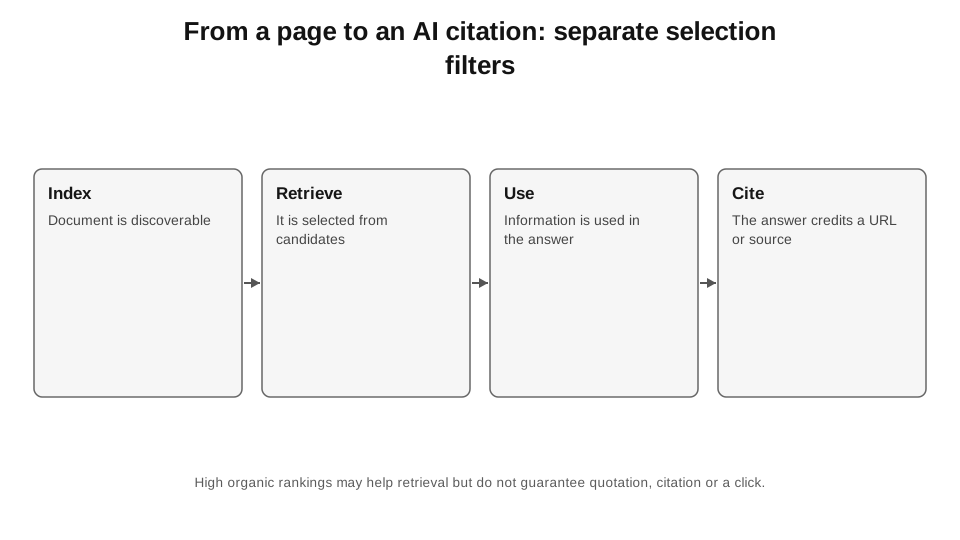
23.1. Ranking ≠ citation
A top-three page has a competitive advantage in relevance/authority, but an AI answer may need a specific fact from a page that ranks lower organically. Conversely, a top page may be a listicle without a specific fact for grounding. Citation optimisation therefore means neither “improving rankings” nor “adding FAQ schema”, but making a source technically eligible and information-dense for the task.
23.2. Clear claims are better than vague paragraphs
I do not break text up mechanically, but I aim for each important claim to have a subject, value, unit, date/context and source. “Withdrawals are fast” is weaker than “in our sample of 50 withdrawals, the median time was X hours over period Y”. The latter is easier to verify, cite and update.
23.3. Source identity must be stable
A stable canonical URL, an author/byline where expected, publication/update dates, organisation identity and links to primary sources help readers assess provenance. Google’s helpful content guidance specifically raises the questions of Who/How and recommends accurate authorship.[2] This is not a “citation factor”, but good publishing hygiene.
23.4. There is no special AI schema for Google Search
The 2026 AI guide explicitly states that special schema.org markup is not required for generative AI Search.[3] Use structured data that matches the actual content and supported Search features. There is no point in creating an invented JSON-LD type “AIAnswer”.
| Layer | Question |
|---|---|
| Technical | URL indexable? canonical stable? snippet allowed? |
| Task fit | Is there a specific answer to the subtask, rather than just general text? |
| Evidence | Are there primary sources/data/methodology? |
| Freshness | Do time-sensitive facts have a verification date? |
| Identity | Who is the author/organisation, and is responsibility clear? |
| Extractability | Are tables/lists/sections readable without JS interaction? |
23.5. Citation volatility is a normal property of a generative answer
An answer may change with the model version, query wording, date, locale or conversation context. A single screenshot is therefore not proof that “we are being cited”. I measure using a repeated prompt set, several runs per period, platform and locale, and record source URLs. The metric is citation frequency within a defined testing system, not absolute visibility across all users.
23.6. Do not confuse citation with traffic
Bing Total Citations does not indicate placement or clicks; Google generative impressions do not provide a dedicated click metric; third-party trackers see their own prompts. A business needs separate layers: citation → referral traffic → assisted conversion → branded demand. Otherwise, “+40% citations” may have no economic outcome at all.
23.7. What can be tested
Source inclusion tests must be substantive: adding an original dataset, clear comparison tables or primary sources, updating stale facts, or creating a tool. Not a test of “we added 17 FAQs and 4 schemas”. We measure citation frequency on a fixed prompt set, organic performance and user metrics, preferably with control pages.
Sources for Chapter 23
1. Bing Webmaster Blog. AI Performance. https://blogs.bing.com/webmaster/February-2026/Introducing-AI-Performance-in-Bing-Webmaster-Tools-Public-Preview
2. Google Search Central. Creating helpful, reliable, people-first content. https://developers.google.com/search/docs/fundamentals/creating-helpful-content
3. Google Search Central. Optimising for generative AI features. https://developers.google.com/search/docs/fundamentals/ai-optimization-guide
4. Google Search Central. AI features and your website. https://developers.google.com/search/docs/appearance/ai-features