A technical model of AI search without the magic: query interpretation, fan-out, retrieval, candidate passages, grounding, synthesis, citations. What Google confirms and what remains a closed implementation.
Data and sources as of: September 14, 2026
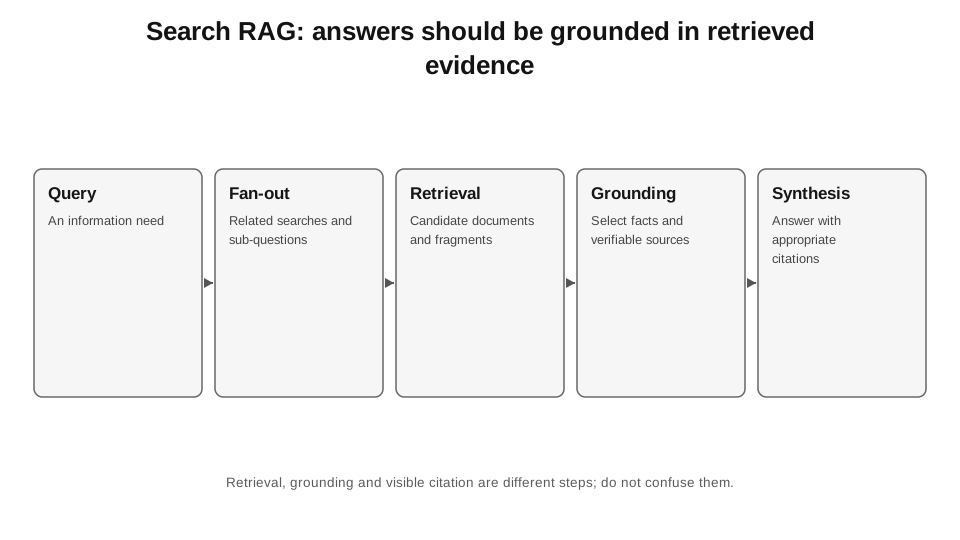
Generative search is better understood not as an “LLM on top of Google”, but as a pipeline connecting classic search capabilities with generative synthesis. In 2026, Google publicly describes retrieval-augmented generation (RAG/grounding) and query fan-out: the model runs related searches, retrieves relevant web pages from the Search index and uses them to produce an answer with links.[1]
22.1. Query fan-out changes the unit of relevance
One user prompt can generate several retrieval queries. For example, “best phone for travel under $600” can break down into camera, battery, roaming/eSIM, durability and current prices. This means a page can be relevant not to the surface prompt but to a specific subtask. SEO practitioners cannot see Google's full fan-out, so there is no need to invent exact hidden queries. Bing already shows sample grounding queries - this is closer to observable data.[2]
22.2. Retrieval ≠ final answer
A document may enter the candidate set and not be used. Another may be used for factual grounding but receive no visible citation. A third may receive a link as an additional source. That is precisely why “we are not in the AI answer” is insufficient: you need to establish which event the tool measures.
22.3. Passage-level usefulness matters, but “a chunk size of 50 words” is not a confirmed rule
Generative systems can extract specific information from pages/passages, but Google does not require content to be deliberately split into small chunks. The 2026 AI guide explicitly debunks the idea that special chunking is a requirement.[1] The practical takeaway is simpler: headings, tables, clear statements and local coherence help both people and extraction, but there is no need to break up normal text for the sake of a pseudo-formula.
22.4. Grounding values freshness and verifiability
RAG is needed precisely so that the model can rely on current external sources. For SEO, this increases the value of pages with clear facts, dates, sources and structured product/local data. But “adding citations” is not a ranking hack. It is more important that the page contain correct, specific, updatable information.
| Stage | Under our control | Not under our control |
|---|---|---|
| Index eligibility | crawl, noindex, canonical, snippet controls | when/whether Google indexes a URL |
| Retrieval readiness | task fit, facts, structure, fresh data | the exact hidden fan-out and candidate set |
| Grounding usefulness | specific claims, evidence, clear sections | which passages the system will select |
| Citation | stable URL, accessible source, clear attribution | whether a visible link will appear in a particular answer |
| Click | title/source trust, value beyond answer | citation position and the UI of a particular experiment |
22.5. The Search index remains the foundation of Google's AI features
Google states explicitly: for a page to be eligible as a supporting link in AI Overviews/AI Mode, it must be indexed and eligible for a snippet in normal Search.[3] This is an important boundary against “LLM SEO without SEO”: if the crawler cannot fetch the page or it is marked noindex, special AI schema will not save it.
22.6. Google's AI Search controls are the same Search controls
For AI features in Search, Google uses Googlebot controls: noindex, nosnippet, data-nosnippet and max-snippet to govern what can be shown.[3] Google-Extended applies to other training/grounding contexts and is not a control for AI Overviews/AI Mode in Search. These must be clearly distinguished.
22.7. What we do not know
The following are not publicly known: the exact fan-out, the number of retrieval rounds, thresholds, passage scoring, prompt rewriting and the weights of organic ranking versus other systems. So any service selling “Google AI's exact citation score” is effectively modelling the surface, not reading the internal system.
Sources for Chapter 22
1. Google Search Central. Optimising for generative AI features. https://developers.google.com/search/docs/fundamentals/ai-optimization-guide
2. Bing Webmaster Blog. AI Performance in Bing Webmaster Tools. https://blogs.bing.com/webmaster/February-2026/Introducing-AI-Performance-in-Bing-Webmaster-Tools-Public-Preview
3. Google Search Central. AI features and your website. https://developers.google.com/search/docs/appearance/ai-features