How to build affiliate pages that genuinely help users choose: reviews, comparisons, bonus/promo pages, EMDs, localisation, affiliate programs and where Google explicitly draws the line on thin affiliation.
Data and sources as of: September 14, 2026
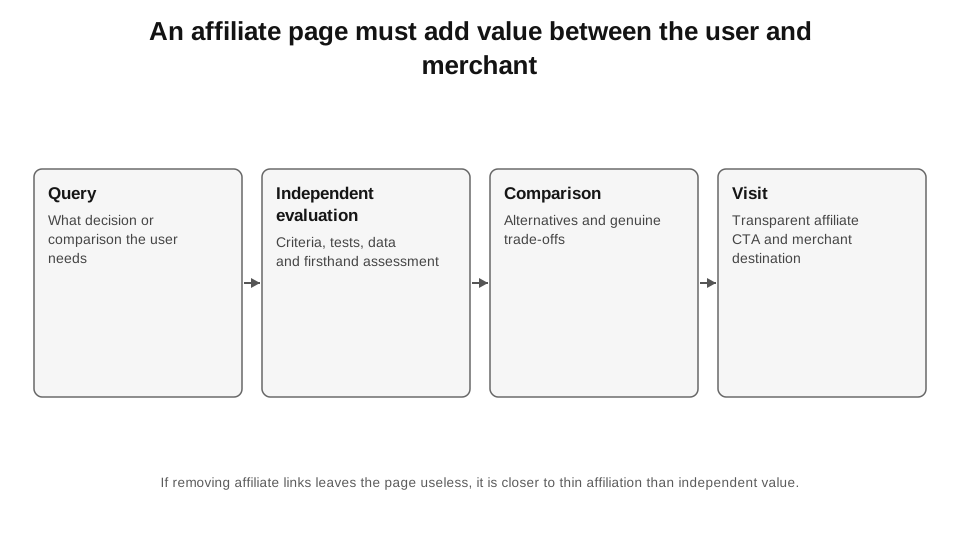
Affiliate SEO is not a fringe version of SEO. It is a business model in which an organic page must simultaneously answer a query, reduce uncertainty before a decision and direct the user to a merchant. The problem begins when the affiliate layer adds nothing between the SERP and the merchant. Google explicitly defines thin affiliation as a practice in which descriptions/reviews are copied from a merchant or network and provide no original value.[1]
21.1. A money page must have a task of its own
Review, bonus, app, promo code, withdrawal, payment methods, alternatives - these are not just keyword modifiers. Each page type serves a distinct decision task. A review helps users evaluate a product; a bonus page helps them understand its value and terms; an app page addresses installation/compatibility; a withdrawal page covers times/methods/limits. If all pages share 80% of their text, the structure was built for query variations, not for the user.
21.2. A review without evidence is weak even if it is very long
Google’s high-quality reviews guidance recommends demonstrating knowledge, first-hand evidence, quantitative measurements, pros/cons and comparisons.[2] For affiliates, this is a practical advantage: account screenshots, actual onboarding, a payment test, the date of the terms, a support response, product changes. Do not invent “we tested it” if you did not test it. In that case, honestly describe your desk research and sources.
21.3. Comparison intent requires criteria
| Layer | What is needed |
|---|---|
| Criteria | what actually influences the choice in this vertical |
| Method | how the facts were collected/verified |
| Normalisation | consistent units and time cut-off |
| Trade-offs | whom the option suits / does not suit |
| Evidence | terms, screenshots, source links, measurements |
| Disclosure | how the affiliate model affects monetisation |
21.4. Bonus/promo pages age quickly
Commercial terms are time-sensitive data. If a welcome bonus has changed, the old page may introduce a factual error and a compliance risk. I store fields in a structured format: amount, match %, wagering, min deposit, max bet, expiry, code, eligible countries, last verified, source. This enables QA and bulk updates without rewriting all the text.
21.5. An EMD does not replace a brand and a content moat
An exact-match domain may be clear in terms of the query and CTR, but Search is under no obligation to rank it because of the words in the domain. In portfolio strategies, an EMD also increases the risk of a doorway-like footprint if dozens of domains lead to the same merchant/offer through very similar pages. Google’s doorway policy explicitly mentions multiple sites/URLs created to target similar queries and funnel users to a single destination.[3]
21.6. Thin affiliation - a policy to read literally
Google also provides positive examples of affiliate value: additional price information, original reviews, rigorous testing/ratings, navigation of products/categories, product comparisons.[1] This is more useful than trying to guess a “minimum uniqueness %”. Unique text without unique value may still be thin.
21.7. Affiliate links and rel
Paid/affiliate relationships must be qualified correctly. Google’s outbound link guidance recommends rel="sponsored" for advertisements/paid placements.[4] This does not prevent the use of tracking parameters or redirectors, but you need to monitor status, destination, geo behaviour and ensure that crawlers/users are not sent into different deceptive flows.
21.8. Multi-GEO affiliate - localisation, not translation
Spain, Mexico and Argentina may share a language but have different operators, payments, regulation, currencies and search behaviour. I do not replicate a single review page 1:1 through AI translation. The product’s factual core may be shared; the offer, legal context, payment methods, terms, CTA, support availability and competitor set may be local.
21.9. What to measure
Beyond rankings/clicks: outbound CTR to merchant, click-to-registration, registration-to-FTD/lead approval, revenue/EPC by landing page, brand/non-brand query mix, freshness error rate, pages per merchant, time-to-update offer. An SEO page that generates many clicks but poor downstream conversion may be the wrong answer, even if it ranks well.
Sources for Chapter 21
1. Google Search Central. Spam policies - Thin affiliation. https://developers.google.com/search/docs/essentials/spam-policies
2. Google Search Central. Write high quality reviews. https://developers.google.com/search/docs/specialty/ecommerce/write-high-quality-reviews
3. Google Search Central. Spam policies - Doorway abuse. https://developers.google.com/search/docs/essentials/spam-policies
4. Google Search Central. Qualify outbound links. https://developers.google.com/search/docs/crawling-indexing/qualify-outbound-links
5. Google Search Central. Reviews system. https://developers.google.com/search/docs/appearance/reviews-system