Without the phrase “Google loves brands”: brand demand, entity consistency, first-party sources, Organization markup, reviews, publishers, co-occurrence and what can actually be measured.
Data and sources as of: September 14, 2026
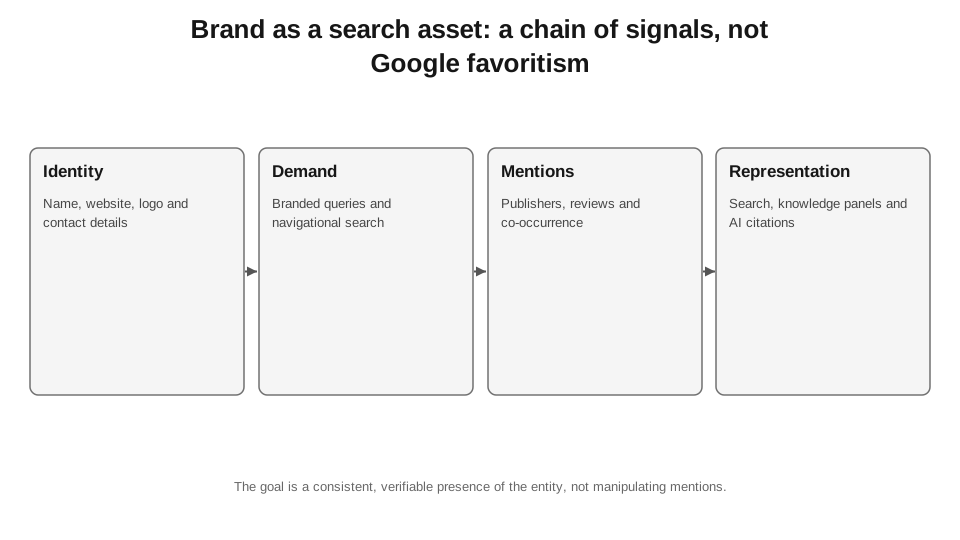
A brand in Search is not a secret ranking factor with a single score. It is a set of observable things: navigational demand, consistent entity facts, mentions, links, reviews, first-party pages, knowledge representations, publisher coverage. A strong brand reduces uncertainty for the user and the system, but we cannot see internal “brand authority”.
20.1. Brand queries - the most direct first-party signal of demand
In GSC, I segment exact brand, brand+modifier and non-brand queries. Trends in brand impressions show not “authority”, but search demand and visibility for the brand’s own entity. Brand+review, brand+login, brand+bonus, brand+support reveal distinct user tasks around the entity. For new brands, this is a strong health metric because it is difficult to fake through internal linking.
20.2. Entity consistency starts with a first-party source of truth
Name, logo, official URL, contacts, legal company, product names, founders/owners where relevant, social profiles - must be consistent. Organization structured data can help Google better understand and disambiguate an organisation, and some fields affect visual elements/knowledge panels.[1] But markup must not describe anything that is absent from the visible content or the actual business.
20.3. Structured data - an explicit clue, not a “create entity” button
Organization/LocalBusiness schema is useful as a machine-readable layer, but Google’s general guidelines require structured data to match visible content and not be misleading.[2] I add only facts I can maintain. SameAs should not be a list of random profiles, nor should the logo differ on every page.
20.4. Independent sources are stronger than 100 pages of your own
A brand mention on its own site proves nothing about its external existence. Reviews, publishers, business directories, app stores, social profiles, partners, regulators, datasets - create external references. I am not claiming that every mention without a link is a ranking signal. I use them as evidence of an entity’s footprint and a source of branded discovery.
| Layer | Metric / Validation |
|---|---|
| Demand | brand impressions, branded queries, direct demand trends |
| Identity | consistent name/logo/URL/contact/legal relation |
| SERP control | share of first-party/controlled results in the brand SERP |
| Reputation | review volume, rating distribution, recurring complaints |
| Independent coverage | publisher/partner/regulator references |
| AI visibility | brand mentions, cited first-party URLs, factual consistency |
20.5. The brand SERP - a real operational surface
For a navigational query, I inventory the top results, sitelinks, knowledge panel, social profiles, reviews, news and autocomplete. The goal is not to “occupy all 10 positions”, but to ensure that users quickly reach the correct official destinations and do not see contradictory facts. For regulated affiliate brands, support, terms and licence/regulatory information are particularly important.
20.6. AI makes factual consistency more important
Generative systems synthesise multiple sources. If the official page says one thing, the app store another and a partner a third, the chance of an incorrect synthesis increases. I create a canonical fact sheet on the first-party site and maintain consistent facts across high-authority profiles. This is not an “LLM hack”, but data hygiene.
20.7. Co-occurrence and mentions: be careful with causality
SEO practitioners often call co-occurrence a confirmed ranking factor. Public data is insufficient to justify such certainty. I view a mention alongside a category/entity as a way to provide external context and enable brand discovery, but I do not assign it an unknown weight. If a digital PR campaign increases mentions, branded searches and referral traffic - that is already a measurable outcome.
20.8. What we know for certain
Google supports Organization/LocalBusiness structured data, uses it for explicit organisation details and may display these facts in knowledge panels/visual elements; structured data must match the actual content.[1][2][3] What we do not know: a universal “brand score” or a formula that converts mentions into rankings.
Sources for Chapter 20
1. Google Search Central. Organization structured data. https://developers.google.com/search/docs/appearance/structured-data/organization
2. Google Search Central. General structured data guidelines. https://developers.google.com/search/docs/appearance/structured-data/sd-policies
3. Google Search Central. Establish your business details. https://developers.google.com/search/docs/appearance/establish-business-details
4. Google Search Central. LocalBusiness structured data. https://developers.google.com/search/docs/appearance/structured-data/local-business