Practical evaluation of linking sites without the cult of DR: source/page/context/rel, link acquisition as a portfolio, anchors as a distribution of risk, paid links, networks, expired domains and the boundary between mechanics and Google policy.
Data and sources as of: September 14, 2026
Backlinks are one of the topics where SEO most often conflates three different things: web graph mechanics, third-party metrics and Google's rules. I separate them. Links can be an important signal for discovery/relevance; DR/DA are models from third-party services; buying links for ranking purposes explicitly falls under Google's link spam policy.[1] These statements can all be true at the same time.
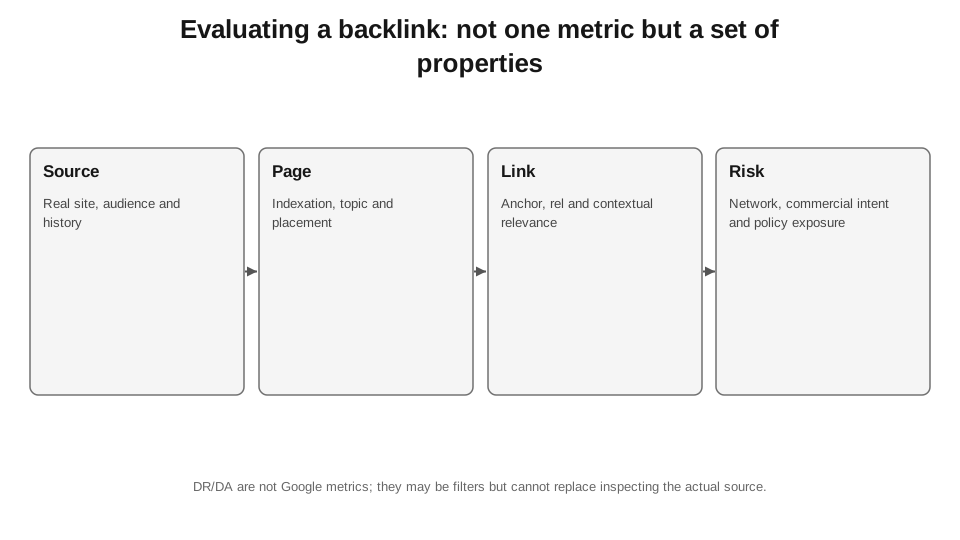
19.1. Evaluating a linking site starts with its real-world substance
Before looking at metrics, I check for an organic footprint, a sound history, real categories, authors, contact details/brand, inbound traffic signals, indexed pages and topical consistency. A “site” with 300 paid guest posts, no audience and random topics may have a high DR thanks to an old link graph, but that does not make the placement strong.
19.2. Page-level context matters more than the domain average
A link exists on a specific page. I look at indexability, traffic/query relevance, internal inlinks, outbound link density, placement, surrounding text and freshness. A link from a topically relevant article that has its own visibility and internal support differs from a link on an orphan post in a strong domain's “blog”.
| Layer | Verification |
|---|---|
| HTTP/index | 200, canonical self/expected, indexable |
| Visibility | queries/traffic or at least a reasonable search footprint |
| Context | the topic of the page and paragraph are genuinely related to the target |
| Placement | body editorial > random footer/sidebar |
| Outlinks | whether the page is a link farm |
| Persistence | whether the publication/archive is stable |
| Rel | sponsored/nofollow/ugc or a plain link |
19.3. Anchor text is not an optimisation target, but a distribution
I do not set a goal to “buy 30% exact-match anchors”. First, I look at the natural language around the entity/brand. For brand/review pages, brand, URL, partial-match, generic and compound anchors are normal. Exact-match commercial anchors can exist, but if the portfolio looks like an SEO link-buying template, that is an additional risk. Anchor distribution needs to be read alongside source types and the timeline.
19.4. Link velocity without a baseline is meaningless
100 new referring domains in a month may be an anomaly for a small local site and normal for a brand after a PR launch. I normalise the rate against the historical baseline, content/PR events, competitor growth and domain age. “Rapid growth” alone is not a documented penalty trigger.
19.5. Paid links: the mechanics may work, but policy risk remains
Google explicitly classifies buying/selling links for ranking purposes as link spam and recommends qualifying paid placements with rel="sponsored" or nofollow.[1][2] This does not prevent the paid-link market from existing. But a senior-level decision must account for probability × impact risk, not just the expected ranking upside.
19.6. PBNs and networks: the main risk is patterns and centralised fragility
A PBN gives control over anchors, placements and timing, but also creates common ownership / infrastructure / content / linking patterns and a single point of failure. I evaluate a network as a portfolio risk: footprint, replacement cost, deindexing history, outbound saturation, host diversity and ownership leakage. “There is no footprint” is not a fact but a hypothesis that cannot be proven from the outside.
19.7. Expired domains and redirects
An expired domain may have a useful history/link graph, but Google has a separate expired domain abuse policy: repurposing primarily to manipulate rankings with low-value content.[3] Redirecting an expired domain to an unrelated money site is not “free PageRank” but a risk strategy with an uncertain outcome. Before buying an expired domain, I check its topical history, anchors, snapshots, status continuity, spam, trademarks and whether legitimate user value can be created.
19.8. Link acquisition as a portfolio
I separate assets into: editorial PR, niche edits, guest posts, partnerships, directories/citations, UGC/community, paid placements, owned network. For each type - cost, expected lifetime, traffic/referral value, policy risk, anchor control. This creates a portfolio where one channel cannot destroy the entire link profile.
Sources for Chapter 19
1. Google Search Central. Spam policies - Link spam. https://developers.google.com/search/docs/essentials/spam-policies
2. Google Search Central. Qualify outbound links. https://developers.google.com/search/docs/crawling-indexing/qualify-outbound-links
3. Google Search Central. Spam policies - Expired domain abuse. https://developers.google.com/search/docs/essentials/spam-policies
4. Google Search Central. Link tagging and link spam update. https://developers.google.com/search/blog/2021/07/link-tagging-and-link-spam-update