What the original PageRank model offers, what it does not explain about modern Google, how to think about graph importance without “link juice”, and why internal and external links form one system with different boundaries of control.
Data and sources as of: September 14, 2026
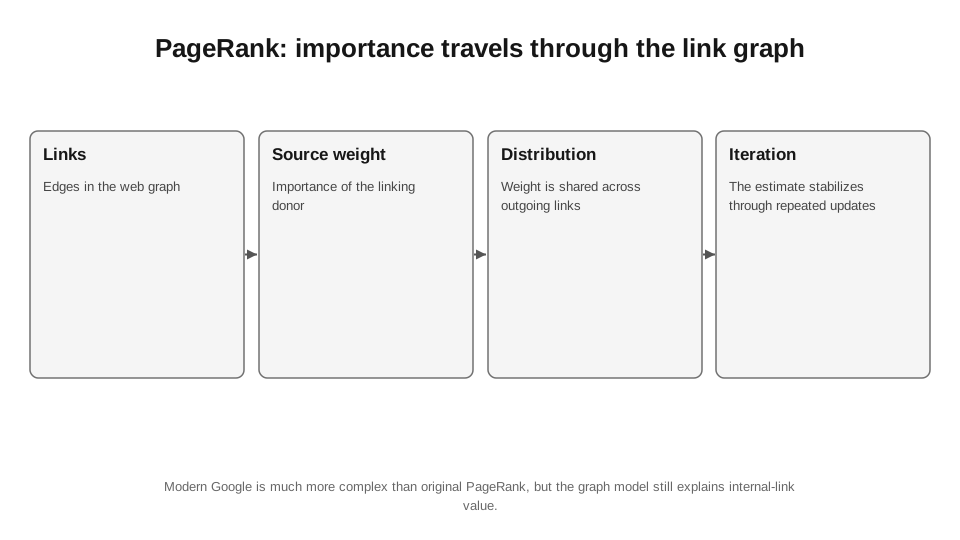
PageRank matters not because an SEO in 2026 can calculate a page’s “real PR”. They cannot. It matters as a model: the web is a directed graph in which links create a structure of recommendations and navigation paths, and importance depends recursively on the importance of the linking pages. The original paper by Page, Brin, Motwani and Winograd described precisely this kind of graph-based evaluation.[1] Modern ranking systems are far more complex, but Google still explicitly names links as one of its relevance signals.[2]
18.1. Link count does not equal PageRank
100 links from almost isolated pages are not necessarily stronger than one link from a page reached by many important paths. Recursion is precisely what distinguishes PageRank from simple indegree. In practice, this explains why sitewide junk links and meaningful editorial references should not be counted in the same column.
18.2. Random surfer - an intuition, not Google’s current formula
The original model is often explained through a random surfer: a user follows links and, with a certain probability, “teleports” to a random page. This provides a sound mathematical basis for understanding steady-state importance. But it is incorrect to claim that modern Google ranking literally uses the same formula with the same damping factor. Patent/paper ≠ current production weights.
18.3. Internal and external graphs - one logic, different levels of control
We can redesign the internal graph. We can only partially influence the external one through PR, product, outreach, partnerships and citations. This makes internal linking the most controllable way to change the topology around money pages. But an internal link does not create external authority from scratch; it redistributes what already exists in the site graph.
| Well explains | Does not prove |
|---|---|
| Why links shape graph importance | that DR/DA equals Google’s PageRank |
| Why the linking page’s importance matters | that any link from a “strong domain” is useful |
| Why internal links can redistribute weight | that a crawler can calculate Google PR precisely |
| Why orphan pages are structurally weak | that PageRank is the only or main ranking signal |
18.4. Third-party authority metrics - useful models if you remember what they are
DR, DA, Authority Score and Trust Flow are built on their own crawls, formulas and link indexes. These are not Google metrics. I use them as comparative features: filtering link prospects, tracking trends and identifying competitor gaps. But I never make a link acquisition decision based on a single score. The most important questions are whether the site is real, whether the page is indexed, whether it has a real audience, whether the context is relevant, and whether the link is editorially plausible.
18.5. Redirects and canonicals change the graph, but not through a magical “100% juice transfer”
Google documents permanent redirects as a strong canonical signal.[3] This provides a basis for proper migrations and consolidation. But Google does not publish an exact “PageRank transfer %”. So claims that “a 301 passes 90/95/100% of the weight” without a source are false precision. In practice, we evaluate the outcome: canonical selection, target indexing, rankings, crawling and backlinks.
18.6. Link decay and the graph over time
The external graph is not static. Pages disappear, redirect, become noindex or change their content; links drop out of templates. So it is not only acquired links that matter, but retained live links. For large projects, I look at lost referring pages, status distribution, redirect chains and whether the link remains in the rendered HTML.
18.7. Practical takeaway
A Senior SEO needs PageRank not as a religion of “juice”, but as a discipline for thinking about graphs. Strong pages should have paths to the documents the business considers important. External links should be evaluated in the context of the source page and the web graph. Everything else is a model with limitations, not access to Google’s internal score.
Sources for Chapter 18
1. Page, Brin, Motwani, Winograd. The PageRank Citation Ranking: Bringing Order to the Web. Stanford technical report. http://ilpubs.stanford.edu:8090/422/1/1999-66.pdf
2. Google Search Central. Link best practices. https://developers.google.com/search/docs/crawling-indexing/links-crawlable
3. Google Search Central. Redirects and Google Search. https://developers.google.com/search/docs/crawling-indexing/301-redirects
4. Brin, Page. The Anatomy of a Large-Scale Hypertextual Web Search Engine. https://infolab.stanford.edu/~backrub/google.html