How to design locale architecture, when separate URLs are needed, how canonical interacts with hreflang, why IP-based auto-redirects break crawling, and how to QA large international clusters without manually checking every page.
Data and sources as of: September 14, 2026
International SEO does not break because hreflang itself is complex. It breaks because the business model, URL architecture, canonicalisation, translations, geolocation and content operations make different decisions about what constitutes a separate page. hreflang does not resolve this contradiction - it only describes the relationship between existing locale URLs.
17.1. Multilingual and multi-regional - different tasks
Google distinguishes between a multilingual site - content in multiple languages - and a multi-regional site - content for different countries/regions.[1] es-ES and es-MX may share a language but differ in commercial contexts, currency, regulation and offers. en-US and fr-CA differ in both language and locale. Architecture should start with product/legal/business differences, not with how many subfolders SEO wants.
17.2. Separate URLs for language versions - a basic requirement
Google recommends different URLs for different language versions, rather than a single URL that changes content based on a cookie or browser language.[1] The reason is practical: the crawler needs a stable document address. Locale-adaptive content may not be fully discovered, since Googlebot often crawls from the US and without an Accept-Language header.
17.3. ccTLD, subdomain or subfolder - a trade-off, not a ranking hack
| Model | Pros | Cons |
|---|---|---|
| example.es | strong country cue, local brand | separate authority/operations, more expensive to scale |
| es.example.com | stack/team isolation | separate host, more complex analytics and deployment |
| example.com/es/ | shared domain and simpler link consolidation | requires disciplined locale routing |
| a single dynamic URL | fewer URLs | risk of incomplete crawling, complex caching/geolocation, poor transparency |
I choose the model based on operational reality: whether there are separate teams, products, regulations, link acquisition and infrastructure. SEO should not force a business to set up 20 ccTLDs if the company cannot maintain them properly.
17.4. hreflang requires reciprocity
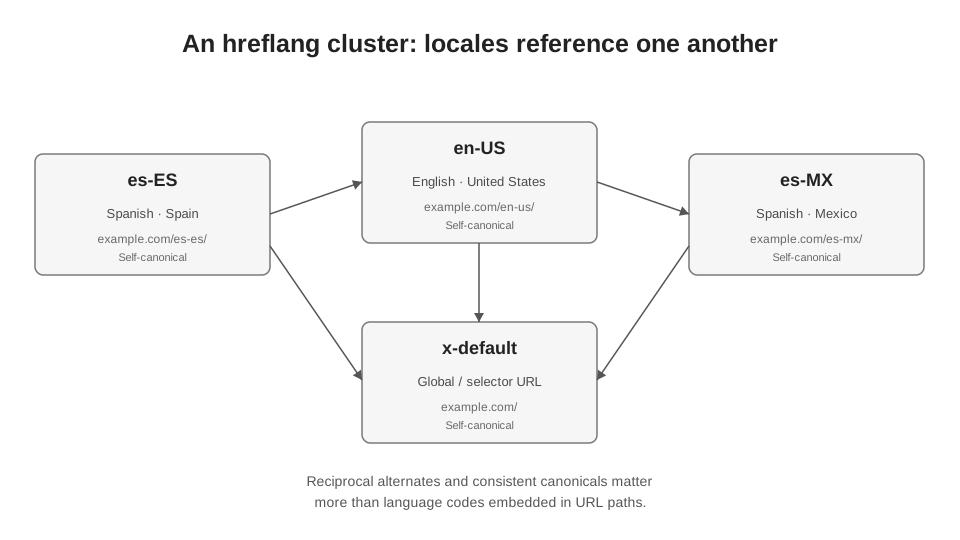
Localised versions must reference one another, and locale codes must be valid. For a large set of pages, sitemap hreflang is more convenient, but the logic is the same. x-default is useful for a global selector or fallback, but it is not an “English-language label”.[2]
17.5. Canonical and hreflang should describe different things
Canonical defines the representative in a duplicate cluster; hreflang defines locale alternatives. For es-ES and es-MX with similar Spanish content, I usually want a self-canonical on each locale URL plus reciprocal hreflang. Canonical es-MX → es-ES alongside hreflang es-MX sends a contradictory message: “this is a separate locale” and “this is not the primary version of the document”.[1][3]
17.6. Do not redirect crawlers based on IP or Accept-Language without a choice
Google explicitly advises avoiding automatic redirects between language versions, since this may prevent users and crawlers from seeing all versions.[1] A better model: a stable URL, a banner/selector suggesting a locale, and crawlable links between alternatives. Geo-personalisation can be implemented within a locale, but it should not hide the documents themselves.
17.7. Translating boilerplate does not create a separate language page
Google determines language from visible content, not the lang attribute or URL. If the menu/footer is translated but the main body remains in English, the system may not treat the page as fully localised.[1] This is especially important for UGC, marketplaces and programmatic pages, where the template is translated but the content that delivers value is not.
17.8. International keyword research is conducted separately for each locale
Translating a keyword list from ES to MX or US to UK misses local vocabulary, brands, regulation, payment methods and SERP composition. I use translation only as a seed. Then I use separate GSC properties/filters, local SERPs, native-language review and business data. Even the same English query may have a different commercial intent in different countries.
17.9. QA for a large hreflang graph
| Verification | Condition |
|---|---|
| HTTP | each hreflang target returns the expected 200 |
| Indexability | target is neither noindex nor blocked |
| Canonical | target is self-canonical or aligned with the locale strategy |
| Reciprocity | A links to B and B links to A |
| Locale code | valid language/region combination |
| Content | the language of the main content matches the locale |
| Sitemap parity | the expected locale inventory is complete |
17.10. What we know for certain
Google recommends separate URLs for language versions, supports hreflang in HTML/headers/sitemaps, advises against forced locale redirects and determines language from visible content. For similar same-language regional pages, it recommends combining canonical and hreflang.[1][2][3] Hreflang is not a ranking boost; its role is to help serve the correct locale variant.
Sources for Chapter 17
1. Google Search Central. Managing multi-regional and multilingual sites. https://developers.google.com/search/docs/specialty/international/managing-multi-regional-sites
2. Google Search Central. Tell Google about localised versions. https://developers.google.com/search/docs/specialty/international/localized-versions
3. Google Search Central. Canonicalisation. https://developers.google.com/search/docs/crawling-indexing/canonicalization
4. Google Search Central. International and multilingual topics. https://developers.google.com/search/docs/specialty/international