How to move from a 200-point audit to a causal model: URL space → crawl → render → canonical → index → serve → monitor. How to prioritise technical defects by impact, scale and cost to fix.
Data and sources as of: September 14, 2026
A checklist is useful as a memory aid, but dangerous as a model. It puts “missing favicon”, “canonical pointing to a 404” and “robots blocks product pages” side by side, even though their business impact differs by orders of magnitude. Technical SEO becomes effective when every defect is tied to a pipeline stage, an affected URL set and an observable outcome.
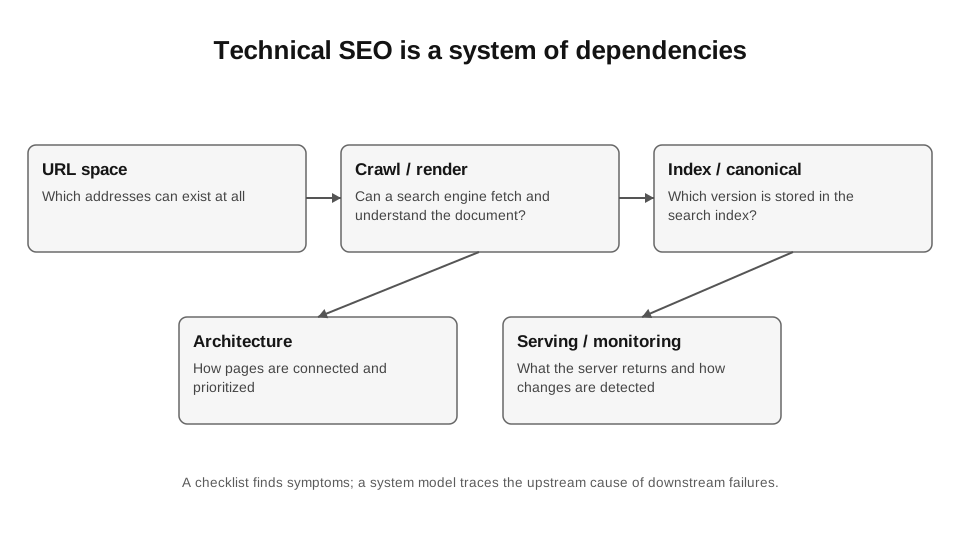
16.1. Upstream defects generate downstream noise
If a template generates a million parameterised URLs, downstream you will see overcrawling, canonical conflicts, index exclusions, noisy logs, GSC coverage clutter and rank dilution. Treating each symptom separately is pointless. I look for the earliest point where the system began creating unnecessary URL space.
16.2. Severity = impact × scale × confidence, not “Critical” from a crawler
An automated audit tool does not know a URL’s business value. A 404 on an old test path may be a non-issue; a 302 instead of a 301 during a domain migration may be a major one. I assess how many valuable URLs are affected; which Search mechanism is disrupted; how confident we are about causality; what the fix costs; and whether the rollout carries risk.
| Axis | 0-1 | 2-3 | 4-5 |
|---|---|---|---|
| Business impact | almost none | a moderately important segment | core revenue / visibility |
| Scale | individual URLs | thousands / one template | a large part of the site |
| Evidence | hypothesis | strong correlation / docs | direct technical evidence |
| Fix cost | expensive rebuild | moderate development effort | simple configuration / template fix |
I do not add these numbers up into a “scientific score”. They force the team to articulate its assumptions explicitly. Often, that alone moves a “Critical SEO issue” down to the 30th line of the roadmap.
16.3. Test the template, not the URL
On a site with 2M pages, almost every technical problem is a template problem. A sample of 20-50 URLs per template yields more than a random crawl of 500k URLs without classification. I always add page_type to crawl/GSC/log datasets. Then “canonical mismatch 7%” becomes “product variant template 63%”.
16.4. Release QA matters more than an annual “technical audit”
The best technical SEO system catches regressions on release day. For critical templates, I automate smoke tests: HTTP, robots, canonical, hreflang, structured data, main content selector, link count, title, sitemap inclusion. A quarterly audit is needed for systemic issues, but it should not be the only control.
16.5. Monitoring should be symptom-based
| Signal | What can break | Reaction threshold |
|---|---|---|
| Googlebot 5xx rate | infrastructure / deployment | deviation from baseline + affected valuable templates |
| Indexed coverage | noindex/canonical/content regression | abrupt change in a specific template |
| Crawl requests | robots/server/url explosion | deviation by host/page type |
| Sitemap valid URLs | generation pipeline | mismatch with expected inventory |
| Canonical mismatch | template / migration | increasing share of conflicting clusters |
| hreflang errors | international release | broken reciprocity / wrong locale mapping |
16.6. Technical debt has an opportunity cost
A fix that saves crawler resources but does not change discovery/indexing/serving of valuable pages may be a nice-to-have. By contrast, slow sitemap generation for a daily inventory of 100k may have a real opportunity cost. I always frame an issue in terms of the expected outcome: “eliminate 3 million unnecessary fetches/day and reduce discovery lag for new products”, not “remove parameters”.
16.7. Tools are sensors, not judges
Screaming Frog, Sitebulb, Ahrefs audit, Botify and Oncrawl see different representations and apply their own rules. I do not import their severity ratings into the roadmap. Crawler + GSC + logs + server + browser + business inventory data must be consolidated into one model. The most important question is whether the defect exists for Googlebot and whether it affects a valuable URL.
16.8. The technical audit deliverable
My deliverable is not a 150-page PDF. It is a table of systemic issues: mechanism, affected template, affected URL count, evidence, business risk, reproduction steps, recommended fix, owner, effort, validation query, rollback risk. An appendix with raw findings can be added. The development team must be able to reproduce the problem without an SEO translator.
16.9. What we know for certain
The search pipeline consists of discovery/crawl/render/index/serve; Search Essentials defines the minimum technical requirements; Google has separate documented controls for robots, status codes, canonical, hreflang, structured data, migrations. There is no official Google “technical health score”. Any 92/100 is a tool metric.
Sources for Chapter 16
1. Google Search Central. Crawling and indexing overview. https://developers.google.com/search/docs/crawling-indexing
2. Google Search Central. Search Essentials. https://developers.google.com/search/docs/essentials
3. Google Search Central. Latest documentation updates. https://developers.google.com/search/updates