How to build internal linking as a managed graph rather than an “add 5 links” checklist: crawlable hrefs, anchors, hubs, orphan pages, sitewide links, money page prioritisation and measuring changes.
Data and sources as of: September 14, 2026
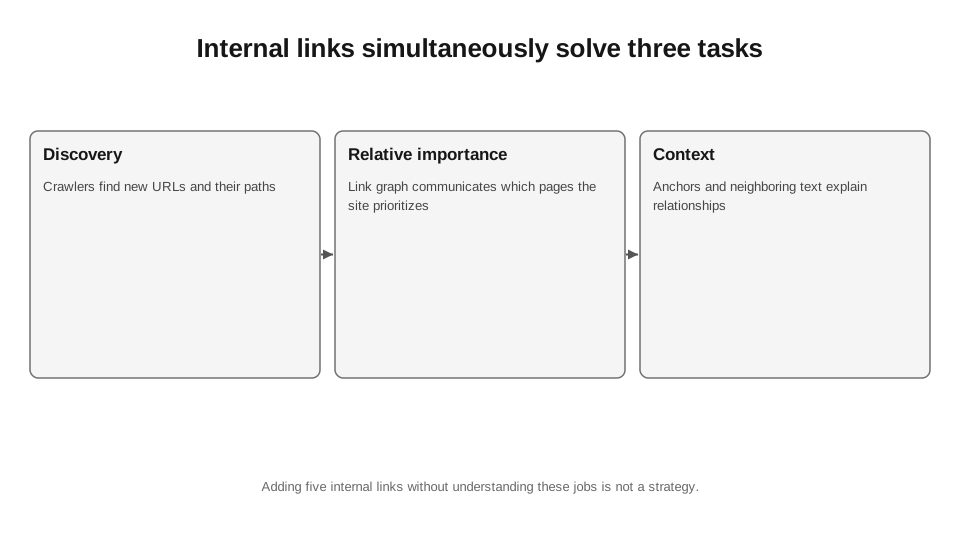
Internal links simultaneously support discovery, convey relative importance within your own graph and provide context for relationships between pages. If you reduce them to “insert a keyword into an anchor”, two thirds of the system disappear. Google explicitly states that it uses links as a signal of relevance and for discovery, and a crawlable link should generally be an <a href>.[1]
15.1. Start with the expected graph, not an automated plugin
I first define the rules: product → category, category → key products, guide → relevant commercial page, brand hub → review/bonus/app, comparison → individual entities, article → deeper explainer. Automation can then look for missing edges. If you start with “link every keyword mention”, the site will quickly turn into a web of noise.
15.2. A crawlable link - a technical requirement, not a design decision
A button with onclick, a div with a router event or a plain-text URL is not guaranteed to be a link for a crawler. Google documents the standard <a href> as a reliable format.[1] On SPAs, I check the DOM after rendering, but I do not want critical navigation to depend on a non-standard JS handler.
15.3. Anchor text should describe the destination
A good anchor reduces ambiguity: “Locowin bonus terms” is better than “read more” if that is what the destination covers. But exact-match anchors are not needed everywhere. I aim for natural variation that fits the context. An anchor is a semantic hint and a UX element, not a field for stuffing.
15.4. Sitewide links have a different role from contextual links
| Type | Strength | Risk |
|---|---|---|
| Main navigation | consistent discovery of important hubs | limited slots, sitewide noise |
| Breadcrumbs | hierarchy and a path back | do not create lateral topical connections |
| Contextual | precise semantic relationship | can be over-optimised with templated anchors |
| Related modules | scalable cross-linking | the algorithm may link to irrelevant pages |
| Footer | utility/global access | should not be turned into a keyword directory |
15.5. Internal PageRank - a model, not a visible Google metric
The classic PageRank model demonstrates an important property: the link graph redistributes weight between nodes. The internal graph is part of this web graph. But SEO professionals cannot see Google's internal PageRank. So a crawler's own “internal PR” is a model based on certain assumptions. I use it comparatively: which pages are excessively central, which are almost cut off, and how the distribution changes after a new menu is introduced.
15.6. Link sculpting through nofollow - a poor substitute for architecture
If a page is not worth crawling or assigning internal importance to, it is better to reconsider the link/URL itself rather than apply nofollow en masse to “preserve PageRank”. Nofollow is a hint for qualifying links and has legitimate use cases for untrusted/sponsored external links, but it is not a modern, universal tool for sculpting the internal graph.
15.7. How I find opportunities
I join GSC pages with the crawl graph. The most interesting groups are: position 5-20 + high business value + few contextual inlinks; pages with clicks but no hub links; pages that cannibalise the same cluster and are linked to in the same way; new pages with no inbound links from authoritative hubs. Then I check whether the link is useful to the user. If not - I do not add it just for the metric.
15.8. Measurement after internal linking changes
| Level | Metric | Expectations |
|---|---|---|
| Crawl | Googlebot requests / discovery latency | important URLs are discovered and refreshed faster |
| Graph | inlinks, depth, modeled internal PR | support for target pages increases without creating chaos |
| Search | impressions, ranking distribution, indexed coverage | the effect is assessed by segment, not by a single URL |
| UX | click-through between pages | users actually use the new navigation paths |
| Business | assisted conversions | links help users move towards a decision, not just the crawler |
15.9. Scalable automation
For a large site, I generate candidate links based on entities/topics, but I do not publish them without rules. Filters: do not link to the same URL; no more than N links per block; target must be indexable, return 200 and be canonical; relevance threshold; target diversity; cap sitewide repetition. AI is good at generating candidates and anchors, but QA must check the destination and context.
15.10. What we know for certain
Google uses links for discovery and relevance; crawlable <a href> links are the recommended format; every important URL must be linked to from at least one page; ecommerce guidance explicitly connects internal links with relative importance.[1][2] We cannot see the exact amount of PageRank passed by a specific internal link.
Sources for Chapter 15
1. Google Search Central. Link best practices. https://developers.google.com/search/docs/crawling-indexing/links-crawlable
2. Google Search Central. Ecommerce site structure. https://developers.google.com/search/docs/specialty/ecommerce/help-google-understand-your-ecommerce-site-structure
3. Google Search Essentials. https://developers.google.com/search/docs/essentials