How to build material that is not just another rehash of the top-10: evidence, information gain, first-party data, freshness, consolidation, templates and content operations in a world of cheap AI text.
Data and sources as of: September 14, 2026
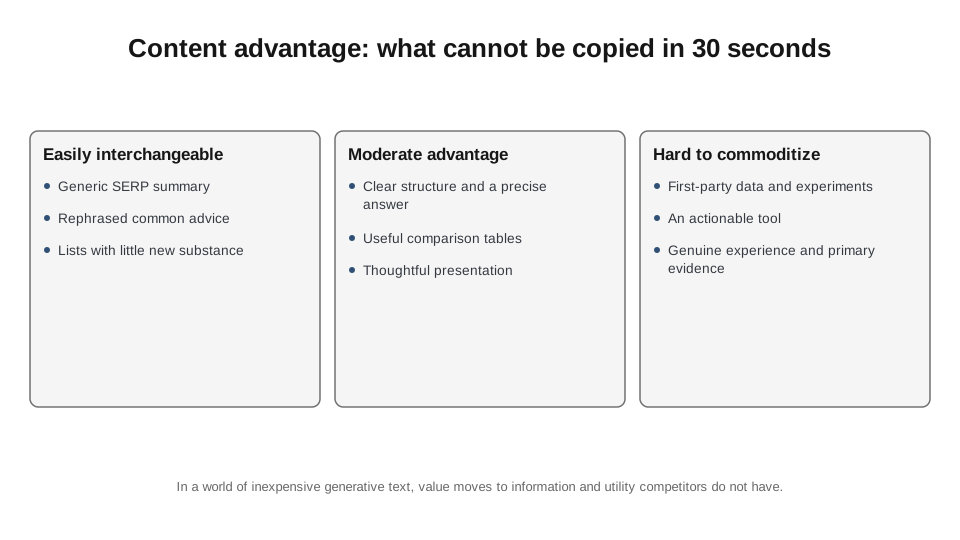
LLMs have made not “content” cheap, but the production of grammatically sound text. That is a big difference. Rewriting 10 results, compiling a list of tips and adding an introduction can now be done at almost no marginal cost. Consequently, this very type of output is ceasing to be a competitive advantage. In its new AI optimisation guide, Google specifically emphasises valuable, unique, non-commodity content.[1]
14.1. Original information - not a decorative “expert comment”
Google’s helpful content guide explicitly suggests checking whether material provides original information, reporting, research or analysis.[2] For me, this is a practical test: if a competitor can copy all the value of a page without access to our data, processes, experts or product, the moat is weak. Not every page needs to be a study, but the most important pages should contain something beyond a retelling of publicly available information.
14.2. Five sources of information gain
| Source | Example | Why it’s hard to replicate |
|---|---|---|
| First-party data | your own sample of GSC, sales, product and customer behaviour data | data unavailable to a competitor |
| Original experiment | SEO test, benchmark, controlled comparison | requires time, methodology and repetition |
| Operational experience | a real migration, recovery or geo-targeting launch | knowledge of failure modes not covered in the documentation |
| Tool / dataset | calculator, database, API, template | utility exists beyond the text |
| Primary-source synthesis | precise comparison of documentation, laws and specs | costly fact-checking and maintenance to keep information current |
14.3. “More words” is not information gain
A 5,000-word page may be less useful than an 800-word table if the rest is repetition. I assess coverage through questions/tasks, not word count. If a user wants to compare three products, the most valuable elements may be a decision table, a test methodology and a conclusion that states its limitations.
14.4. A content brief must define the evidence
I add an “Evidence required” field to the brief. For a review, this may include product screenshots, actual terms, payments, a withdrawal test and a support response. For a technical guide - code tested on a sample, source documentation, before/after. For research - sample, period, inclusion criteria, calculation. This instils discipline in the team better than a list of “LSI keywords”.
14.5. AI content: evaluating the production process and output
Google’s spam policies explicitly state that scaled content abuse is defined by primary purpose and low value, regardless of whether the content is created by AI, a human or automation.[3] Therefore, “AI content penalty” is inaccurate as a blanket claim. The risk lies in mass-producing interchangeable pages, factual errors, outdated facts and a lack of added value.
14.6. Freshness - a new date is not an automatic advantage
I distinguish between factual freshness and cosmetic freshness. If a bonus, price, law, API, product spec or supported feature has changed, the document needs updating. If the topic is foundational, an “Updated today” date without changes adds no information. For a large content inventory, it is useful to have a freshness SLA by type of fact rather than for the page as a whole.
14.7. Content decay needs to be diagnosed by component
A page’s decline may be due to a demand shift, SERP composition, competitor improvement, an outdated section, broken links, a changed product or a site-wide issue. So “update the article” is not a diagnosis. I compare the query mix, sections, competitors, links, conversion and freshness-sensitive facts. Sometimes the best solution is not to add anything, but to remove 40% of the outdated material.
14.8. Consolidation is more effective than endlessly updating weak URLs
When 4 articles address the same intent, have low traffic and repeat one another, I tend to consolidate them into one strong document, transfer unique fragments, implement redirects and update internal links. This is not a universal rule: if the intents differ, merging will do harm. The decision should be based on the SERP and the task model.
14.9. A content system must include pre-publication QA
| Layer | Verification |
|---|---|
| Facts | does every time-sensitive claim have a source and a date |
| Entities | correct brands, models, countries, currencies, units |
| Intent | does the page complete the primary task without further searching |
| Evidence | what does this page offer that is absent from commodity SERP content |
| Internal links | is the page integrated into the graph, with logical next steps |
| Conversion | does the CTA match the intent rather than get in the way of the answer |
| Updateability | which fields need checking after 30/90/180 days |
14.10. What we know for certain
Google recommends helpful, reliable, people-first content and explicitly asks about original information/research/analysis; the 2026 AI guide emphasises valuable, unique, non-commodity content; scaled content abuse depends on purpose and value, not on whether AI was used.[1][2][3] There is no confirmed Google metric called an “information gain score” that an SEO can measure with an external service.
Sources for Chapter 14
1. Google Search Central. Optimising for generative AI features. https://developers.google.com/search/docs/fundamentals/ai-optimization-guide
2. Google Search Central. Creating helpful, reliable, people-first content. https://developers.google.com/search/docs/fundamentals/creating-helpful-content
3. Google Search Central. Spam policies - scaled content abuse. https://developers.google.com/search/docs/essentials/spam-policies