Why intent cannot be reduced to “informational/commercial”, an entity is not a list of NLP terms, and topical authority is not measured by article count. A practical model for SERPs, content and architecture.
Data and sources as of: September 14, 2026
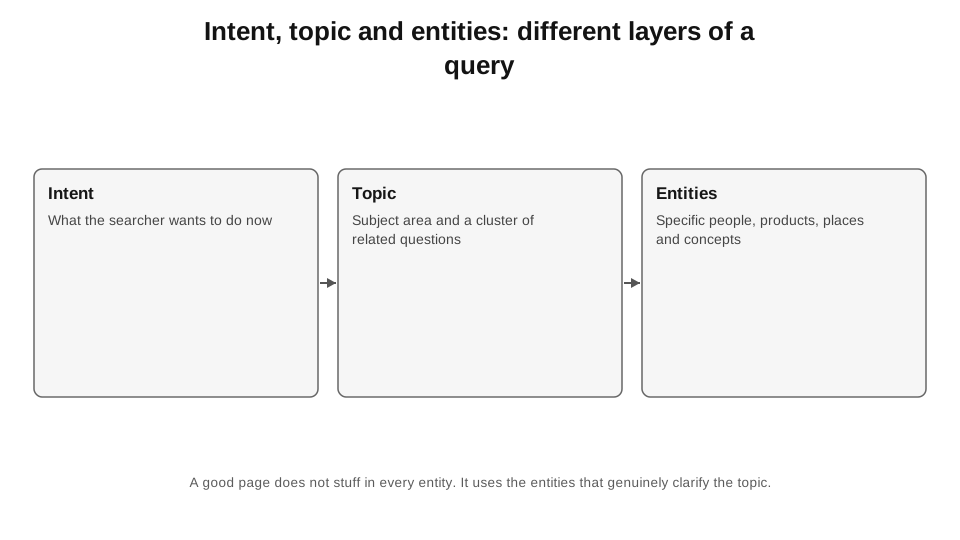
Three concepts - intent, topic and entity - are often lumped together as “semantics”. As a result, SEO ends up with lists of entities to “insert”, an intent classification with four colours, and a content hub with 80 articles because “we need to cover the topic”. I separate them. Intent is the action or outcome the user wants. Topic is the subject area. Entity is a specific object that can be unambiguously distinguished from other objects.
13.1. Intent is not a label, but a set of expectations for the answer
“Commercial investigation” tells an editor nothing unless the expectations are broken down. For “best online casino Spain”, the user may expect a list of operators, safety criteria, bonuses, payments, legal context and a quick route to the site. For “casino X review”, the expectations are different: a specific brand, trust, withdrawals, KYC, bonus terms, app and support. Both are commercial, but the content object is different.
13.2. The SERP is the best external indicator of intent interpretation, but not the absolute truth
I record dominant page types, repeated subtopics, brands/entities, features and what is missing. But I do not copy the SERP into a brief. The current SERP may be weak, mixed or shaped by a shortage of good documents. A Senior SEO’s task is to understand the pattern and check where there is an opportunity to provide a better answer.
13.3. Entities are needed for accuracy, not “density”
If a page is about the iPhone 18 Pro, it makes sense to name Apple, the model, chipset, camera system, iOS, storage variants and relevant predecessors accurately. But “entity optimisation” does not mean inserting 40 related names. Google’s structured data documentation describes entity-like markup as explicit clues about a page’s meaning, but does not promise a ranking boost based on the number of entities.[1]
13.4. Topic coverage does not equal URL count
If 200 articles can be written about a topic, that does not mean the business should have 200 URLs. I assess coverage by task: are there answers for primary commercial tasks, support questions, comparison, trust, troubleshooting and post-purchase needs? If 20 pages provide full coverage, the additional 180 may simply be scaled sameness.
| Layer | Question | SEO-solutions |
|---|---|---|
| Intent | What outcome does the user need? | page type, structure, CTA, level of detail |
| Topic | What is the subject and scope of the content? | cluster, supporting content, coverage |
| Entities | Which specific objects and concepts are being discussed? | factual accuracy, structured data, disambiguation, internal links |
13.5. A multi-intent SERP requires a decision, not automatic splitting
If a SERP contains product pages, guides and videos, there are several strategies. Create separate pages for the intents; build one strong mixed page; or focus on the intent with the highest business value. I look at segment stability and conversion. If Google has maintained two types of results for years, this may be genuine multi-intent behaviour rather than “cannibalisation”.
13.6. Query fan-out makes task modelling more important
In AI Search, Google explicitly describes query fan-out: the model runs related queries for subtopics.[2] The practical takeaway is not “let’s create a page for every fan-out query”. Quite the opposite: we need documents that answer logical subtasks well and contain enough specifics to be retrieved as sources. This is another argument for thinking in tasks rather than exact-match phrases.
13.7. Entity consistency for a brand
For a brand, I aim for consistent basic facts across first-party sources: name, legal entity/brand relationship, URL, logo, contact details, location and product naming. Organization structured data can give Google explicit clues about an organisation and be used in knowledge panels and attribution surfaces.[3] But markup will not fix the chaos if different pages have different names and contact details.
13.8. A practical semantic brief template
| Block | What should be |
|---|---|
| Primary task | one sentence: what the user wants to accomplish |
| Secondary tasks | what needs to be checked/understood before making a decision |
| Entities | specific objects and terms required for accuracy |
| Evidence | what data, sources, screenshots, tools or tests will provide an advantage |
| Out of scope | what we deliberately leave out so the page does not become an encyclopedia |
| Internal graph | where the user comes from and where they will logically go next |
13.9. What we know for certain
Google uses systems to understand meaning and relevance, structured data can provide explicit clues about content, and generative Search uses query fan-out. What is not publicly known: a universal “entity score”, a required number of entities or a formula for topical authority. I therefore use these terms as working models, not official Google metrics.
Sources for Chapter 13
1. Google Search Central. Introduction to structured data. https://developers.google.com/search/docs/appearance/structured-data/intro-structured-data
2. Google Search Central. Optimising for generative AI features. https://developers.google.com/search/docs/fundamentals/ai-optimization-guide
3. Google Search Central. Organization structured data. https://developers.google.com/search/blog/2023/11/introducing-organization-markup
4. Google Search Central. Ranking systems guide. https://developers.google.com/search/docs/appearance/ranking-systems-guide