How to stop collecting 100,000 keywords “just in case”, separate wording from the task, combine GSC, SERPs, third-party volume and business data, and decide which queries deserve dedicated pages.
Data and sources as of: September 14, 2026
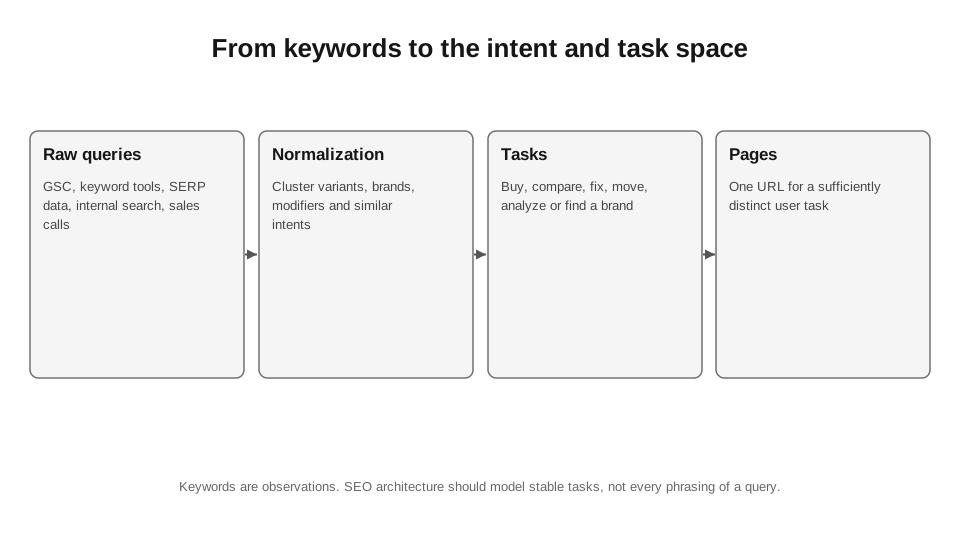
Keyword research done poorly is a tool export, a KD < 10 filter and word-based clustering. Done well, it is a demand model. A keyword is only one way to express a task. One need generates dozens of formulations, while one phrase can carry several search intents. The output of research is therefore not a CSV with volume, but a map of query space → task → page type → business value → evidence.
12.1. Demand sources have different systematic biases
| Source | Strength | Blind zone |
|---|---|---|
| GSC | actual impressions/clicks for your site | does not show demand where the site had no visibility; some queries are anonymised |
| Keyword tools | broad discovery and third-party volume/keywords | estimates, proprietary databases and models; not a census of actual queries |
| SERP | shows the actual composition of results and search intent | snapshot; depends on locale/time/personalisation |
| Internal search | the language of existing users and navigation problems | only your audience |
| Sales/support | actual buyer objections and wording | small and uneven sample |
| Google Trends | relative trends and seasonality | does not provide absolute search volume |
Search Essentials explicitly recommends using the words people use to search for your content in prominent places on the page.[1] But this does not mean “create a URL for every phrase”. Modern systems understand relevance without an exact match for every variation, and Google specifically warns against creating pages for every fan-out query solely to manipulate Search.[2]
12.2. Normalisation starts with modifiers
For a commercial cluster, I break queries down into a base entity and modifiers: brand, product class, location, price, bonus, promo, app, review, comparison, safety, payment method, withdrawal, registration, alternative, problem. This reveals which dimensions are systematic and which are incidental. If “brand + review”, “brand + bonus” and “brand + app” have different SERPs and different tasks, they are candidates for separate page types. If the SERPs are almost identical and the user expects one comprehensive page, multiplying URLs will create cannibalisation.
12.3. Clustering by SERP overlap is useful, but it is not the truth
SERP-overlap clustering answers a practical question: does Google currently tend to show the same URLs for two queries? But it depends on country, device, date and SERP volatility. I use overlap as evidence, not as the sole rule. For a high-value cluster, I check manually: is the task the same, is the page type the same, and is there a separate conversion path?
12.4. Volume without click opportunity overvalues informational head terms
With AI Overviews and numerous SERP features, 10,000 monthly searches do not equal 10,000 potential organic visits. I add SERP click opportunity to the keyword model: ads, local, shopping, featured snippet, AI, video, brand dominance. This is not a precise CTR forecast, but a common-sense adjustment. For an affiliate query with a volume of 700 and strong commercial intent, the actual value may be higher than for an informational query with 20,000 searches that is answered within the SERP.
12.5. Business value is a separate axis, not a CPC column
CPC is useful as a third-party market signal, but it does not replace your own economics. I assess conversion probability, revenue per conversion, approval rate, LTV or affiliate EPC, depending on the model. I then prioritise clusters, not keywords. A simple expected value calculation: search opportunity × expected CTR band × conversion rate × value per conversion. Each factor should have a range, not a falsely precise number.
12.6. New sites and existing sites need different research
On a new project, I build an external map of demand: competitors, tools, SERPs, forums, product taxonomy. On an existing site, the priority shifts to first-party data: GSC queries/pages, internal search, landing page conversions, lost impressions, pages in positions 5-20, clusters with a large gap between impressions and clicks. An existing site already has its own “demand sensor”; ignoring it in favour of someone else’s volume data is a mistake.
12.7. Page decision: when a query deserves its own URL
| Question | Yes - argument for a separate URL | No - argument for consolidation |
|---|---|---|
| Is there a distinct user task? | A distinct decision / workflow / intent | Just different wording |
| Is the SERP substantially different? | A different type of results or different competitors | The same URLs and format |
| Is there distinct data/content? | The page has its own informational value | The template simply swaps the keyword |
| Is there business value? | A distinct conversion path or important visibility | No distinct outcome |
| Can the page be properly integrated? | There is a place for it in the IA, with internal links | The URL will be an orphan created for the sake of the long tail |
12.8. “KD 0” does not mean “easy”
Third-party KD is a model specific to a particular service. It may underestimate a brand SERP, a regulated vertical, a fresh query or a SERP with strong domains and few links. I never use KD as a gate. For low-KD queries, I look at why the SERP is the way it is: are these genuinely weak pages, or does the tool simply not measure the factor that determines competition?
12.9. The research deliverable
My final dataset includes cluster_id, primary task, query examples, locale, page type, current URL, proposed URL, demand range, SERP features, top competitors, business value, evidence available, content gap, internal hub, priority and status. This is already a foundation for architecture, content operations and measurement. A “keyword-volume-KD” CSV is not an SEO strategy in itself.
Sources for Chapter 12
1. Google Search Central. Search Essentials. https://developers.google.com/search/docs/essentials
2. Google Search Central. Optimising for generative AI features. https://developers.google.com/search/docs/fundamentals/ai-optimization-guide
3. Google Search Console. Performance data filtering and limits. https://developers.google.com/search/blog/2022/10/performance-data-deep-dive