Why menus and URL folders do not equal architecture, how to model relationships between money pages and supporting content, how to measure depth and orphan pages, and why every important URL must have a clear path through the graph.
Data and sources as of: September 14, 2026
Information architecture is often drawn as a tree: Home → Category → Subcategory → Product. This is a useful presentation diagram, but technically a site is a graph. A page may receive links from the menu, breadcrumbs, a topical guide, a comparison page, the footer and a related products block. Google explicitly explains that it analyses relationships between pages and may use the number of steps to a page and the number of internal links as signals of relative importance.[1]
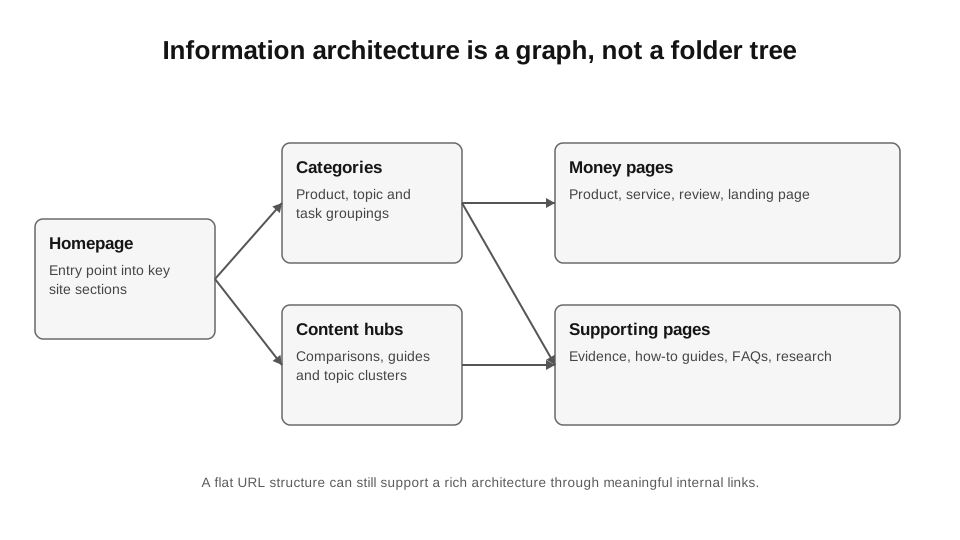
Author’s diagram based on Google Search Central’s ecommerce site structure and link best practices.
11.1. Architecture starts not with URLs, but with a set of tasks
I start by listing the document types the business actually needs: category, product/service, comparison, review, how-to, research, legal/support and locale variants. Then I define how users move between them. URL structure is the implementation, not the primary model. Google specifically notes that it does not rely on URL structure as the main way to determine an ecommerce site’s structure; instead, it analyses links between pages.[1]
11.2. Every important URL must have at least one proper internal path
In its link best practices, Google explicitly recommends that every important URL receive a link from at least one other page on the site.[2] For me, this is the minimum, not the optimum. A money page that can only be found in a sitemap technically exists, but is barely integrated into the architecture. On a large site, I count not only orphan pages but also the number of independent paths to an important template.
| Metric | What it measures | How to read |
|---|---|---|
| Click depth | the minimum number of clicks from selected entry points | Compare within page types rather than looking for a magic maximum. |
| Internal inlinks | how many crawlable links point to a URL | A high count does not guarantee ranking, but indicates priority within your own graph. |
| Unique source templates | which page types the links come from | One sitewide footer link ≠ several contextual paths. |
| Orphan rate | the proportion of required URLs without internal inlinks | Calculate against the expected indexable inventory, not all URLs in the crawl. |
| Hub coverage | the proportion of money pages linked to a logical hub | Helps identify content that exists but lacks topical context. |
11.3. Depth has no universal threshold
The advice that “everything should be within three clicks” is convenient, but not universal. For a site with 500 URLs, this may be natural; for a catalogue with 5 million SKUs - not so. I look at the distribution: what the median depth is for money pages, which URLs make up the long tail, whether deep pages coincide with poor crawling/indexing performance, and whether the depth stems from business logic or broken navigation.
11.4. Hubs are not “SEO category pages”, but graph compression points
A hub is needed when it shortens the path between related documents and gives users a clear overview of the space. A good hub can be a category, a comparison landing page, a thematic guide or a brand page. A bad hub is a page created solely to interlink 100 articles without a task of its own. If a page does not help with navigation or decision-making, it adds URL space, not architecture.
11.5. Faceted navigation - architecture multiplied by combinatorics
Filters can create useful landing pages for stable demand, but each additional dimension multiplies the URL space. Google calls faceted navigation the most common source of overcrawling problems and recommends either blocking unnecessary combinations or managing those that should be crawled with strict discipline.[3] The “index/noindex” decision should therefore be based on an inventory of demand and business value, not on the fact that the CMS can generate a URL.
11.6. Architecture for affiliate sites: money pages should not be isolated islands
In affiliate projects, a common extreme is to direct 90% of internal link equity to review/bonus pages, while supporting content exists only to capture long-tail traffic. I build bidirectional connections: informational → commercial to move users towards a decision, commercial → explanatory to provide evidence and address objections, brand hub → specific products/offers, comparative pages → individual reviews. This helps users while also making the graph semantically coherent.
11.7. A practical architecture audit
I take crawl data with inlinks/outlinks, a sitemap inventory, GSC clicks/impressions and business value. For each indexable URL, I add type, parent concept, click depth, internal inlinks, unique linking templates, traffic, conversions and status. Then I look for four classes: important URLs without graph support; disproportionately strong utility pages; duplicate hubs; deep URL classes with weak crawl/index coverage. This turns “improve internal linking” into a concrete work queue.
11.8. What we know for certain
Google uses links for discovery and as a relevance signal; its crawler readily extracts standard <a href> links; Google analyses page relationships and relative importance; for ecommerce, it recommends navigation paths of category → subcategory → products; every important URL should have a link from another page.[1][2] Google does not publish the exact internal weight of each internal link.
Sources for Chapter 11
1. Google Search Central. Help Google understand your ecommerce site structure. https://developers.google.com/search/docs/specialty/ecommerce/help-google-understand-your-ecommerce-site-structure
2. Google Search Central. Link best practices. https://developers.google.com/search/docs/crawling-indexing/links-crawlable
3. Google Search Central. Faceted navigation guidance. https://developers.google.com/search/blog/2024/12/crawling-december-faceted-nav
4. Google Search Central. URL structure best practices. https://developers.google.com/search/docs/crawling-indexing/url-structure