Why indexing only makes a document a candidate rather than giving it a position; how to separate relevance, ranking, SERP features, locale and personal context; and why position is the outcome of a query, not a permanent attribute of a URL.
Data and sources as of: September 14, 2026
After indexing comes the part of Search that SEO most often compresses into the word “ranking”. In practice, effective diagnosis benefits from distinguishing at least three decisions: which documents to retrieve from the index as candidates, how to order those candidates and what exactly to show the user in a particular interface. Google describes ranking systems as automated systems that analyse many factors and signals across a vast index to find relevant and useful results.[1]
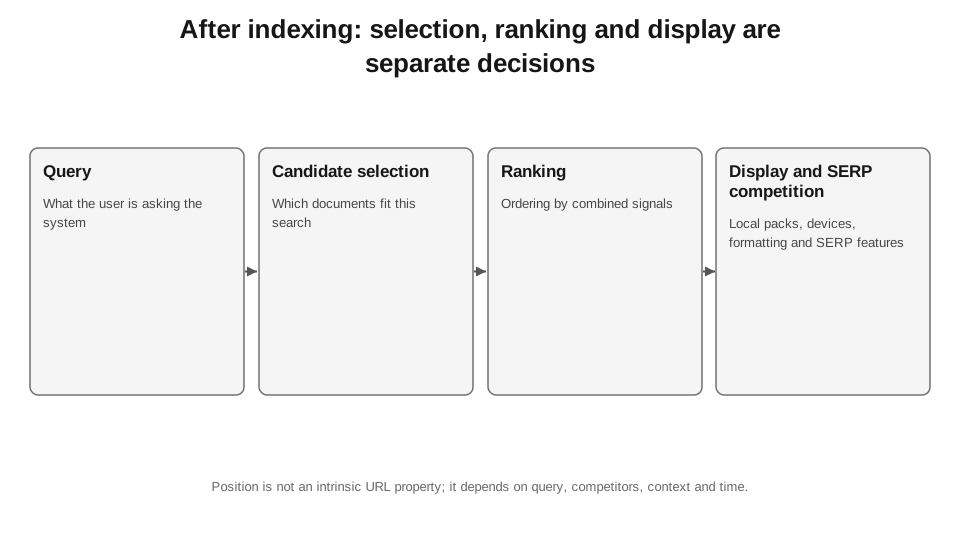
Author’s diagram based on the Google Search ranking systems guide and How Search Works.
10.1. Position is not stored inside a page
The phrase “this page ranks in position 3” is convenient but imprecise. It has a position for a specific query, country, device, search surface, time and set of competitors. Query interpretation changes - the candidate set changes. A local pack, shopping block or AI Overview appears - the geometry of the SERP changes. The country changes - the intent and set of sources change. A rank tracker therefore provides an observation, not a document’s internal score.
10.2. Retrieval before ranking: first you have to enter the candidate set
If a document is not retrieved for a particular information need, it is too early to talk about “improving its position”. This layer is less visible from the outside in classic search, but for AI Search, Google already explicitly describes RAG and query fan-out: systems run related searches, retrieve relevant pages from the index and then use them as sources.[2] The mechanics of generative Search have made an old problem more obvious: ranking and retrieval are not the same thing.
10.3. “Ranking factor” is too crude a unit of analysis
Google writes about many factors and signals, but that is not a licence to turn every correlation into a “ranking factor”. Page speed, links, freshness, language, location, meaning of query, content relevance - different systems may matter for different classes of queries. A Senior SEO’s practical work is not about finding the global weight of signal X. It is about identifying which class of problems constrains a particular set of pages in a particular SERP.
| Level | Question | Example of an error in analysis |
|---|---|---|
| Eligibility | Can the document be shown at all? | noindex/robots/manual action are interpreted as “rankings dropped”. |
| Retrieval | Does the document enter the candidate set for the intent? | Another 500 words are written, even though the page addresses a different task. |
| Ranking | How is the document evaluated relative to other candidates? | DR replaces analysis of the SERP itself. |
| Serving | What should be shown in a particular country, on a particular device and in a particular format? | A single desktop rank tracker is presented as representing all of Search. |
| Presentation | What does the result look like, and what CTR does it receive? | Position is stable, but CTR falls because of a new SERP feature. |
10.4. Query interpretation: a “keyword” does not equal intent
The same phrase can represent several possible tasks. Google may interpret “jaguar” as a car, an animal or a brand depending on the context; in a commercial SERP, “best X” may mean a review, a list, a category or a marketplace. That is why I do not start optimisation with TF-IDF or “let’s add an exact match”. First, I document the composition of the SERP: page types, dominant intents, features, brands, freshness, local relevance, commercial focus and whether that composition is stable over time.
10.5. Page-level and site-wide signals
In its ranking systems guide, Google explicitly clarifies that its systems operate primarily at the page level, but also use site-wide signals and classifiers. This is an important antidote to two extremes: “Google ranks the domain; the page does not matter” and “every URL is completely independent”. In practice, I analyse both levels: the individual document and the properties of its class/site, but I do not assign third-party metrics such as DR the role of Google’s internal site score.[1]
10.6. Relevance without sufficient quality does not guarantee top positions; neither does quality without relevance
A page may be “very high-quality” by editorial standards yet address the wrong intent. Conversely, an exact-match page may be relevant in its wording but fail to give the user enough information, evidence or functionality. In practical competitive analysis, I break the gap down along two axes: semantic/task fit and evidence/value. This leads to better decisions than “the competitor has 2400 words; we have 1800”.
10.7. SERP features change visibility without changing rank
The classic position metric does not measure screen real estate. Position 1 below an AI Overview, two ads, a shopping carousel and a local pack has different economics from position 1 in a simple results page. That is precisely why we separated visibility from click yield in earlier chapters. At this stage, it is important to add another principle: the serving system determines not only the order of blue links but also the form of the answer.
10.8. Locale, language and device are part of serving, not “noise”
In international SEO, I never combine rankings from different countries into a single average. Google documents separate mechanisms for localisation and hreflang, and mobile/desktop results may differ. An average position of 4.8 may comprise position 2 in Spain and position 18 in Mexico. For the business, these are two different tasks, not one “position 4.8”.
10.9. How I compare competitors in the SERP
| Axis | What I capture | Why |
|---|---|---|
| Page type | category, review, tool, product, forum, publisher | Do not compete with a different format without a reason. |
| Task | buy, compare, verify, learn, find a brand | Identify dominant and secondary intents. |
| Evidence | data, sources, screenshots, original tests, experts | Find information gain, not text volume. |
| Authority context | links, brand, mentions, topical graph | Understand the competitive landscape without a magic DR threshold. |
| SERP features | AI, snippets, video, local, shopping, PAA | Assess the actual click opportunity. |
| Stability | which domains/page types hold their positions for 4-8 weeks | Separate a structural pattern from a chance snapshot. |
10.10. Correlation studies: useful for hypotheses, dangerous as a recipe
If top-3 pages have more links, faster Core Web Vitals or longer text on average, this does not show that the difference in that metric caused the ranking. Ranking samples are, by definition, confounded by brand, site type, intent, URL age and dozens of other variables. I use such studies to generate hypotheses, then validate decisions with my own data, controlled changes or at least segmentation.
10.11. Diagnostic model: eligibility → retrieval → ranking → serving → click
This sequence saves hours. If a page is excluded by noindex - we do not analyse anchors. If it is indexed but appears nowhere, even for a narrow task-fit query - we check retrieval/relevance. If it consistently holds position 8-12 for the right intent - we examine the competitive gap. If it is in position 2 but clicks are falling - we examine SERP composition and CTR. A single figure, “organic traffic -30%”, does not contain a diagnosis.
10.12. What we know for certain
Google uses automated ranking systems with many signals; page-level and site-wide signals coexist; Search Essentials does not guarantee serving even for a technically valid page; retrieval and query fan-out in generative features are publicly described; search results are dynamic and depend on the query and context.[1][2][3]
What we do not know: the full rank score formula, signal weights, the exact candidate set and all the conditions under which a particular system is activated. The professional model, therefore, is not to “learn 200 ranking factors”, but to distinguish observable system states and test hypotheses against your own data.
Sources for Chapter 10
1. Google Search Central. A guide to Google Search ranking systems. https://developers.google.com/search/docs/appearance/ranking-systems-guide
2. Google Search Central. Optimising for generative AI features on Google Search. https://developers.google.com/search/docs/fundamentals/ai-optimization-guide
3. Google Search Central. Search Essentials. https://developers.google.com/search/docs/essentials
4. Google Search Central. In-depth guide to how Google Search works. https://developers.google.com/search/docs/fundamentals/how-search-works