Why the same information need produces different sources in Google, ChatGPT, Perplexity and Copilot, and how to measure this correctly in SEO
Product and documentation status: September 12, 2026
In 2026, it is no longer enough to say that a page is “visible in AI.” Visible where, exactly? In an AI Overview in Google's standard results? In AI Mode? In ChatGPT Search? In Perplexity? In Copilot? This is not a cosmetic distinction. The same query can lead these systems to a similar conclusion, but through different subqueries, different sets of documents and different rules for displaying sources.
My working model is simple: there is no single, universal set of “AI results.” There are several interfaces for accessing information. They partly rely on search indexes, ranking, retrieval and generative models, but they do not have to interpret a query in the same way or cite the same URLs. That is precisely why optimisation “for AI in general,” without specifying the platform, almost always turns into a collection of generic advice.
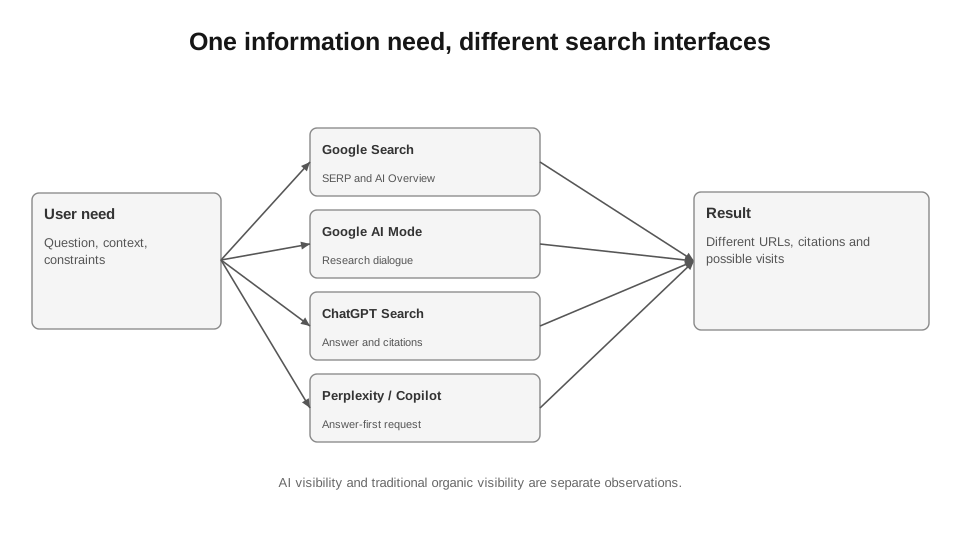
Author's diagram. It describes the differences between interfaces, not the internal architecture of a specific platform.
2.1. AI Overview and AI Mode can no longer be treated as two sizes of the same block
At the product level, Google itself distinguishes between these modes. AI Overview appears within the standard results page when Google's systems consider a generative answer a useful addition to classic search. AI Mode is designed for more complex queries, comparisons, topic exploration and follow-up questions. Both formats can use query fan-out, but Google explicitly notes that they may operate on different models and techniques, so the answer and the set of links may differ.[1]
In January 2026, Google brought these interfaces even closer together: users gained the ability to ask follow-up questions directly from an AI Overview and continue in a conversation. At I/O 2026, Google was already describing this as a seamless transition from a results page with an AI Overview to a conversation in AI Mode, with context preserved.[2] For users, the boundary between the “SERP” and “chat” is becoming less noticeable. For SEO, by contrast, that boundary is critical, because different formats may display different URLs.
As of Google's August 31, 2026 update, AI Overviews has more than 2.5 billion monthly active users, while AI Mode has exceeded 1 billion monthly active users.[3] These are neither shares of all search queries nor click metrics. They are product audience metrics. But they are enough to stop treating generative search as a laboratory experiment that can be left outside the core SEO strategy.
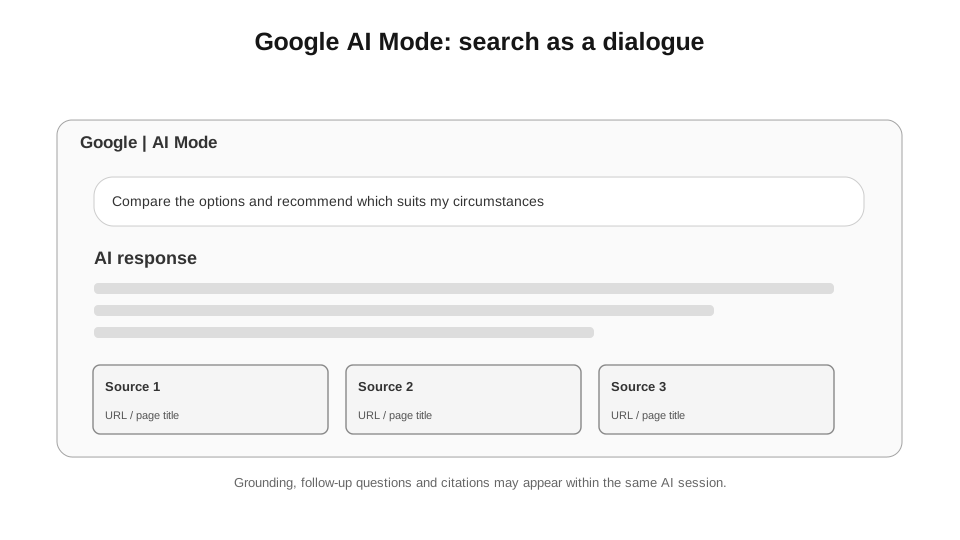
Schematic reconstruction based on Google's official description. Original material: https://blog.google/products-and-platforms/products/search/ai-mode-development/
| Identification | AI Overview | AI Mode |
|---|---|---|
| Entry point | Standard Google Search page | Separate AI mode / continuation from AI Overview |
| When useful | Brief summary for a more complex query | Research, comparisons, multi-step questions |
| Follow-up questions | Yes, with a transition into a conversation | Yes, this is a core part of the interface |
| Query fan-out | May be used | May be used |
| Source set | Does not have to match AI Mode | Does not have to match AI Overview |
| Basic SEO eligibility | The URL must be indexed and eligible to appear with a snippet | The same basic Google Search requirements |
DATA
Google explicitly states that AI Overview and AI Mode may use different models and techniques. This matters more than any SEO term: if the source set differs at the product level, a single “position in AI” cannot be a valid universal metric.
2.2. Data: similar answers do not mean similar sources
The best way to see the difference between AI Overview and AI Mode is not to argue about the interface, but to look at source overlap. In a study published in December 2025, Ahrefs compared 540,000 pairs of answers for citation analysis and 730,000 pairs for text analysis. The data was collected in the US in September 2025.[9]
The result clearly shows why the model that “AI Mode simply expands AI Overview” is weak. The semantic similarity of the answers was high: around 86%. In other words, the systems often reached similar substantive conclusions. But the overlap in cited URLs was only 13.7%, and the overlap in unique words was around 16%.[9] In other words, the conclusion may be similar, while the path to it may be entirely different.
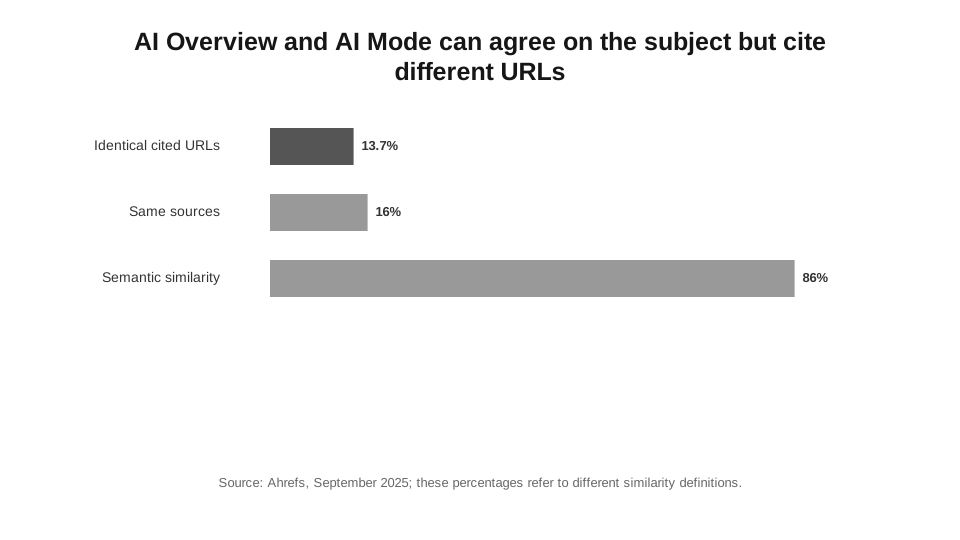
Data: Ahrefs, https://ahrefs.com/blog/ai-overviews-vs-ai-mode/ Sample: 540,000 pairs for URL analysis and 730,000 pairs for answer analysis, US, September 2025.
In the same study, AI Mode produced answers approximately four times longer on average and contained 2.5 times as many person and brand entities. If a brand was already mentioned in AI Overview, the probability of its appearing in AI Mode in this sample was 61%. Meanwhile, 11% of AI Overviews and 3% of AI Mode answers contained no cited sources.[9] These figures should not be carried over into 2026 as constants: the models and interfaces have already changed. Their value lies elsewhere: they demonstrate the divergence between the systems across a large sample.
For practical SEO, this means that even within Google, at least two tasks need to be treated separately: presence in AI Overview and presence in AI Mode. If a site is frequently cited in one format, that is not yet proof that the other format sees it in the same way. Conversely, absence from AI Overview does not automatically mean absence from AI Mode.
2.3. ChatGPT Search: the search query is formed after the user’s question
In ChatGPT, the entry-point logic is different. The user does not necessarily decide that they are now “going to search”. ChatGPT may launch a web search automatically when an answer requires up-to-date information, or the user may select search manually.[4] This changes not only the interface, but also what SEO considers a query.
OpenAI explicitly describes the rewriting mechanism: the initial question may be transformed into one or more targeted search queries. After reviewing the first results, the system may send additional, more specific queries.[4] In other words, the phrase the user typed does not necessarily match the phrase the system used to search for your document.
This is an important reason why directly comparing the initial query, Google’s top 10 results and ChatGPT’s sources often reveals little overlap. If ChatGPT has broken the need down into several other search formulations, comparing its sources only with the SERP for the initial phrase is methodologically insufficient.
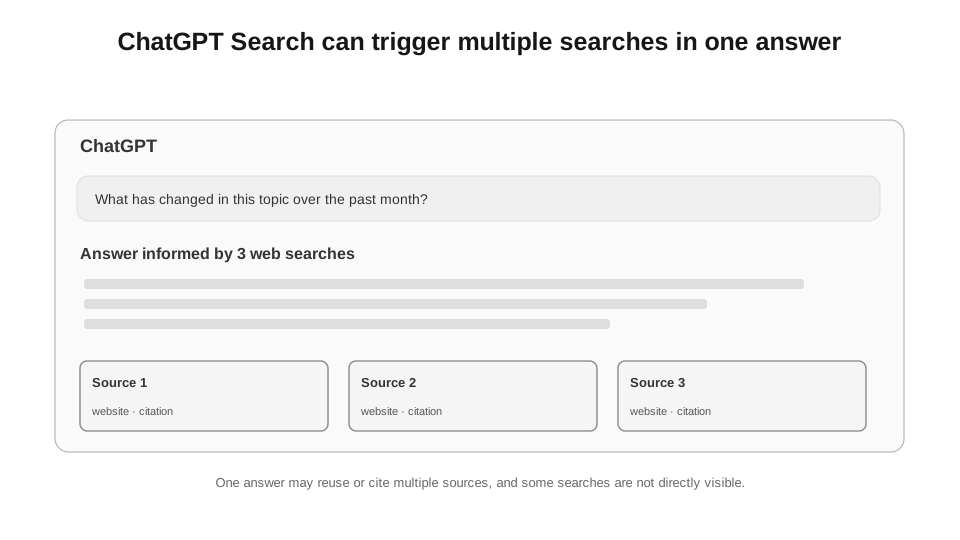
Schematic representation based on OpenAI’s official help documentation: https://help.openai.com/en/articles/9237897
For site owners, OpenAI explicitly separates search discovery from model training. To allow content to appear in ChatGPT Search summaries and snippets, OAI-SearchBot must not be blocked. GPTBot is a different crawler used to control the potential use of content in training.[5] This is a fundamental technical distinction: prohibiting training should not automatically become a prohibition on search discovery if the business wants to receive referral traffic and citations from ChatGPT.
OpenAI also states that referrals from ChatGPT Search automatically include utm_source=chatgpt.com.[5] This is one of the few areas of AI search where the referral source can be identified without a model or a third-party service: ChatGPT traffic can actually be separated out in analytics. But this measures only referrals. A brand may be mentioned or cited without a click, and GA4 will not show that.
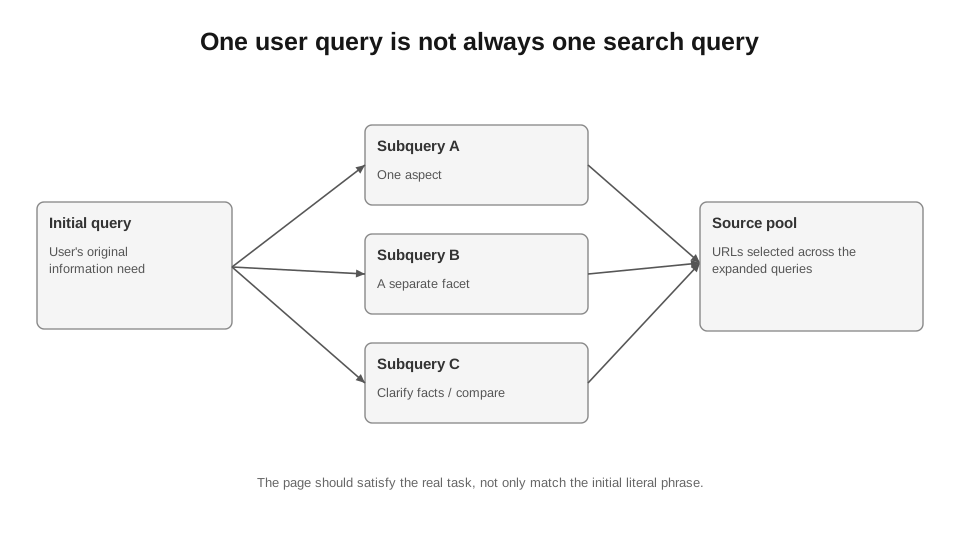
Author’s diagram. Basis: Google Search Central describes query fan-out; OpenAI Help Center describes rewriting a question into one or more targeted queries.[1][4]
2.4. Perplexity and Copilot: the answer comes before the list of links
From the outset, Perplexity has positioned itself as a search engine with a generative answer. Its official help documentation describes the process quite simply: interpreting the question, searching the internet in real time, summarising the information found and linking to sources.[6] What matters for SEO is not the marketing language but the fact that a page competes not only for a place in a results list, but for inclusion in the set of sources used to construct the answer.
In July 2026, Perplexity separately updated its crawling documentation. PerplexityBot is used to index pages and surface sites in Perplexity results. A separate agent, Perplexity-User, is used for user-initiated requests. In its documentation, Perplexity states that PerplexityBot respects robots.txt; different logic applies to the bot that executes a user's request.[7] This is another example of why “allow all AI bots” or “block all AI bots” is a poor technical approach.
Microsoft presents yet another picture. Since February 2026, Bing Webmaster Tools has shown AI Performance for Microsoft Copilot, Bing generative summaries and selected partner integrations. The report includes total citations, the average number of cited pages, URL-level citations, trends and a sample of grounding queries—the search phrases through which AI retrieved content used in the answer.[8] This is particularly valuable because Bing exposes part of the intermediate layer between the query and the citation.
| Platform/Format | How the result is generated | What SEOs see directly | What not to assume |
|---|---|---|---|
| Google AI Overview | A generative answer within Search; may use query fan-out | Impressions in Google reports; visible sources in the answer itself | That a top-3 organic result will automatically become the third source or higher |
| Google AI Mode | A conversational answer with search sources and follow-up questions | Links in the answer; generative visibility in Google | That the sources match those in AI Overview |
| ChatGPT Search | May rewrite a question into several search queries and search automatically | Citations / Sources, visits with utm_source=chatgpt.com | That the user's original text is the actual search query |
| Perplexity | Web search + generative summary + sources | Cited sources; bot logs | That its retrieval logic matches Google's |
| Microsoft Copilot / Bing AI | Search-based generative answers and grounding | Bing AI Performance: citations, cited pages, grounding queries | That citation count equals ranking position or authority |
2.5. Organic ranking and AI citation overlap, but they are not the same thing
The claim that “ranking in the top 10 is enough to get cited by AI” sounds attractive because it carries the old SEO model into a new interface. The data does not support this simplification. In March 2026, Ahrefs updated its AI Overview study covering 863,000 SERPs and approximately 4 million URLs shown in AI Overview. Under the updated methodology, 38% of pages cited in AI Overview also ranked in the top 10 organic results for the same query.[10]
That is substantial overlap, but not equivalence. If 38% of cited pages are in the top 10, most cited URLs under this particular methodology were outside the top 10 or in other result blocks. More importantly, the previous version of the Ahrefs study from 2025 estimated a significantly higher overlap. Ahrefs itself attributed the update to changes in parsing and methodology.[10] For me, this is a useful lesson not about the exact figure, but about discipline in working with research: AI Search is changing so quickly that even a familiar percentage needs to be stored alongside its date, sample and calculation method.
A separate Ahrefs study of 15,000 queries across ChatGPT, Gemini, Copilot and Perplexity showed an even weaker relationship with Google's top 10. On average, only around 12% of URLs cited by ChatGPT, Gemini and Copilot appeared in Google's top 10 for the original query; Perplexity was closer to classic search results: almost a third of cited URLs matched Google's top 10.[11] This is not a direct comparison with the AI Overview study: a different product, a different sample, a different method. But the direction is the same: the citation layer is not a copy of the organic ranking layer.
MYTH
Myth: “If a page ranks in Google's top 3, it will automatically become a source for an AI answer.” Fact: strong organic rankings may increase the chance of being among the candidates, especially in Google AI Search, but public data does not support a 1:1 rule. Being cited depends on a separate source selection process after query interpretation and fan-out.
2.6. Source instability: one screenshot proves nothing
Classic rank tracking has accustomed SEO practitioners to a relatively stable unit of observation: query, position, date, country, device. A generative answer adds another layer of randomness. In November 2025, Ahrefs analysed more than 43,000 queries, each with at least 16 recorded AI Overviews over a month. Between consecutive observations, the answer text changed in approximately 70% of cases, and the average lifespan of a given answer state was 2.15 days.[12]
Citations are even more revealing: when an AI Overview updated, an average of 45.5% of the cited URLs changed. Meanwhile, the substance remained considerably more stable: the average semantic similarity between consecutive answers was 0.95 out of 1.[12] This is almost the same pattern we saw when comparing AI Overview with AI Mode: the answer may remain close in meaning while the sources rotate.
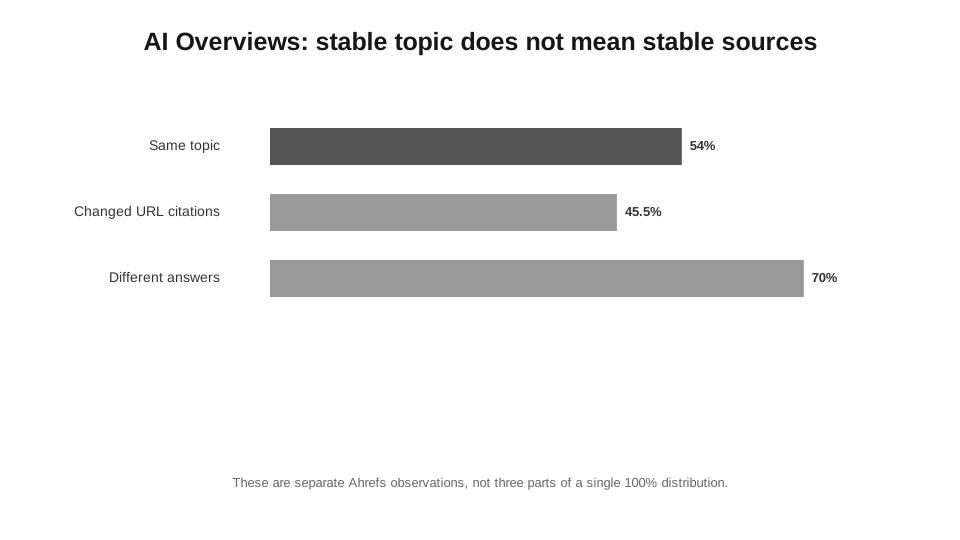
Data: Ahrefs, more than 43,000 queries, at least 16 observations per query over a month. https://ahrefs.com/blog/ai-overview-change/
This invalidates a practice I see in many “GEO audits”: someone enters ten queries once, takes screenshots and calculates a visibility share. That figure may be useful as a snapshot, but it cannot be presented as a stable share of visibility. If almost half the cited URLs can change between consecutive answers, repeated measurements and aggregation are necessary.
2.6.1. The unit of measurement I use
For AI visibility, I store more than just the query and answer. The minimum unit of observation must include the exact query text, platform, country, language, date, session type, presence of prior context, list of cited URLs, brands mentioned and whether or not a click-through occurred. If the platform personalises the answer, that must also be recorded.
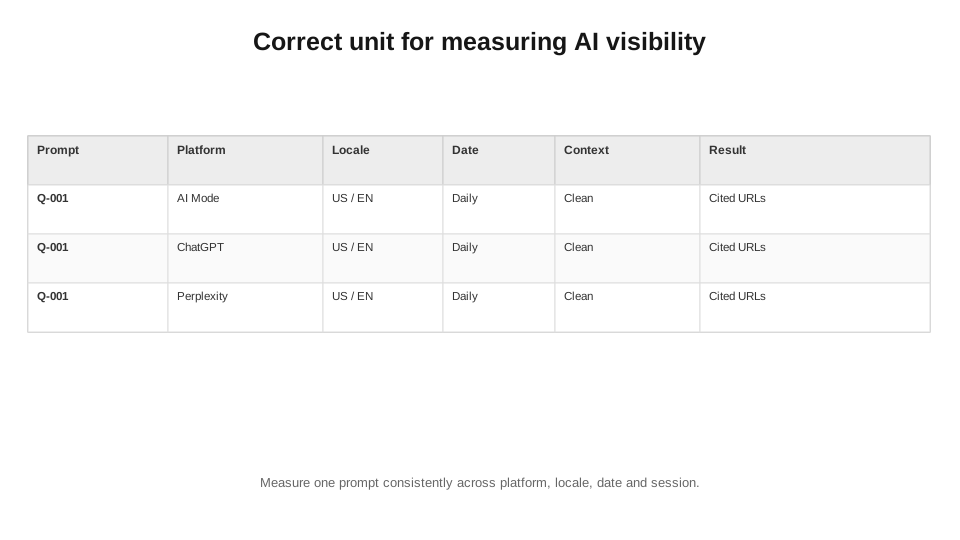
Author’s diagram. The values in the rows illustrate the record structure, not actual test results.
My working standard for research that will influence a budget or content plan: I do not consider one run sufficient. If collection costs allow, I run several repeats on different days and analyse the frequency of appearance, not just whether an appearance occurred. This is not a “Google rule”, but a methodological response to the high volatility of generative results.
2.7. Why the user’s query can no longer be confused with the system’s search query
In classic SEO, we are used to building keyword sets from what users type into the search box. In a generative environment, an additional layer emerges between the user’s phrase and document retrieval. Google calls this mechanism query fan-out: the system may perform several related searches across subtopics and data sources.[1] OpenAI describes functionally similar behaviour: ChatGPT Search rewrites a question into one or more targeted queries and may run additional refinements after the initial results.[4]
This does not mean that keyword collection and analysis have become unnecessary. On the contrary, we need keywords to understand real demand, search volume, SERPs, competition and the user’s language. But the keyword ceases to be the only unit for which the system retrieves a document. For a complex question, we need to think in terms of a space of subtasks: which facts need to be found, which criteria compared, which constraints checked and which entities connected.
A practical example. The query “which laptop should I get for frequent flights, under 1,200 dollars, to work with large spreadsheets without carrying a charger all day” may require separate checks of weight, battery life, price, processor performance, memory capacity, availability of a specific model and real-world battery tests. The page does not have to contain the entire long query verbatim. It must provide a strong answer to one or more information subtasks that actually arise in such a scenario.
2.8. Access control: search bots, training bots and user-request bots are not the same thing
The technical side of AI search often starts with robots.txt, and it is very easy to make a serious mistake here. Different platforms have different crawlers for different tasks. OpenAI separates OAI-SearchBot, which is needed for search discovery and for content to appear in ChatGPT Search, from GPTBot, which is used to control the potential use of content for training.[5] Perplexity separates PerplexityBot, used to build its search index, from Perplexity-User, used for user-initiated requests.[7]
Google also separates search from other uses of content. For AI Overviews and AI Mode, Googlebot remains the core mechanism for controlling crawling. If an owner wants to limit the text that may appear in search, Google recommends standard snippet controls: nosnippet, data-nosnippet, max-snippet or noindex. Google-Extended applies to certain other Google AI systems; it is not a separate indexing switch for AI Overview or AI Mode.[1]
| System | Robot / control | What it controls | Practical error |
|---|---|---|---|
| Google Search AI | Googlebot + snippet controls in Search | Crawling, indexing and snippet length in Search | Blocking Search out of fear of model training |
| ChatGPT Search | OAI-SearchBot | Content discovery for ChatGPT Search results and summaries | Confusing OAI-SearchBot with GPTBot |
| OpenAI model training | GPTBot | Potential use of web content for training | Assuming it is required to appear in Search |
| Perplexity | PerplexityBot | Indexing for Perplexity results | Blocking the crawler and then demanding consistent citations |
| Perplexity user request | Perplexity-User | Requesting a page in response to a user action | Treating it as a regular search bot |
WARNING
Blanket blocking of all bots with “AI” in their User-Agent may also cut off search visibility that the business actually wants to preserve. Before implementing any WAF rule, three questions must be answered: who is crawling, for what function, and what exactly the business wants to allow or block.
2.9. What we can actually optimise, and what we do not control
After all this, it is easy to swing to the opposite extreme: if sources are unstable and systems differ, it may seem that nothing can be optimised. That is also wrong. We do not control the specific list of URLs in an answer, but we do control a large share of the input conditions that determine whether a page can be a candidate at all.
For Google, the fundamentals remain the same: a page must be accessible to Googlebot, indexed, eligible to appear with a snippet, connected through internal links, contain important information in text form and comply with Google’s search policies.[1] For ChatGPT, we must not block OAI-SearchBot if we want to appear in summaries and citations.[5] For Perplexity, we must allow PerplexityBot if visibility in the service is a business objective.[7]
What follows is not “secret GEO optimisation”, but competition over the usefulness of a specific document. Clear facts, proprietary data, primary sources, clear tables, freshness, unambiguous entity names, actual product specifications, prices, terms, dates and research methodology—all of these give the system information it can accurately extract and use. This does not guarantee citation. But it creates a much stronger candidate document than generic text that adds nothing to the existing corpus of web documents.
| Layer | What we control | What we don’t control |
|---|---|---|
| Access | robots.txt, WAF, status codes, internal links | Recrawl frequency for a specific platform |
| Index / discovery | canonicalisation, noindex, URL quality and stability | Guaranteed inclusion in a third-party system’s index |
| Content | facts, structure, proprietary data, updates, entities | The exact subquery the system will generate |
| Source selection | document relevance to an informational subtask | The specific weighting of signals and the order of citations |
| Display | snippet controls where the platform supports them | The generative answer format and interface |
| Business outcome | landing page, offer, analytics, conversion | Whether the user will click after receiving an answer without clicking through |
2.10. How I build a cross-platform test without fooling myself
If the task is to understand where a brand or site actually appears in generative search, I do not start with a random list of queries invented by an SEO specialist. I start with the real demand landscape: GSC, internal site search, sales data, support requests, People Also Ask, forums, commercial modifiers and questions that actually arise before conversion. I then use this to build a benchmark set of user tasks.
The second principle is not to mix intents. An informational question such as “how does X work”, a comparison such as “X versus Y”, a recommendation such as “which should I choose”, a local task such as “where to find”, a transactional task such as “buy/book” and a navigational task such as “the brand’s official website” must be analysed separately. Otherwise, the average citation share will simply blend entirely different system behaviours.
The third principle is a consistent environment. For each run, I record the language, country, login status, whether the conversation is fresh or ongoing, and the date. For platforms with personalisation, a separate “clean” profile is advisable. If a system uses conversation history, the first and fourth turns cannot be compared as the same query.
The fourth principle is to capture more than whether the brand is mentioned. I record separately: whether the brand appears in the text; whether a brand URL appears among the sources; which exact URL; how many sources the answer contains in total; whether a competitor appears; whether the link is clickable; what type of page is cited; whether it is a homepage, category, article, video, forum, profile or third-party mention.
The fifth principle is repetition. Because sources are unstable, a single answer has little evidential value. For large query sets, I would rather reduce the number of platforms or the collection frequency than keep a single unrepeated observation for each and call it a stable share of visibility.
| Field in the dataset | Why is it needed |
|---|---|
| query_id / task_id | A stable task identifier, independent of the prompt text |
| exact_query | The exact text entered by the user or test |
| intent / funnel stage | To avoid mixing informational and commercial scenarios |
| platform / surface | AI Overview, AI Mode, ChatGPT, Perplexity, Copilot, etc. |
| country / language | Locale and language can change the sources |
| session_state | Clean session, logged-in profile, follow-up query |
| captured_at | Answers and citations change over time |
| brand_mentioned | Whether the brand appears in the text |
| cited_urls | Specific URLs, not just domains |
| competitor_mentions | Comparative visibility |
| answer_hash / snapshot | Makes it possible to see whether the answer itself has changed |
| referral_clicks | Only where traffic can actually be attributed |
2.11. How to read metrics without creating another DR
AI search is already spawning dozens of proprietary metrics: visibility score, citation share, answer share, mention share, source share and query coverage. The problem is not the metrics themselves. The problem begins when a derived metric from a third-party service is treated as a direct platform signal. This is the same mistake SEO has made for years with DR or DA.
Any proprietary AI metric must start with a clear denominator. “A citation share of 22%” means nothing without answering: 22% of what? Of all answers? Of answers that contained any sources at all? Of all cited URLs? Of the three most prominent citations? For a single run or averaged across repeated runs? Which query set? Which country? Which platform?
To manage a team, I use a few simple metrics. Coverage: in how many benchmark tasks the brand or site appeared at least once during the period. Citation frequency: in how many observations a particular domain or URL was cited. Source concentration: what share of all citations is accounted for by a few pages. Competitor gap: in which task groups a competitor consistently appears while we do not. Instability: how often the mix of sources changes between repeated observations. These are not Google or OpenAI standards. They are practical ratios for internal analytics.
2.12. A 90-minute practical audit: do different AI search systems see you the same way?
This audit does not replace ongoing tracking. Its purpose is to establish, in an hour and a half, whether a problem exists at all and where to look for it.
| Time | What we do | What we record |
|---|---|---|
| 0-15 min | Take 10-15 real tasks from GSC, sales and support; group them by intent | query_id, intent, country, language |
| 15-35 min | Check Google AI Overview / AI Mode where they are available | whether there is an AI answer, a brand, a cited URL, a competitor |
| 35-55 min | Run the same tasks in ChatGPT Search and Perplexity | exact list of cited URLs and page types |
| 55-70 min | Compare source URLs across platforms | domain overlap, URL overlap, competing pages |
| 70-80 min | Check bot access and logs | Googlebot, OAI-SearchBot, PerplexityBot, WAF blocking |
| 80-90 min | Formulate 3-5 hypotheses that can be tested with data | technical issue, content gap, weak source page, lack of entity corroboration |
If the results show that a site ranks well in Google but barely appears in ChatGPT and Perplexity, I do not start by rewriting all the content “for LLMs”. First, I check whether the relevant crawlers can access the required pages at all. Then I look at which types of documents competitors cite: primary sources, reviews, categories, directories, forums, videos. Only then do I formulate a content hypothesis.
If the reverse is true—the site is frequently cited in AI answers but receives almost no clicks—the problem may not be SEO. The answer itself may satisfy the information need without a click. In that case, we need to assess whether it makes sense to shift content towards tasks where the user still needs the site: a calculator, a personalised offer, an up-to-date database, a tool, booking, checkout, a detailed comparison, original research. This is precisely where visibility turns back into action.
2.13. What we know for certain and what remains a hypothesis
We know for certain from official documentation that Google AI Overview and AI Mode can use query fan-out and can show different answers and sources.[1] We know that to appear as a source link in Google AI Search, a page must be indexed and eligible to appear in regular results with a snippet.[1] We know that ChatGPT Search can rewrite a question into one or more search queries and add follow-up searches.[4] We know that OAI-SearchBot and GPTBot have different functions.[5] We know that Perplexity has a separate search bot and a bot for user requests.[7] We know that Bing already shows citations and grounding queries in Webmaster Tools.[8]
We do not know from public sources the exact weights of URL selection signals in Google AI Mode, ChatGPT Search, Perplexity or Copilot. We do not know of a universal “citation factor”. We do not know a formula that converts an organic ranking into a probability of citation. We cannot determine a stable share of visibility from a single screenshot. And we have no grounds for calling any specific paragraph length, number of lists or schema.org markup a universal way to “get into an LLM”.
That is precisely why a strong strategy in 2026 looks less magical than the marketing around GEO. Document accessibility, clear architecture, a strong source page, accurate facts, proprietary data, stable entities, freshness, external corroboration, repeated measurement. The new interface adds new selection points and new metrics, but does not remove the need to be the best available source for a specific information task.
NOTE FROM PRACTICE
If, after an AI audit, you cannot identify a specific competitor URL, a specific query, a specific platform, the observation date and the reason why that document is stronger as a source, the audit does not yet provide an actionable task for the team. “Improve GEO” - that is not a task. “Add an up-to-date pricing table with a last-updated date to /pricing/, because those are precisely the competitor pages cited in 14 out of 30 benchmark queries” - that is a task.
Chapter sources
1. Google Search Central. AI features and your website. https://developers.google.com/search/docs/appearance/ai-features Official Google documentation on AI Overviews, AI Mode, query fan-out, technical eligibility and snippet controls.
2. Google. A new era for AI Search. I/O 2026. https://blog.google/products-and-platforms/products/search/search-io-2026/ AI Mode updates, a seamless transition from AI Overview, agents and the new Search box.
3. Google. New opportunities, control and insights for website owners. https://blog.google/products-and-platforms/products/search/new-controls-website-owners/ Published June 3, 2026, updated August 31, 2026; the audience for AI Overviews and AI Mode.
4. OpenAI Help Center. Searching the web with ChatGPT. https://help.openai.com/en/articles/9237897 Description of web search, citations and query rewriting into one or more targeted searches.
5. OpenAI Help Center. Publishers and Developers - FAQ. https://help.openai.com/en/articles/12627856 OAI-SearchBot, GPTBot, noindex and utm_source=chatgpt.com.
6. Perplexity Help Center. How does Perplexity work?. https://www.perplexity.ai/help-center/en/articles/10352895-how-does-perplexity-work Official description of real-time web search, summarisation and citations.
7. Perplexity. Crawlers. https://docs.perplexity.ai/docs/resources/perplexity-crawlers PerplexityBot, Perplexity-User, robots.txt and IP ranges.
8. Microsoft Bing. Introducing AI Performance in Bing Webmaster Tools. https://blogs.bing.com/webmaster/February-2026/Introducing-AI-Performance-in-Bing-Webmaster-Tools-Public-Preview Total Citations, Average Cited Pages, grounding queries and page-level citation activity.
9. Ahrefs. Are AI Mode and AI Overviews Just Different Versions of the Same Answer?. https://ahrefs.com/blog/ai-overviews-vs-ai-mode/ 730,000 answer pairs; citation overlap, semantic similarity and entity overlap.
10. Ahrefs. Update: 38% of AI Overview Citations Pull From the Top 10. https://ahrefs.com/blog/ai-overview-citations-top-10/ 863,000 SERPs and around 4 million AI Overview URLs, March 2026.
11. Ahrefs. Only 12% of AI Cited URLs Rank in Google’s Top 10 for the Original Prompt. https://ahrefs.com/blog/ai-search-overlap/ 15,000 queries; ChatGPT, Gemini, Copilot and Perplexity, August 2025.
12. Ahrefs. AI Overviews Change Every 2 Days. https://ahrefs.com/blog/ai-overview-change/ Over 43,000 queries; volatility of answers, citations and entities, November 2025.