What has actually changed by 2026, how AI has affected clicks, and why ranking, retrieval, citation and traffic now need to be measured separately
IN BRIEF
The classic SEO chain has not disappeared: a page still needs to be discovered, rendered, assigned a canonical version, indexed and retrieved from the index. What has changed is the results interface and the economics of the click. The same page can now simultaneously be an organic result, a source for an AI Overview, a link in AI Mode, or receive no click at all even though its information was used in the answer. Ranking position is therefore no longer a sufficient unit of measurement.
Before AI search emerged, SEO was often reduced to a linear model: query -> SERP -> position -> CTR -> click -> conversion. Even then, it was a simplification because of featured snippets, local results, product blocks, images and other SERP elements, but it worked well enough for most tasks. In 2026, this model systematically underestimates what happens between a query and a visit to a website.
The reason is not that Google has stopped ranking documents. Quite the opposite: Google explicitly describes AI Overviews and AI Mode as features built on the search index, core ranking and quality assessment systems, RAG and query fan-out. The underlying search infrastructure has not gone anywhere. A new layer has appeared after retrieval: the system can retrieve several sources, use them as the factual basis for an answer, synthesise text and show the user only some of those sources. For SEO, this is a fundamental distinction: ranking and citation are related, but they are not the same event.[1][2]
1.1. What exactly broke in the old SEO model
The problem with the old model is not ranking positions themselves. Position still makes sense where the user sees classic organic results and chooses between them. The problem is that position no longer describes a site's entire search visibility.
A single user query can generate several internal subqueries. Google calls this mechanism query fan-out; I will use that term throughout. The official example: for a query about a lawn overgrown with weeds, the system may search in parallel for the best herbicides, chemical-free weed removal methods and prevention techniques. Each subquery produces its own set of candidate pages. The user receives one answer, but the actual search space is broader than the literal wording of the original query.[2]
For SEO, this means that exact-match logic becomes even less useful as the primary way to model demand. A page may be relevant not to the original phrase but to one of the subqueries, a particular passage of text or a relationship between entities that the system used during query fan-out. This is not proof that “keywords are dead”. It is proof that a single keyword has long ceased to represent the entire space of possible queries.
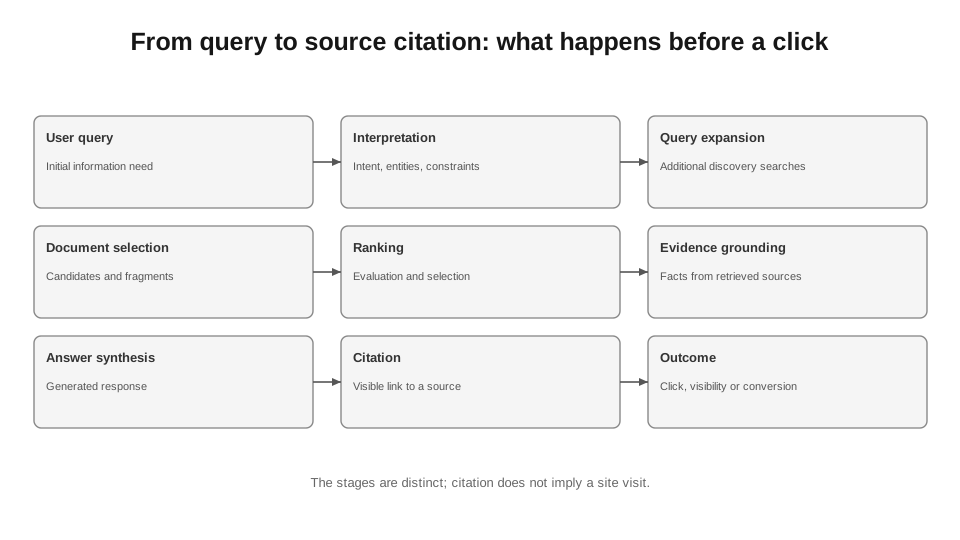
Author's diagram. The mechanics are summarised based on Google Search Central: https://developers.google.com/search/docs/appearance/ai-features
| Surface | What the user sees | What matters for SEO |
|---|---|---|
| Classic organic results | A list of ranked URLs and other SERP elements | Ranking, snippet eligibility, CTR, intent alignment |
| AI Overviews | A generated answer and source links alongside classic results | Retrieval, grounding, citation eligibility, organic visibility |
| AI Mode | A generative answer as the primary interface, with follow-up queries | Query fan-out, retrieval coverage, source pages |
| Bing/Copilot | Generative answers with source links | Citation, source URLs, source-finding queries, citation trends |
| ChatGPT Search | An answer with web sources and citations; the system may run several search queries | Crawler access, eligibility for use as a source, website visits, citation presence |
MY WORKING MODEL
Ranking != retrieval != citation != mention. A page can rank well and not be cited. It may be retrieved but not included in the final answer. It may be cited without ranking in the top 3 organic results. A brand may be mentioned as an entity without a direct URL. If analytics reduces all of this to average position, it loses sight of part of the system.
1.2. Data: AI answers really do change the economics of the click
It is important here not to fall into either of two extremes. The first: “AI has taken all SEO traffic.” That is not true. The second: “nothing has changed because users still click.” That, too, is poorly supported by the data. As of 2026, there are at least two independent datasets pointing in the same direction: when an AI answer satisfies an information need directly in the search results, the rate of click-throughs to external sites falls.
DATA: AHREFS, 300,000 KEYWORDS
An updated Ahrefs study dated February 4, 2026 compared 150,000 keywords with an AI Overview and 150,000 informational keywords without an AI Overview. For the first organic position, the actual CTR in the AI Overview group in December 2025 was around 1.57%. The counterfactual estimate, calculated using the change in CTR in the informational control group, was around 3.73%. The difference: approximately -58%. This is a correlational study, not a randomised experiment, so the correct wording is: the presence of an AI Overview correlated with an approximately 58% lower CTR for the first position.[3]
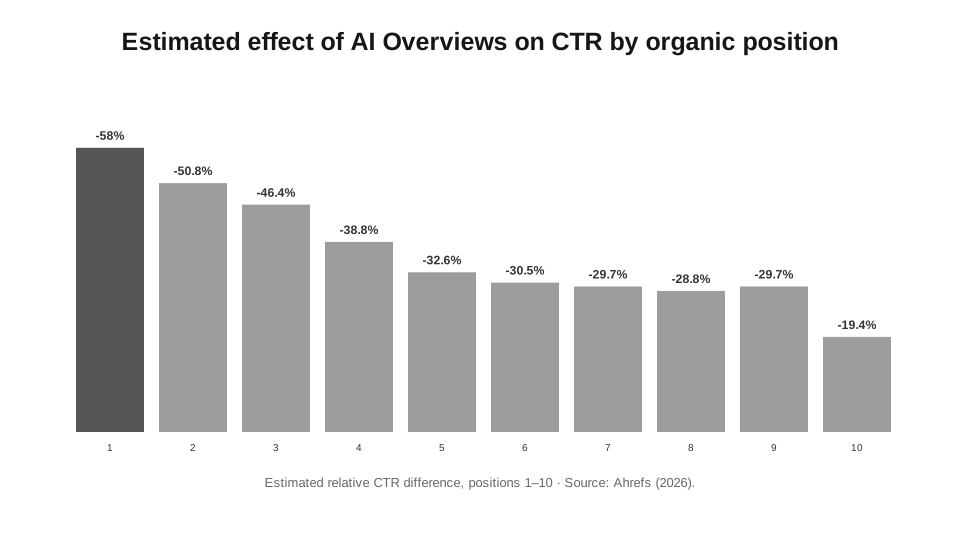
Data: Ahrefs, 300,000 keywords, February 4, 2026. https://ahrefs.com/blog/ai-overviews-reduce-clicks-update/ This is a model-based estimate derived from observations, not a randomised causal experiment.
| Organic Position | Estimated impact of AI Overview on CTR |
|---|---|
| 1 | -58.0% |
| 2 | -50.8% |
| 3 | -46.4% |
| 4 | -38.8% |
| 5 | -32.6% |
| 6 | -30.5% |
| 7 | -29.7% |
| 8 | -28.8% |
| 9 | -29.7% |
| 10 | -19.4% |
The -58% figure itself is striking, but its value for a Senior SEO is not as a number to put into a presentation. The methodology matters more. Ahrefs did not simply compare the current CTR of queries with and without an AI Overview. The researchers used a baseline from before the widespread rollout of AI Overview and a control group of informational queries to estimate what the CTR of queries with an AI Overview might have been without that factor. This still does not eliminate confounding variables: query composition, SERP composition, changes in user behaviour, differences between devices, seasonality and other search result features. But this methodology is stronger than simply stating that “queries with an AI Overview have a lower CTR.”
DATA: PEW RESEARCH CENTER, 68,879 GOOGLE SEARCH SESSIONS
Pew analysed behavioural data from 900 adults in the US for March 2025: 68,879 unique Google search sessions, of which 12,593 contained an AI answer. On pages with an AI answer, users clicked through to a traditional search result in 8% of sessions; without an AI answer, in 15%. Links within the AI answer were clicked in approximately 1% of sessions. Users ended their search session after a SERP with an AI answer in 26% of cases, versus 16% without one.[4]
This is a different type of study. Pew did not attempt to estimate the CTR of a specific position. The researchers examined real users’ behaviour after a Google results page. The direction was the same: when an AI answer appears in the results, the share of sessions without a click-through to an external site increases.
Another useful detail from Pew: in their sample, an AI answer appeared in approximately 18% of all Google search sessions. The likelihood depended heavily on the form of the query: only 8% of one- or two-word queries had an AI answer, whereas among queries with 10 or more words, the share was 53%. For queries beginning with question words such as “who”, “what”, “when” and “why”, the share reached 60%.[4]
The practical takeaway matters more than the market-wide average share of AI Overviews. If a site relies on short navigational or transactional queries, the market average says almost nothing about the risk to that particular site. If a site depends on long informational queries, content that solves specific problems or pages that answer questions, AI answers may appear much more frequently. AI Overview risk therefore needs to be calculated using your own query set, rather than applying an average percentage from a study to the entire site.
1.3. Position without CTR is now an even more dangerous metric
In traditional reporting, it was often enough to observe: position is stable, impressions are growing, clicks are falling. Then came assumptions about the title, snippet, seasonality or weaker demand. In 2026, changes to the search results format itself need to be added to that list.
The scenario “impressions are growing, clicks are falling, average position is stable” can no longer be analysed without segmentation by search results type. If a page appears more often in a generative format, it may gain visibility that does not convert into a conventional click in the same way as a classic organic link. At the same time, not every drop in CTR can automatically be attributed to AI: CTR depends on the share of branded and non-branded queries, device, country, query length, SERP composition, position distribution and changes in demand itself.
ANALYTICAL RULE
Do not explain a drop in clicks by pointing to AI until you have broken down the data at least by country, device, branded and non-branded queries, query type, page type, position range, appearance in generative formats and time period. The phrase “AI took the clicks” without this breakdown is just as weak an analysis as “a Google update took the traffic.”
1.4. What Google officially confirms about AI search
In 2026, Google described the mechanics clearly enough to cut through some of the market noise around “GEO hacks”. Google’s generative search features rely on its core ranking and quality evaluation systems. To obtain up-to-date information, they use RAG: they find relevant pages in the index and use them as the factual basis for an answer. The system can also fan out the original query into several parallel subqueries.[2]
For a page to appear as a source link in AI Overviews or AI Mode, it must be indexed and eligible to appear in regular Google results with a snippet. Google explicitly states that there are no separate technical requirements solely for AI features.[1] This is critical: if a URL cannot make it through the basic search pipeline, adding “AI optimisation” on top does not solve the problem.
MYTH / DATA / CONCLUSION
MYTH: Google AI search requires llms.txt, special Markdown, “AI schema” or mandatory chunking of pages into small fragments. DATA: Google’s current documentation explicitly states that Google Search does not use llms.txt as a special signal; does not require content to be split into small chunks; and does not require separate schema.org markup for generative search. CONCLUSION: these things may be useful to other systems or internal processes, but there is no basis for selling them as a Google requirement for ranking in AI search.[2]
There is an important nuance here. “No special markup for AI” does not mean that structured data is unnecessary. Google specifically clarifies that it remains useful for regular search features and rich results. It simply should not be sold as a magic GEO factor. The same applies to headings, tables and FAQs: they can improve readability, information structure and extraction, but there is no official requirement to split a page into special chunks “for LLMs”.
1.5. The biggest change for content: generic information is losing value
AI has changed not only the SERP but also the economics of content. If an answer consists of publicly available facts that dozens of pages recount in the same way, it becomes increasingly easy for a search engine to generate it without requiring a click through to yet another similar page. In its AI search documentation, Google emphasises unique information, expert input, first-hand experience and material that does more than simply retell what is already online.[2]
For an SEO team, this translates into operational terms very simply. “Another article on the same topic” is no longer a sufficient unit of content production. A page must have at least one information asset of its own: data, a real-world test, a tool, a dataset, a pricing snapshot, a comparison methodology, screenshots, first-hand observations, a calculator, API data, regional specifics or some other practical value absent from interchangeable competitors.
This is not a romantic demand to “write better”. It is an economic requirement to create information that a generative system cannot cheaply synthesise from a dozen interchangeable documents. If your text can be reconstructed from the top-10 competitors with almost nothing lost, it offers little information gain.
1.6. Measurement in 2026: what can already be observed directly
As recently as 2025, one of the main problems with AI search was that SEO professionals could see the end result but had almost no data on where and how a site appeared in generative answers. In 2026, the situation improved.
GOOGLE SEARCH CONSOLE
On June 3, 2026, Google announced separate Search Console reports for generative AI features. By August 31, 2026, they had been rolled out globally. In a dedicated report, Google shows generative impressions, pages, countries, devices and dates, with hourly, daily, weekly and monthly granularity. The announcement itself does not list clicks as a separate metric in this report.[5]
Google is finally providing its own data on generative visibility, but this is not yet the full funnel. We can see which URLs received impressions in generative features, where and when. But the standard report does not fully answer the question: which specific citation produced which click and which conversion? That requires combining several data sources.
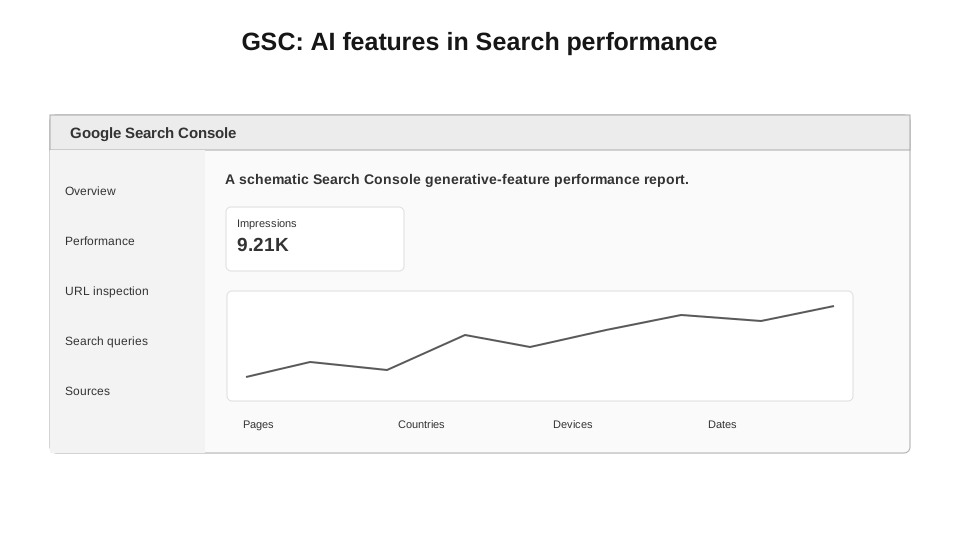
Schematic reproduction of Google’s official screenshot, with no added metrics. Original: https://developers.google.com/search/blog/2026/06/gen-ai-performance-reports
BING WEBMASTER TOOLS
Since February 10, 2026, Bing Webmaster Tools has offered AI Performance in public preview. The dashboard shows total citations, the average number of cited pages, URL-level citation activity, visibility trends and the queries AI used to find content that was subsequently cited. Bing specifically cautions that these queries are shown as a sample, not a complete log.[6]
Bing provides an even deeper level of diagnostics. If a URL is frequently cited but the range of queries used to find it is narrow, the page may have strong visibility in only one topical cluster. If most citations go to a few URLs, those pages can be compared with others to check for differences in topic coverage, entity clarity, fact density, freshness, link equity and query relevance. But even here, the number of citations cannot be called an “AI ranking”. Bing explicitly explains that citation activity does not equate to a page’s placement, authority or role in a particular answer.[6]
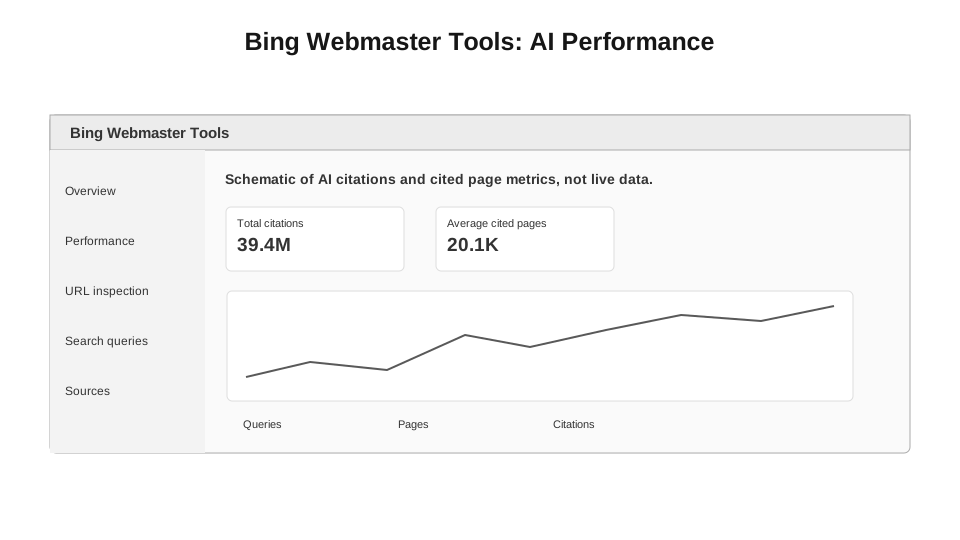
Schematic reproduction of Microsoft Bing’s official screenshot. Original: https://blogs.bing.com/webmaster/February-2026/Introducing-AI-Performance-in-Bing-Webmaster-Tools-Public-Preview
1.7. A practical measurement model for an SEO team
I would not build a separate “GEO dashboard” disconnected from SEO analytics. It is more useful to break visibility down into four layers and identify exactly where value is being lost.
| Layer | Key question | Data |
|---|---|---|
| Indexability | Can the system use the URL at all? | Indexing status, canonical version, robots, snippet eligibility, crawling and rendering |
| Inclusion in retrieval | Does the page make it into the candidate document set? | Grounding queries, topical coverage, relevance to the topic and entities, page citation patterns |
| Visibility | Does the user see the page or source? | Organic impressions, generative impressions, citations, source URLs, brand mentions |
| Business outcome | Does this visibility create value for the business? | Clicks, sessions, assisted conversions, leads, revenue, referrals from AI and other sources |
You can then calculate your own derived metrics. These are not Google metrics and should not be presented as industry standards. They are practical analytical ratios that let you compare your own data across periods.
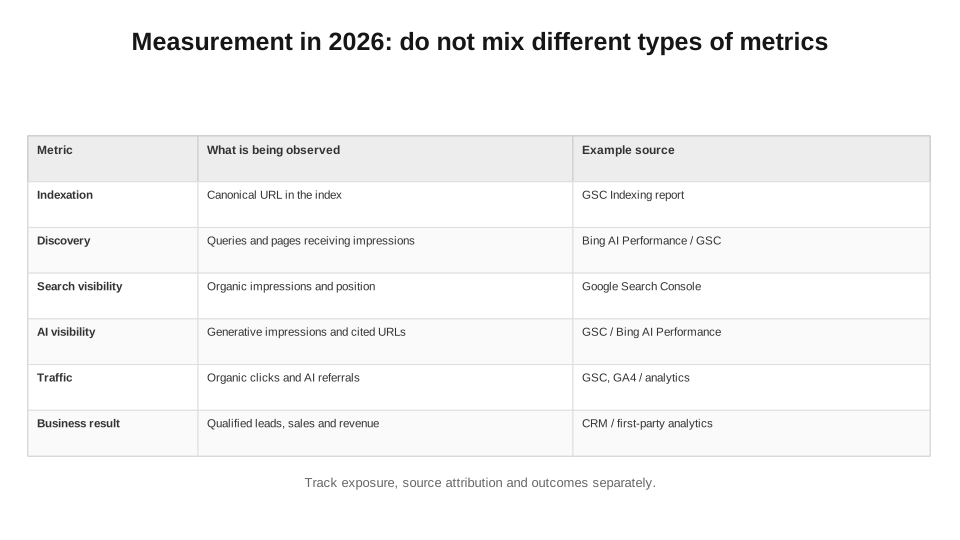
Author’s diagram. The metrics and data sources correspond to the measurement model in this chapter.
ALGORITHM: 4 DERIVED METRICS
1) Generative impression share = generative impressions / all search impressions. Use this as an indicator of trends, not as a “share of all queries”: aggregated impressions across different formats do not necessarily equal the number of unique searches. 2) Citation concentration = citations of the top-N URLs / all site citations in Bing. Shows how heavily AI visibility depends on a handful of pages. 3) Grounding query coverage = number of relevant topic clusters in which the site is cited / number of target clusters in your model. This is an internal metric, and its denominator is defined by your own classification of keywords and entities. 4) AI-assisted conversion rate = conversions in which a measurable AI referral was the primary or assisting channel / sessions from those referrals. For ChatGPT and other sources, check attribution accuracy separately.
Most importantly: do not mix different denominators. Generative impressions in Google, citations in Bing and referrals from ChatGPT describe different events. You cannot simply add them together into a single “AI visibility metric” without normalisation and a clear definition of what it means. Otherwise, the dashboard looks attractive but ceases to be a diagnostic tool.
1.8. How to investigate a drop in organic clicks: Senior SEO-level diagnostics
If organic clicks have fallen by 20%, I do not start with the hypothesis “it is AI”. I start by breaking the problem down. First, I check demand: impressions, Google Trends, year-on-year trends and seasonality. Then I look at the ranking distribution: have rankings really held steady within important groups of pages and queries? Next, I check the composition of the SERP: AI Overviews, local and product features, video, news and other elements. Only then do I assess whether the decline in click yield coincides with an increase in generative impressions.
A simple formula is enough for this: click yield = clicks / impressions for a specific segment. Not for the entire site at once, but for the same set of queries, pages, countries and devices. If click yield falls while rankings remain stable or improve, and generative impressions rise at the same time, the hypothesis that the new results format is having an impact becomes stronger. If the query mix or ranking distribution has also changed, causality is not proven.
CAUTION
Do not compare “CTR before AI” and “CTR after AI” across different query mixes. If, in 2025, the site ranked mainly for short commercial queries, while in 2026 the share of long informational queries increased, overall CTR is almost guaranteed to change even without AI. Compare identical cohorts first, and only then draw a conclusion.
1.8.1. How to read patterns in data without guesswork
A single signal almost never provides a ready-made diagnosis. You need a combination of signals. What follows is not “Google’s algorithm” but a diagnostic matrix: it shows which hypothesis to test first, rather than declaring a cause without testing.
| What we see | First hypothesis | What to check next |
|---|---|---|
| Rankings down + clicks down + generative impressions unchanged | Loss of rankings or relevance | URL and query cohorts, competitors, Google update dates, shifts in intent, technical changes |
| Rankings stable + impressions stable + click yield down + generative impressions up | Click cannibalisation by new SERP features | Presence of an AI Overview across the selected query set, breakdown by device and country, SERP composition, comparison of periods before and after the change |
| Generative impressions up + organic clicks flat or down | Visibility without equivalent value in clicks | Which pages receive impressions, whether commercial page visibility is growing, assisted conversions |
| Bing citations up + source-retrieval queries concentrated on one topic | Narrow topical coverage during retrieval | Expand the factual content of adjacent target clusters; compare cited and uncited pages |
| Brand mentions and citations up + visits up + conversions weak | Post-click mismatch | Landing page intent, CTA, offer, speed, tracking and path to conversion |
1.9. What this changes in SEO strategy right now
First change: an SEO plan can no longer be built solely around the task of “improving rankings”. For some informational clusters, rankings may improve with almost no additional traffic. Prioritisation must account for click potential in the specific SERP format, not just query search volume and current ranking.
Second change: keyword research needs to move from a list of phrases to a model of the query space. I still use keywords, search volume, SERPs and clustering, but my final planning unit is not an individual keyword; it is an intent, entity or problem cluster. This better reflects query fan-out and the actual structure of modern search.
Third change: the content plan must distinguish interchangeable material from content that is difficult to copy. If a page exists only because “a competitor has an article like this”, its strategic value is low. If a page contains proprietary data, a tool, a comparison methodology, a workflow or information unavailable in other sources, it has a better chance of remaining useful to both users and retrieval systems.
Fourth change: visibility reporting needs to be separated out. An organic ranking, an organic click, a generative impression, a citation, a source URL, a query used to find a page for AI, a visit from AI and a conversion are different events. When they are mixed into a single metric, the team loses sight of exactly where the problem arose.
Fifth change: technical SEO becomes more important, not less. For source links in AI, Google uses the same basic search eligibility requirements: a page must be indexed and eligible to appear with a snippet. If a site has chaotic canonical versions, rendering problems, noindex, soft 404s, broken internal linking or pages that simply never make it into the index, “GEO optimisation” has nothing to build on.[1]
1.10. A 60-minute check: is AI already changing your organic performance?
This is not a full audit. It is a quick diagnostic check that tells you whether the problem warrants deeper investigation at all.
| Time | What to do |
|---|---|
| 00-10 min | Select 20-50 landing pages with the largest absolute loss of clicks year over year or period over period. Look at actual clicks lost, not the percentage decline. |
| 10-20 min | For each page, break down queries by branded/non-branded, intent and length. Check ranking ranges, countries and devices. |
| 20-30 min | Look at the Search Console report on generative AI features: whether these URLs are among the pages with generative impressions, how their visibility has changed over time, and in which countries and on which devices. |
| 30-40 min | In Bing Webmaster Tools, check cited URLs and the queries AI used to find sources. Look not just at citation counts, but at the topics that lead to them. |
| 40-50 min | Check the SERPs for a representative query set using a rank tracker or SERP API: the presence of an AI Overview, other SERP features and changes in SERP composition. Keep the country and device consistent. |
| 50-60 min | Form three separate hypotheses: declining demand, lost rankings, and lost clicks due to a change in SERP format. Do not combine them into a single cause. For each, identify data that could disprove it. |
1.11. Where facts end and hypotheses begin
We know for certain that Google uses its search index, ranking and quality assessment systems, RAG and query fan-out in generative search features.[1][2] We know for certain that Google does not require llms.txt, special AI markup or separate schema.org markup to appear in these features.[2] We have strong external data showing that AI answers correlate with lower click rates in informational search results.[3][4] We also have first-party reports from Google and Bing that already let us see generative impressions, citations, cited pages and the queries the system used to find sources.[5][6]
What we do not know from public sources: the exact signal weights for inclusion in an AI answer; a universal formula for citation probability; the full relationship between organic position and citation; the complete set of internal retrieval signals; or a stable “GEO ranking factor” that can be optimised with a single technical trick. If someone sells this as established fact, demand evidence, methodology and sample size.
CHAPTER CONCLUSION
SEO in 2026 has not become a different profession. It has become a more layered measurement system. The basic search pipeline remains, but a generative layer has emerged after retrieval that can capture some of the value of a click and create a new type of visibility. A strong SEO professional therefore no longer asks only “where do we rank?” They ask: is the URL accessible, is it retrieved, is it used as a source, does the user see it, do we get a click, and does that visibility translate into a business outcome?
Chapter sources
Verified as of September 12, 2026. Dynamic products and interfaces require another fact-check before final printing.
1. Google Search Central. AI features and your website.. https://developers.google.com/search/docs/appearance/ai-features Official documentation: requirements for appearing in AI Overviews and AI Mode, retrieval and query fan-out.
2. Google Search Central. Optimising your website for generative AI features on Google Search.. https://developers.google.com/search/docs/fundamentals/ai-optimization-guide Official documentation from 2026: RAG, working with sources, technical requirements and debunking common myths about AI optimisation.
3. Ahrefs. Update: AI Overviews Reduce Clicks by 58%.. https://ahrefs.com/blog/ai-overviews-reduce-clicks-update/ February 4, 2026. An observational study of 300,000 keywords with a model-based estimate of the impact of AI Overview on CTR.
4. Pew Research Center. Google users are less likely to click on links when an AI summary appears in the results.. https://www.pewresearch.org/short-reads/2025/07/22/google-users-are-less-likely-to-click-on-links-when-an-ai-summary-appears-in-the-results/ A study of the behaviour of 900 adults in the US: 68,879 unique Google search sessions.
5. Google Search Central Blog. Introducing Search Generative AI performance reports in Search Console.. https://developers.google.com/search/blog/2026/06/gen-ai-performance-reports June 3, 2026; note updated after the report’s global rollout on August 31, 2026.
6. Bing Webmaster Blog. Introducing AI Performance in Bing Webmaster Tools Public Preview.. https://blogs.bing.com/webmaster/February-2026/Introducing-AI-Performance-in-Bing-Webmaster-Tools-Public-Preview February 10, 2026. Citations, cited pages, queries used to find sources and URL-level activity.
7. OpenAI Help Center. Searching the web with ChatGPT.. https://help.openai.com/en/articles/9237897 Current product documentation: web search, citations and sources.
8. OpenAI Help Center. Publishers and Developers - FAQ.. https://help.openai.com/en/articles/12627856-publishers-and-developers-faq Current guidance for publishers and crawlers, including OAI-SearchBot and referral tracking.