How to read canonical not as a tag, but as a system for aligning signals: why duplicates are normal, when Google ignores your hint, how to diagnose conflicts and how to avoid losing data across URL variants.
Data and sources as of: September 14, 2026
Canonical is often checked as a Boolean field: tag present - good, tag absent - bad. This is a weak model. Canonicalisation happens not in an HTML tag, but in a system that groups identical or very similar documents and selects a representative for the cluster. rel="canonical" is just one of the signals. Google explicitly describes the canonical as the representative URL the system selects from among duplicates; redirects and rel="canonical" are strong signals, a sitemap is a weaker one, and the final choice remains with Google.[1][2]
In practice, this means that a canonical issue is rarely resolved by adding another tag. If internal links point to one version, the sitemap contains a second, a redirect leads to a third, hreflang specifies a fourth, and canonical a fifth, you have created a voting system with no majority. A technical audit must check signal alignment at the URL cluster level, not at the individual document level.
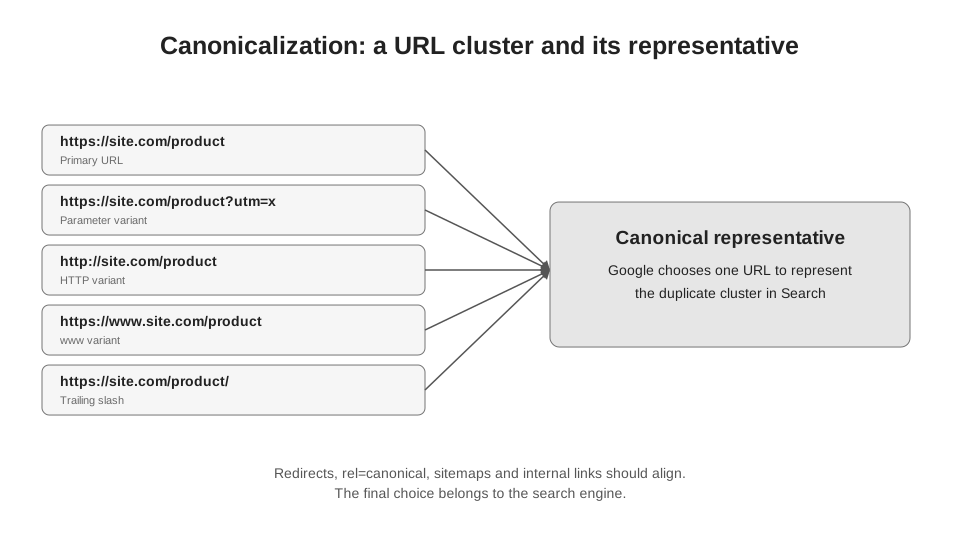
Author’s diagram based on Google Search Central documentation on canonicalisation and consolidating duplicate URLs.
8.1. A duplicate does not mean a violation
Duplication within a site is not in itself spam. Sorting parameters, UTM parameters, HTTP/HTTPS, www/non-www, alternative regional URLs, printer-friendly pages or CMS variants can produce identical main content. The system’s task is not to “penalise the duplicate”, but to avoid storing and serving a dozen equivalent representatives unnecessarily.[1]
For SEO, the consequence is different: if many URLs represent the same document, signals and reporting can become fragmented. Search Console reports a substantial share of its data against the canonical URL, so an analyst looking only at raw URLs from GA4 or a crawl may see a different picture from Google. This is precisely why a canonical cluster should be treated as a separate unit of data.
8.2. Signal strength: redirects, canonical, sitemaps and internal links
| Signal | What it tells the system | Common mistake |
|---|---|---|
| 301/308 redirect | The old URL has permanently moved to a new one. Google calls redirects a strong canonical signal. | The redirect leads to A, while the new page’s canonical points back to B. |
| rel="canonical" | Which URL is the preferred representative of a duplicate. A strong signal, but not a directive. | A canonical pointing to a non-equivalent page or a canonical chain. |
| Sitemap | Which URLs the site owner considers primary. A weaker signal. | The sitemap systematically contains parameterised URLs or redirecting URLs. |
| Internal links | Which version the site actually uses in its graph. | Menus, breadcrumbs and content link to non-canonical variants. |
| hreflang | The relationship between localised variants. Must align with canonical. | hreflang specifies a URL that canonicalises into another cluster. |
Google specifically recommends linking internally to canonical URLs. This does not mean that one stray internal link will “override” the canonical; it means that the site graph should be consistent. If a CMS has been generating parameterised URLs for decades, canonical does not make that architecture clean - it merely helps the system understand your intent.
8.3. A self-canonical is useful as a declaration, but not as magical protection
I add a self-referencing canonical to primary HTML pages by default, unless there is a specific reason to do otherwise. This makes the intent explicit and reduces dependence on how the CMS generates parameters or alternative URLs. But a self-canonical does not “lock in” a page forever. If the system sees a stronger set of conflicting signals or considers another URL a better representative of the duplicate, it may choose a different canonical.[1][3]
8.4. Canonical must point to an equivalent document
The worst habit is using canonical as a rubbish chute. For example, canonicalising all filtered categories to the base category, even when the filter produces a different set of products and has independent search demand; or canonicalising all product variants to a single SKU, even though the content and offering differ substantially. If the pages are not duplicates or very close variants, canonical is no substitute for a proper decision about indexing, architecture or redirects.
Cross-domain canonicals are particularly dangerous. They are technically supported, but they make a strong statement: “the primary version of this material is on another domain”. For syndication, this may be appropriate; for an accidentally copied template, it is a disaster. I always include external canonicals in a separate report.
8.5. Canonical and hreflang: first the cluster, then the locale
For regional pages in the same language, Google recommends combining canonical and hreflang. The practical model: each localised URL should remain canonical within its own logical cluster, while hreflang links the alternatives. If es-ES is canonicalised to a global English URL while hreflang simultaneously declares es-ES as a separate variant, the system receives conflicting signals of intent.[4][5]
8.6. How to interpret “Google-selected canonical”
When URL Inspection shows that the user-declared canonical and Google-selected canonical do not match, this is not a diagnosis. It is a symptom. The next step is to compare content, status codes, redirects, internal links, the sitemap, hreflang, mobile/desktop variants and URL history. I look not for “why Google ignores the tag”, but for “which other set of signals looks more consistent to the system”.
| Symptom | What to check first | Typical solution |
|---|---|---|
| Google selects a parameterised URL | Internal inlinks, sitemap, backlinks, response chain | Align all internal signals with the clean URL. |
| Google selects another domain/host | Redirects, cross-domain canonical, duplicates, migration history | Remove unintended external signals and check 301 redirects. |
| Google selects a URL in another language | hreflang, main content language, canonical cluster | Separate the locales and implement reciprocal hreflang annotations. |
| Google does not accept the canonical pointing to the base category | Content similarity between the filtered page and the base page | Determine whether the filtered page is actually a duplicate; do not use canonical as noindex. |
8.7. Canonicalisation metrics for a large site
On a large site, I reduce a canonical audit to a matrix: “URL → final status → declared canonical → canonical final status → indexability → inlinks → sitemap → selected canonical”. Issues are then grouped by template. If 80 thousand URLs using one facet template are canonicalised through a redirect, that is one systemic error, not 80 thousand tasks.
A useful indicator is the Canonical Agreement Rate: the proportion of indexable URLs whose declared canonical matches the expected primary URL under business rules. This is an internal metric, not a Google metric. Its value lies in regression monitoring: after a release, you can see that the proportion of aligned URLs has fallen from 99.4% to 92.1%, even before the change becomes apparent in visibility.
8.8. What we know for certain
Google groups duplicates and selects a representative; redirects and rel="canonical" are strong signals, while a sitemap is a weaker one; signals can be combined; canonical is a hint, not a directive; duplicates are not inherently spam; regional variants in the same language require canonical and hreflang to be aligned.[1][2][4]
What is not publicly known: the exact weight of each canonical signal in a given cluster and the formula Google uses to resolve a conflict. So “reinforce the canonical with three more signals” is a practical engineering strategy, not a reconstruction of a proprietary algorithm.
Sources for Chapter 8
1. Google Search Central. What is canonicalisation. https://developers.google.com/search/docs/crawling-indexing/canonicalization
2. Google Search Central. How to specify a canonical URL with rel="canonical" and other methods. https://developers.google.com/search/docs/crawling-indexing/consolidate-duplicate-urls
3. Google Search Central. Fix canonicalisation issues. https://developers.google.com/search/docs/crawling-indexing/canonicalization-troubleshooting
4. Google Search Central. Managing multi-regional and multilingual sites. https://developers.google.com/search/docs/specialty/international/managing-multi-regional-sites
5. Google Search Central. Localised versions. https://developers.google.com/search/docs/specialty/international/localized-versions